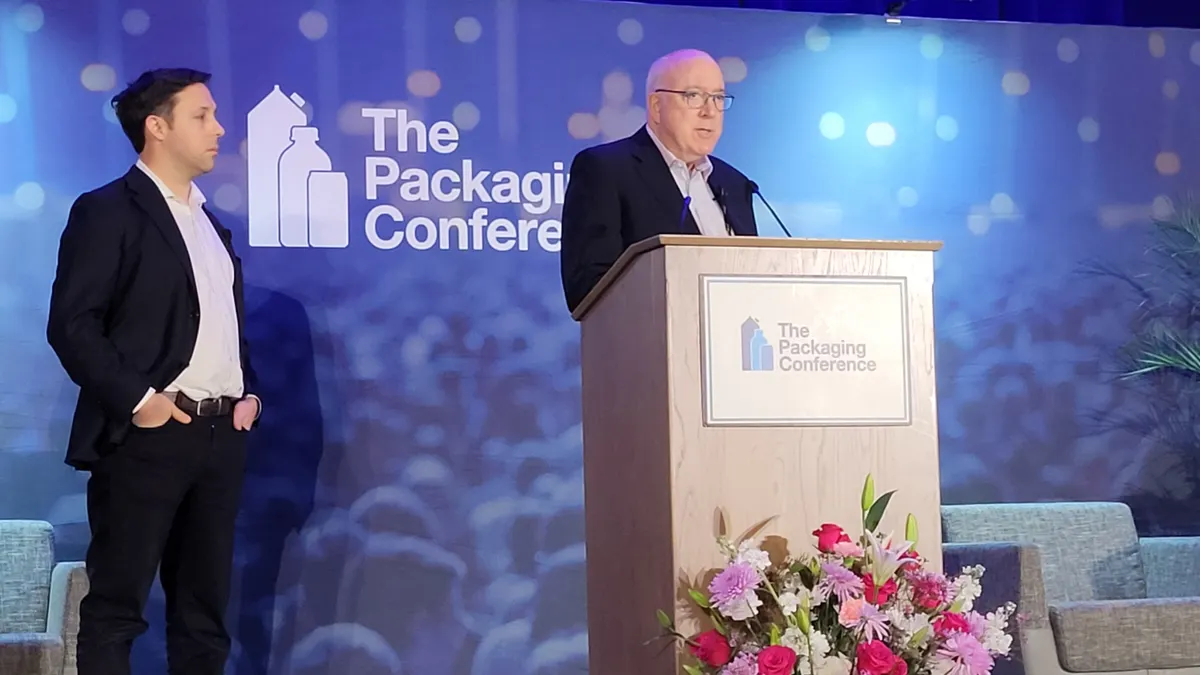
AUSTIN, TEXAS — Bigger is better, at least when considering how a packaging company’s size and growth affect its valuation, said speakers from Perella Weinberg Partners during a session at The Packaging Conference on Monday. Valuations are affecting the industry’s M&A activity, with both being lower than usual the last couple years — but upward potential is emerging in 2026.
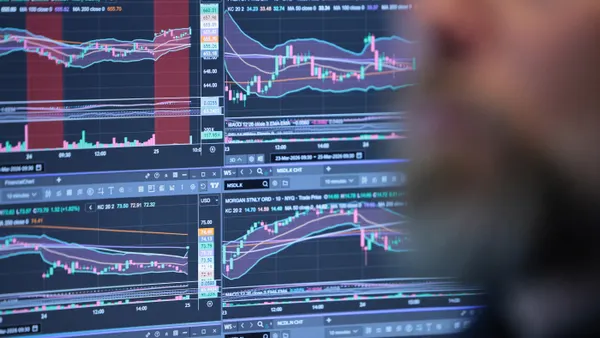
When looking at the stock price performance of two dozen of the top packaging companies, about two-thirds experienced a decrease in the last year, with the median being a 6.5% decrease, said David Ambrose, managing director at Perella Weinberg Partners.
Growth expectations positively affect valuations. And with earnings performance down across most of the industry, companies are looking for other growth opportunities to appeal to investors. That’s where M&A comes in.
“There are certainly opportunities to continue becoming more efficient and taking costs out. But if you want to change the valuation of the business, growth is really the primary target,” Ambrose said. “It's interesting to note that the top four [companies] in performance are all involved in some sort of acquisition or divestiture or major event, so that wasn't core growth.”
Part of the reason packaging company valuations have lagged is that macroeconomic conditions have tamped down growth prospects for the past couple years. That, in turn, negatively affects M&A. Over the last year or two, “we've seen a downtick in just overall packaging M&A activity, because there is still a lot of uncertainty out there in the marketplace,” Ambrose said.
During the past decade, the number of packaging transactions peaked at 352 in 2021, according to the firm’s data. The firm tracked 154 transactions in 2025. 2024 was the highest year in terms of overall valuation, at $54 billion, due to multiple megamergers.
Further underscoring the concept that investors are rewarding company size and scale, the handful of companies that underwent megamergers during the last 18 to 24 months is seeing a valuation uptick, he said. Perella Weinberg expects several more megamergers to occur in the coming years, and that “will ultimately continue to fundamentally alter the landscape of the packaging universe.”
Glimmers of hope are emerging, which should drive up valuations. Lower interest rates are one factor that could drive growth in 2026 and beyond.
“And the good news is private equity is starting to dust off its files in packaging companies, largely because of the valuation,” said Tim Burns, senior advisor at Perella Weinberg. “Strategics will likely follow, but the PE guys get in there early.”
Another trend expected to accelerate this year is PE acquiring publicly traded companies and taking them private. Recent examples include BWGI acquiring Verallia in July 2025, and Sealed Air’s pending acquisition by CD&R that is slated to close this year. The idea is attractive because patient capital and a lack of quarterly scrutiny can enable portfolio transformation.
“Take-private is a nice strategy for these guys. And as I said before, the PE investors that we know are really engaging and looking for the next opportunity,” Burns said.
No major shifts are projected through 2031 regarding market share for each packaging material; paperboard will still lead, followed by flexibles, and collectively those two materials will still constitute nearly half of the packaging market.
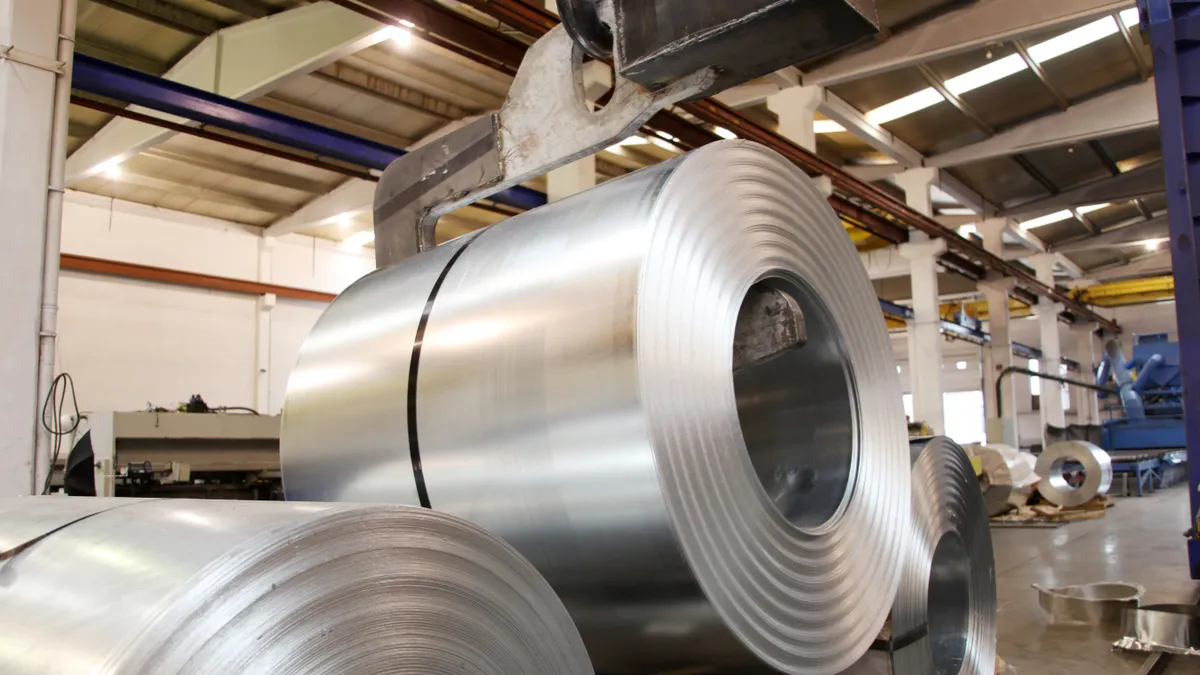
While “growth is challenged” overall, Burns said, some small differences should creep in regarding which materials see growth. Rigid metals are eyed as having the highest compound annual growth rate through 2031, at 3.1%, followed by closures and dispensers at 2.8%. “When rigid metals are leading the pack, you know things have changed,” he said.
That’s partially due to sustainability trends driving companies away from plastics and toward metals or fiber, speakers said. “[Beverage] cans have done a wonderful job of capturing all kinds of new products,” including for sustainability reasons, Burns said, citing that almost 80% of new products on the beverage side are in cans.
Overall, speakers said the packaging industry is undergoing an evolution due to M&A and other factors, with more change expected. “It’s a very critical time,” Burns said.