
North America led the global spices and seasonings market with a 40.47% share in 2023, driven by demand for convenience foods, the popularity of ethnic cuisines, and expanded non-traditional applications in the U.S. and Canada. With the global market projected to reach USD 29.57 billion by 2032 at a 4.89% CAGR, packaging strategy—especially closure selection—has become a key competitive lever.
As product portfolios shift to trending flavors like gochujang, Aleppo pepper, Peruvian aji amarillo and floral-savory blends with saffron and lavender, packaging must protect flavor, support high-speed operations, and deliver a strong consumer experience. The cap you choose can determine your throughput on the line and your performance on the shelf.
Spice Bottle Closures Engineered for High-Speed Operations
Modern spice filling lines typically run 150–450 bottles per minute. At these speeds, closures must withstand dumping into hoppers, transfers, orientation, and final high-speed capping without deformation, breakage, or pop-opens. This is not just a material decision—it’s an engineering decision.
For example, the move from inside hook to outside hook flap-lid designs has significantly reduced cap pop-open issues on products like black pepper, where essential oils can interact with polypropylene. Robust hinges, reliable snaps, and properly engineered threads are all critical.
Jack H. Hotz, Senior Director of Sales at MRP Solutions, summarizes the challenge, “The closure has to survive the entire journey through the hopper, rectifier, and capper while maintaining performance at line speed. To ensure this, quality manufacturers perform rigorous testing.” At MRP Solutions, closures undergo at least 1,000 open-and-close cycles to validate hinge integrity across the product’s life.
Thread Tolerances and Their Impact on Performance
Thread profile tolerances are a key factor in plastic cap performance. In the ISO metric system, pitch diameter tolerances such as 6h, 6H, and 6e define how cap and bottle threads fit together. Maintaining these tolerances within tight limits ensures consistent engagement, proper torque, and seal integrity. When thread specifications drift out of range, lines can jam, caps can misapply, and operations can grind to a halt. The “simple” flip-top closure reflects decades of refinement to avoid these issues at production scale.
Post-Consumer Recycled Resin and Sustainability
Spice brands are under pressure to improve sustainability, and caps are an important part of that strategy. Post-consumer recycled (PCR) polypropylene is now available in 25%–100% content, with validated color-matching to keep brands on-spec while reducing virgin resin use.
Working with PCR introduces some aesthetic tradeoffs. PCR polypropylene typically starts as a light gunmetal gray, influencing final color; yellows in particular can be more difficult to match. Many brands, however, use these subtle variations to underscore their environmental story and signal responsible sourcing.
Polypropylene closures are fully recyclable and fit well into circular packaging goals. Many forward-thinking manufacturers are already standardizing on 30% PCR content, putting them ahead of tightening regulations and rising consumer expectations.
Consumer Experience as a Differentiator
Even in a highly engineered closure, the end user’s experience is decisive. Today’s consumers expect one-handed operation, whether they are cooking at the stove or grilling. The audible “snap” when closing a spice cap reinforces freshness and gives reassurance that the package is properly sealed.
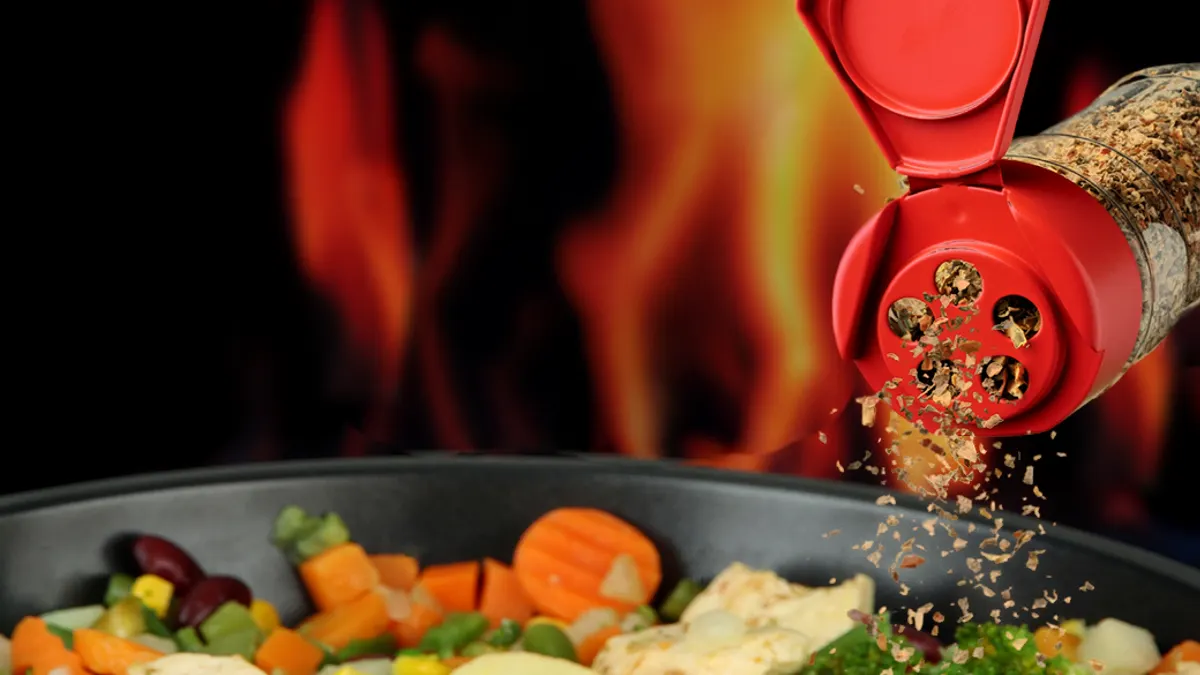
Consumer research continues to influence closure design. MRP Solutions developed the Dual Flapper® cap to address these needs: a robust-hinge dispensing closure with two orifices that opens easily with one hand. One side allows a fine shake; the other supports accurate spoon-measured pouring.
Common spice cap configurations include:
- Single-Flap Lids – One hinged flap that exposes either a pour spout or shaker opening; ideal for simple, everyday use.
- Dual-Flap (Sift-and-Pour) Lids – Two flaps: one with small holes for sprinkling, one with a larger opening for pouring or spooning; suited for a wide range of particle sizes.
- Shaker Lids – Fixed shaker-style tops designed to deliver uniform, controlled dispersion of ground spices and blends.
Service and Support: The Hidden Differentiator
Even the best closure design can fail to deliver value without strong technical support. Successful spice brands treat their closure providers as engineering partners, not just component suppliers.
During format changes or closure conversions, on-site technical assistance can be the difference between a smooth start-up and expensive downtime. Even small differences in closure height or geometry may trigger adjustments to rails, caps sorters, or induction sealers. Experienced support during line trials, qualifications, and troubleshooting protects production schedules and ensures optimal performance.
As Hotz notes, getting the process right is critical. MRP Solutions supports customers with field service professionals who travel to plants for line qualifications and issue resolution, helping to de-risk closure transitions.
Making the Strategic Choice
Selecting a closure supplier is a long-term strategic decision, not a simple price comparison. Total cost of ownership includes:
- Closure reliability and quality consistency
- Fit with your sustainability goals (e.g., PCR content, recyclability)
- Consumer usability and brand perception
- Depth of engineering and technical support
The typical closure selection and qualification cycle runs nine to eleven months, reflecting the testing, validation, and line trial work required in high-speed packing environments. Brands that invest in this process and build strong supplier partnerships report better uptime, fewer supply disruptions, and more resilient packaging programs.
In a growing and rapidly evolving spice market, you need closure partners who combine deep engineering expertise, sustainability innovation, and comprehensive service across all spice cap formats. The right closure choice can create meaningful competitive advantage from your line efficiency to the consumer’s kitchen—supporting brand loyalty, operational excellence, and environmental responsibility.