Dive Brief:
- Artificial intelligence can help advance packaging circularity, especially in the design phase, according to a report from the Consumer Goods Forum’s Plastic Waste Coalition of Action and consulting firm Bain & Co. Advanced sorting and material traceability opportunities also stand out.
- Approximately 3 in 10 businesses are “already using AI to unlock value across the packaging lifecycle, from reducing material use at the design stage to improving sorting quality,” researchers determined through interviews, market analysis and case studies.
- Opportunities to leverage AI span material producers, packaging converters, CPGs, retailers with private labels, and waste management companies. Still, bottlenecks stand in the way of scaling AI for packaging circularity, the report says.
Dive Insight:
As with many industries, AI holds promise to aid applications across the packaging supply chain. But most of those opportunities are yet to be realized.
The Consumer Goods Forum brings together senior leaders from approximately 400 retailers, manufacturers and service providers globally. Many of its members are major packaging purchasers. CGF’s Plastic Waste Coalition of Action focuses on improving packaging design, optimizing extended producer responsibility programs and more.
“AI will not solve packaging circularity on its own, but used in the right way, it can significantly accelerate progress,” said Mario Abreu, chief sustainability officer at confectionery company Ferrero and co-chair of CGF’s Plastic Waste Coalition of Action, in a statement.
CGF and Bain's research identified 15 main use cases for AI to improve packaging circularity. The partners then narrowed down eight high-priority pain points and determined four areas that have already shown tangible results.
Some of the most notable pain points included:
- Overcoming technical limitations on new packaging materials and designs: Innovation can be slow and costly due to limited proven alternatives and high development costs. Where alternatives are available, they’re often more costly or less durable than traditional materials.
- Making the packaging portfolio recyclable, and actually recycled: Much recyclable packaging is not actually collected or recycled. There are also challenges balancing recyclable design with other sides of sustainability such as CO2 emissions and consumer expectations.
- Incorporating and getting access to more recycled content: There are cost, quality, supply, standardization, traceability and food-grade limitations.
- Setting up refillable and reusable packaging systems: This necessitates new infrastructure and tracking. It also requires consumer adoption and education.
- Staying up to date with regulations and getting accurate data and reporting: Variation by jurisdiction only increases reporting demands.
Taking into account the challenges, the top four areas where researchers believe incorporating AI is already feasible and beneficial are:
- Optimizing packaging designs: AI can analyze performance data, SKU requirements and supply chain specs. This can help identify spots to reduce overall material, optimize dimensions for shipping and improve recyclability for regulatory compliance. Examples include Amazon’s “package decision engine,” which in part combines computer vision and machine learning to determine the most efficient packaging format for an item.
- Generating new designs: AI can help develop new packaging formats via deep learning, generative algorithms and simulation models that have the power to consider “thousands of design and material combinations to serve defined high-level goals.” Examples include Nestlé’s use of AI-powered digital twins to virtually test packaging performance.
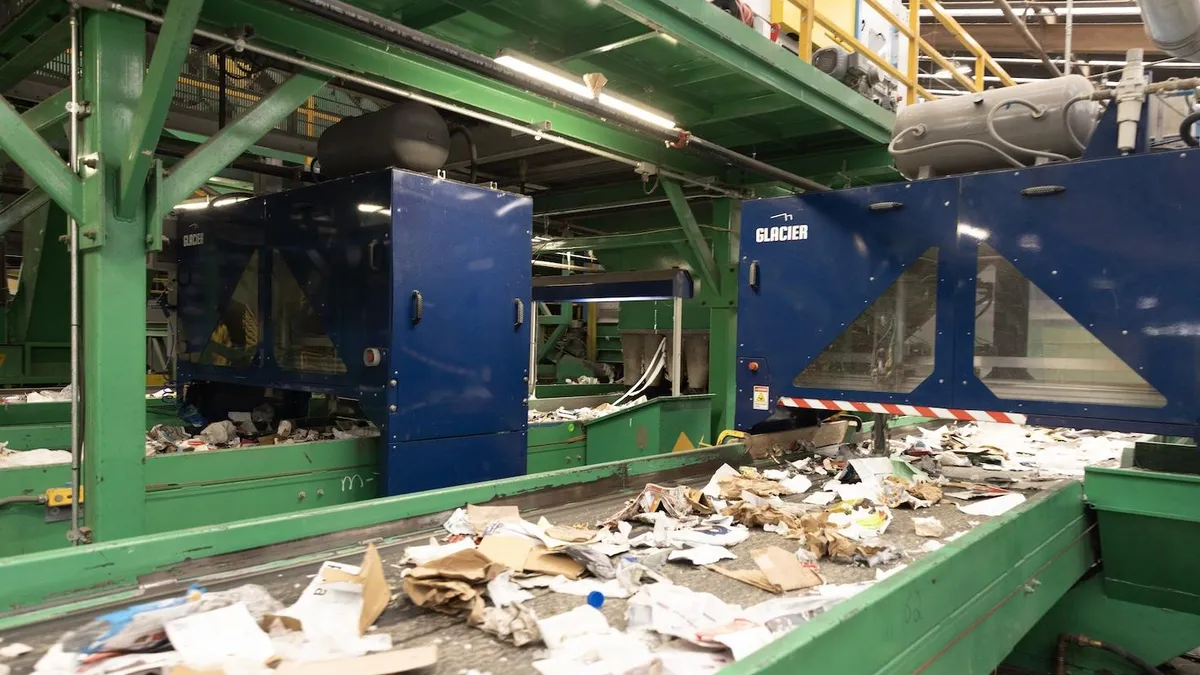
- Advanced sorting: This could include using AI-powered systems featuring computer vision, which enables robotic arms to precisely ID and separate materials, and analytics that use collected data to aid reporting. Examples include Colgate-Palmolive’s partnership with Glacier to understand how its toothpaste tubes, designed for recyclability, are being sorted and recycled at MRFs.
- Material traceability: Machine learning and pattern recognition can help to track packaging by integrating data from sensors, computer vision and production systems related to waste flows, sorting defects and more. Examples include Aldi’s pilot with eco2Veritas to validate outcomes for flexible plastic waste collected in stores.
Bottlenecks to adoption remain. These include inaccessible supplier data, high upfront costs for AI systems, challenges integrating with legacy systems, and confusion on who in the value chain should shoulder these investments, according to the report. On an organizational level, there may be few AI experts dedicated to implementing such projects, as well as resistance from design and operations teams.