The cold-chain packaging business isn't always a gas.
Demand for dry ice, frequently used in combination with temperature-controlled packaging, is vastly outpacing production due to supply issues with its main component, carbon dioxide. No short-term turnaround is on the horizon, resulting in some concern about a potential shortage emerging in 2026. These dynamics and others are prompting packaging manufacturers to double down on R&D for alternative temperature-assured solutions.
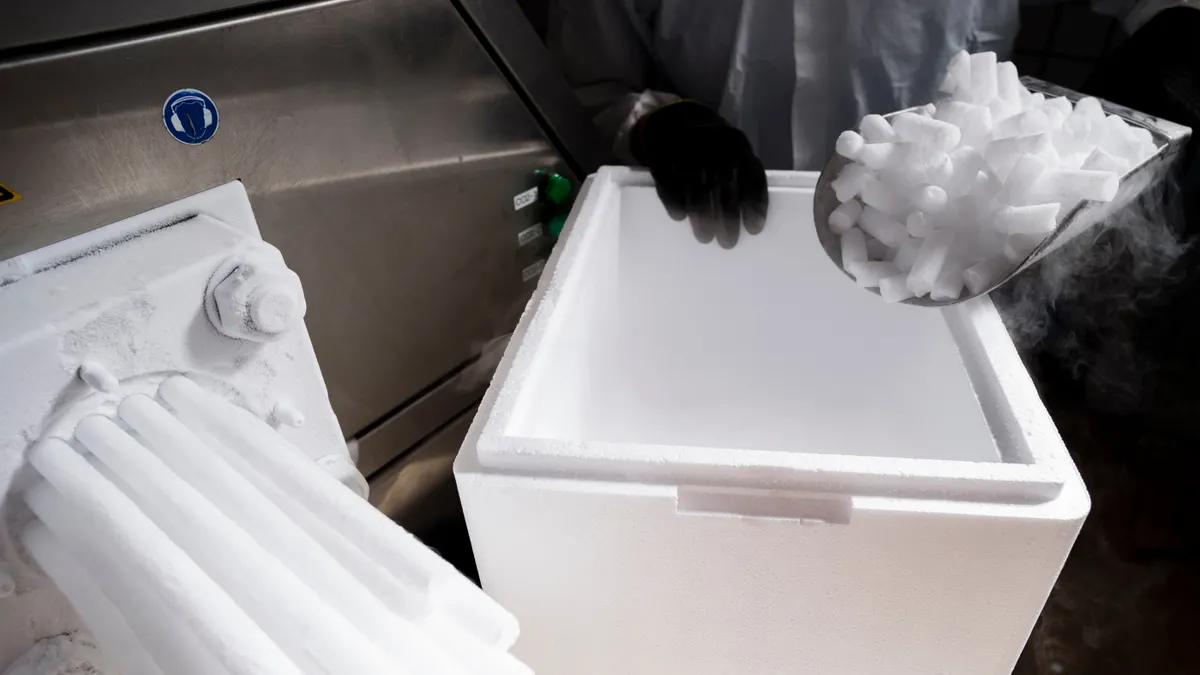
For about a century, dry ice has been a go-to product used in temperature-sensitive shipments because of its ultra-cold nature; long lifespan; and that it sublimates, or changes state from solid to gas without becoming a liquid, which prevents messes and damage to packaging. Plus, it is one of the cheapest options.
"One of the big things dry ice has going for it is its affordability for the amount of cooling power that it offers per pound," said Bill Mayer, director of research and development at temperature-controlled packaging manufacturer Peli BioThermal. However, as dry ice becomes scarcer, "it starts to make some of the other options look even more attractive."
Although tight supply is driving up the cost of dry ice, it’s still considered more affordable than most alternatives, such as gel packs. For example, single-use, salt-based options can be 15 to 20 times more expensive, according to Frank Butch, director of cold chain solutions at Veritiv.
The supply and demand imbalance is interfering with certain supply chains for industries that rely on cold-chain packaging, sources say. It's also touching sectors that increasingly have adopted a direct-to-consumer model.
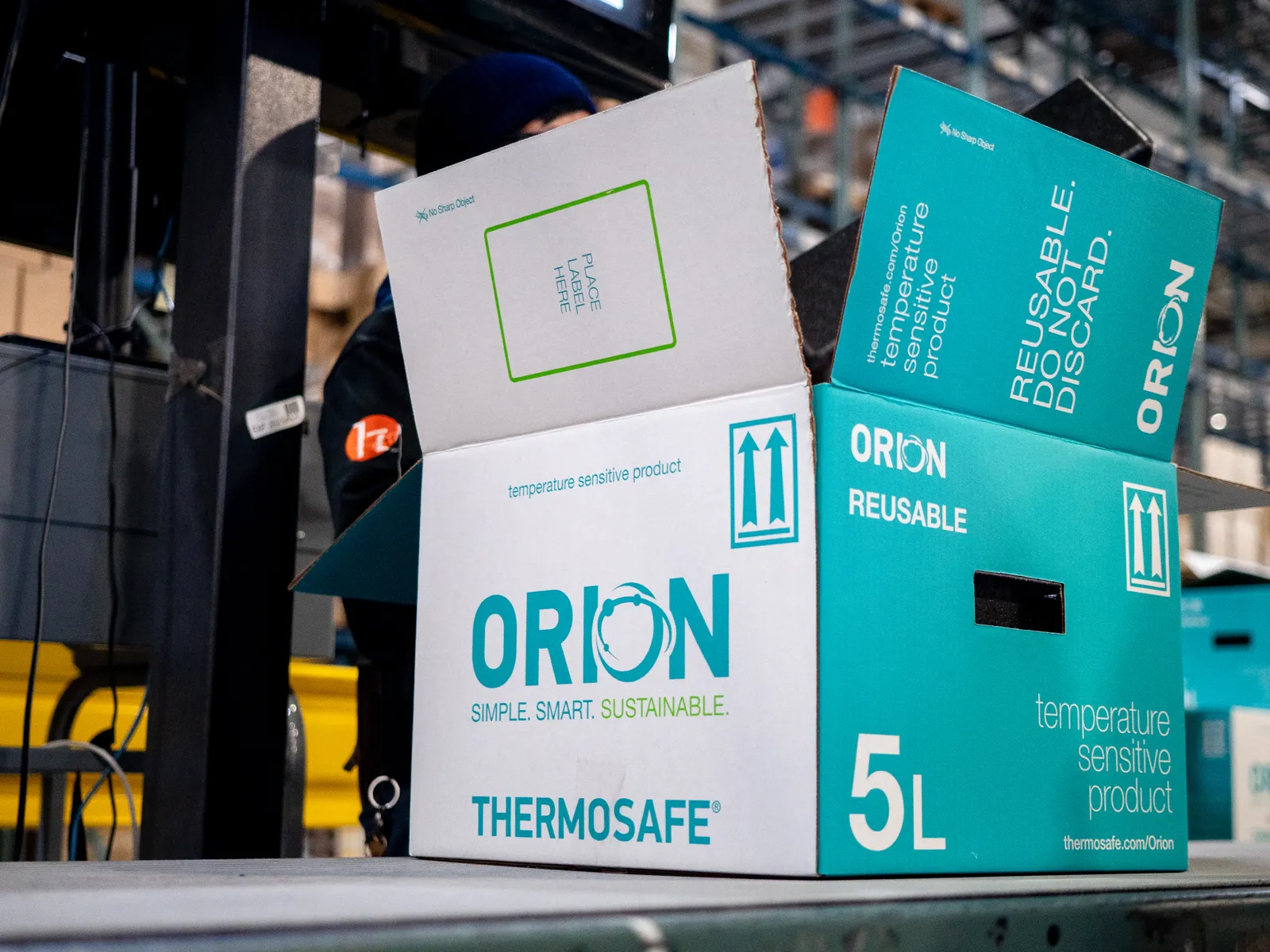
"Dry ice is a part of the cold chain that no one really thinks about until it starts to run on short supply. It's one of those things you take for granted, and then everybody — as cheesy as it sounds — feels a chill," said Vivian Berni, director of product management and strategic marketing at ThermoSafe. "Here's the opportunity for packaging innovation to really offset some of those risks. ... We are adapting."
The situation spotlights differences among cold-chain packaging, specifically the temperature a company's offerings are designed for. Dry ice is most commonly used in shipments of frozen products or those that need to maintain very cold temperatures, rather than refrigerated shipments. Pharma, including GLP-1 drugs, has driven growth recently for refrigerated solutions, sources say.
The "sweet spot" for 99% of Nordic Cold Chain Solutions' customers is packaging that supports refrigeration temperatures of 36 to 46 degrees Fahrenheit, such as for perishable food or pharma shipments, rather than frozens, said Chief Commercial Officer Keith Baechle.
"My customer base doesn't use as much dry ice as other customer bases might, so I haven't seen much of a change in the market to this point," he said, noting that certain customers still do request packaging compatible with dry ice.
While packaging companies innovate to develop alternatives, currently "there is not one out there" with the same apples-to-apples value in terms of dry ice's effectiveness and cost profile, Baechle said.
Cold-chain packaging manufacturers report ongoing research and development for better, more sustainable temperature-assured options — in some cases to get away from dry ice entirely, whether due to supply, safety or regulatory concerns.
"We have heard an increase in partners commenting, 'Dry ice is a headache; if I could remove it, I would,’” said Hannah Sieber, co-founder and CEO of Artyc, a cold-chain solutions provider for the healthcare industry.
The four-year-old business touts its battery-operated, reusable coolers as helping customers to "say goodbye to dry ice." These solutions can be customized for various temperatures, and "a lot of our customers will use us for short transfers in lieu of dry ice," Sieber said.
In addition to altering packaging formats, some shippers are reshaping logistics for how their products travel and the number of touch points they encounter.
"Some companies may have just shipped from a single point in the past, requiring a lot more dry ice," said Chris Bradley, chief marketing and sustainability officer at Veritiv, which offers cold-chain packaging for applications spanning a variety of temperatures. Now, more of the company’s customers are shifting to regional cold storage capacity to shorten lane duration, subsequently reducing dry ice requirements, Bradley said.
A problematic imbalance
Dry ice is created from carbon dioxide, and the CO2 production industry is experiencing a yearslong imbalance in supply and demand. While the dry ice shortage resulting from vaccine shipment surges during the COVID-19 pandemic is well in the past, sources say the current uneven dynamics are worth attention. A shortage potentially could materialize in 2026, according to a gas industry expert.
"We're not in outright shortage. We could kind of get into a shortage next year — it just depends on what the producers are able to do," said Maura Garvey, president of Intelligas Consulting.
Dry ice production in the U.S. currently is about 4,600 tons per day, she said. Demand for dry ice has grown 5% annually for nearly a decade, and Intelligas expects that clip to continue for the next five years. However, CO2 production capacity has only grown 0.3% per year for the past 10 years.
Plus, there are "some plants out there that definitely are not producing dry ice at the capacity they were built," Garvey said. She pointed out that plants producing CO2 generally operate a maximum of 350 days per year, whereas dry ice plants operate roughly 275 days per year.
CO2 typically is a byproduct of other industrial production, such as for ammonia and ethanol. California is one of the nation's leading CO2 suppliers, but the state is losing a chunk of its capacity: Two plants are closing by the end of this year and one by the end of April 2026, equating to a loss of nearly 850 tons per day by early next year, Garvey said.
"So we are having a problem with supply not really growing enough — and we're losing supply," Garvey said.
A minimum of five plants that produce 300 tons of CO2 daily would need to be added in the U.S. by 2030 to support the projected level of demand growth, according to Intelligas data. Although some companies are working to get plants online, the additions aren’t coming fast enough, according to Garvey.
For example, she explained that chemical company Linde plans to expand an ethylene oxide plant in Texas, which would double the CO2 production capacity — but that's not happening until 2027. Some smaller plants also are coming online, "but it's going to take a bit to catch up," Garvey said.
Food-related sectors constitute the greatest U.S. dry ice demand
It takes approximately 1.5 pounds of CO2 to make one pound of dry ice, Garvey explained. But that ratio can increase to up to 2.5 pounds of CO2 for one pound of dry ice depending on producers' system configurations and whether they have recovery cycles.
Dry ice applications make up about 20% of CO2 demand in the U.S., and Intelligas projects that share will increase to 23% by 2030. Food applications — such as meat processing — comprise the bulk of demand, and food transport has been a growth driver the last eight years.
But the fastest growing demand sector now is industrial blast cleaning, Garvey said. Dry ice blasting, in which compressed air propels dry ice pellets onto a surface, has increased from 5% to 10% annually for the last five years as a more environmentally friendly deep cleaning option in industrial settings, she said. However, that end-use application is not complementary to cold-chain packaging supply chains.

Adapting through innovation
Many cold-chain packaging manufacturers are innovating to alleviate dry ice supply and cost concerns, while also seeking safer and more sustainable alternatives.
Dry ice is considered a hazardous material with transport restrictions. The material releases CO2 as it sublimates, which can cause a buildup of pressure and risk rupturing, resulting in Department of Transportation protocols including limits on how much dry ice is allowed on a plane.
"By designing packaging that reduces the amount of dry ice that's needed per individual package, you can actually get more packages on the plane for allowance," Peli BioThermal's Mayer said, adding that this ultimately results in fewer transportation emissions. "If we switch to using a phase-change material, you eliminate the dry ice altogether."
ThermoSafe has adapted its R&D efforts to reduce customers’ dry ice dependency, said Berni. That includes coaching customers in switching to alternatives, but also "designing systems that stretch every pound of dry ice further with high performance insulation, and redesigning the container geometry to make sure that it reduces the melt rates."
Increasingly, customers are diversifying their cold-chain packaging mix, she said, including incorporating phase-change materials — or materials that provide heat transfer when they change state between liquid, solid or gas — such as with gel packs.
Veritiv has found through ongoing material testing that saltwater works well to maintain cool temperatures, said Butch. However, it's still not as effective as dry ice, and no alternative material exists yet that is a 1-to-1 equivalent, he said, noting that “98% to 99% of the [industry’s] solutions that are frozen are going to be using dry ice.”
On the safety side, exposing human flesh to dry ice can cause cold burns, similar to frostbite, so handlers should wear proper personal protective equipment. This makes dry ice a less ideal coolant for shipments heading to sensitive locations, such as if children might be present, said Artyc's Sieber.
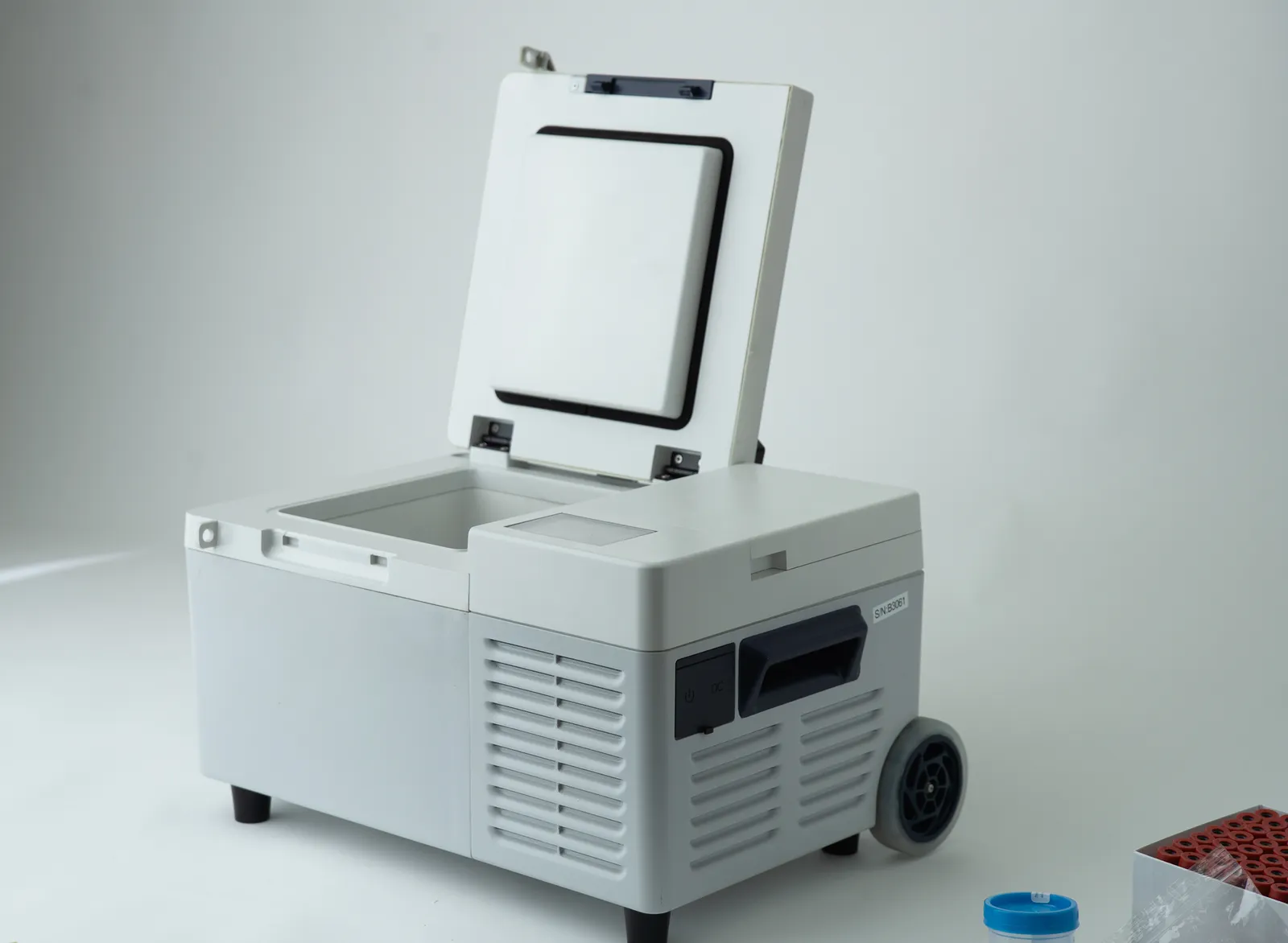
Artyc is "building an on-demand cold chain" for healthcare and life sciences with battery-operated durables that directly cool the air in the payload space via a small compressor, she said. The larger units replace the need for dry ice, expanded polystyrene and phase-change materials, while addressing transport challenges specifically in the middle mile and the last mile, she said. The coolers have built-in Internet of Things capabilities for tracking real-time conditions including temperature and chain-of-custody visibility.
"Our goal is to build more resilience, reliability and sustainability," Sieber said. "We're providing peace of mind and ease around transfers by reducing reliance on dry ice."
Sustainability is now a leading consideration during cold-chain packaging R&D, sources unanimously agreed, and it represents a key reason for creating dry ice alternatives. The demand comes from companies' voluntary goals as well as regulations in the United States and abroad, they said.
"Conversations on sustainability have increased exponentially over the past year. And I would even cite, in the last five years it's been something that comes up more naturally on the customer's behalf," Berni said.
Producing dry ice isn't an environmentally conscious process, said Veritiv's Butch, considering the product tends to be manufactured from CO2 captured from industrial facilities. In addition, debate surrounds the sustainability of cold-chain packaging itself.
Expanded polystyrene is a commonly used type of cold-chain packaging material due to its insulating properties and low cost. But many companies are trying to reduce their EPS use because of its contentious environmental profile. ThermoSafe offers an EPS that it heralds as biodegradable at home. It also offers boxes with vacuum insulated panels to cut down on EPS use and provide a lighter weight option.
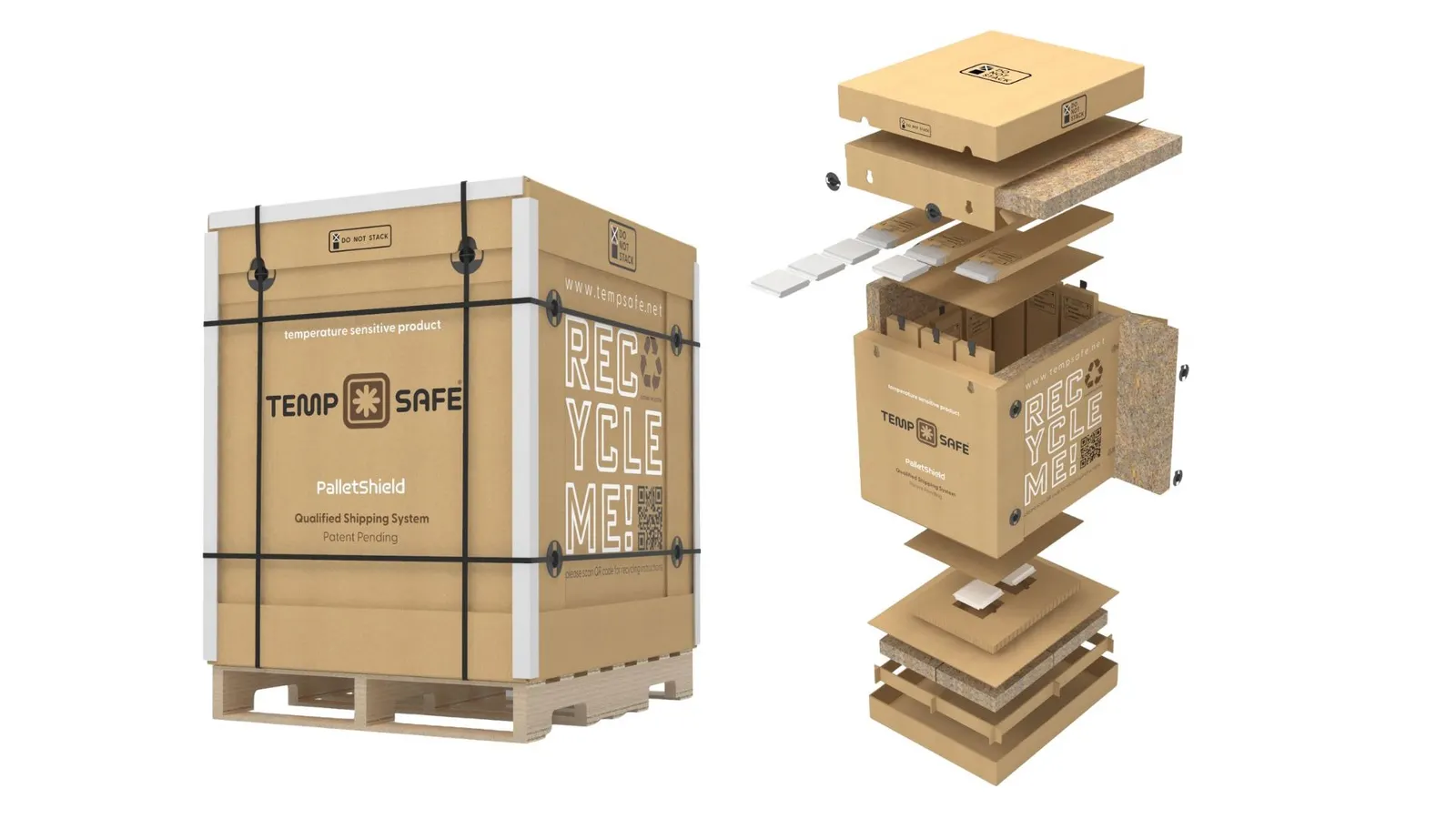
Veritiv similarly relies on VIPs wherever possible. And last week, the company introduced a new pallet shipper called TempSafe PalletShield for bulk cold-chain shipments. Instead of EPS, the insulation is made from a cellulose material that can be recycled curbside, Bradley said.
“Within our R&D labs, we've tested 25 different types of materials over time for R-value, thermal conductivity,” he said. “We can now get a cost-competitive solution that's fully sustainable and curbside recyclable.”
This autumn, Peli BioThermal launched a new dry ice shipping product, Vēro One, that it says is curbside recyclable and was designed to address growing demand for sustainable cold-chain solutions. It includes a corrugated box and other fiber elements inside. Peli says it’s a single-use product for instances when reusables aren’t an option.
However, the company’s reusables are not only sustainable but “cost effective when you can return that shipper, refurbish it, clean it and use it for another journey,” said Kai Goellner, new product development manager at Peli BioThermal. “That reusable technology has really been the bedrock of what we offer.”
Both ThermoSafe and Artyc also champion the sustainability benefits of their reusable insulated containers. In this space, customers have a “very specific focus on packaging waste reduction,” said Artyc’s Sieber.
Meanwhile, Nordic Cold Chain Solutions this year introduced Nordic Express Pack specifically for shipping GLP-1 drugs.
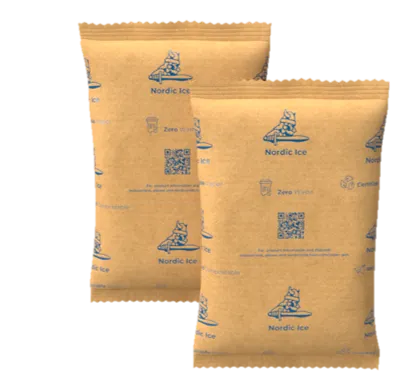
The product is compact, which allows for more product per shipment and lower emissions, Baechle said. In addition, the company’s biodegradable gel packs can be added to home compost piles or their contents can be poured down a drain, he said. The company also offers gel packs designed to have the same performance as conventional versions covered in plastic, but that are instead encased in paper to enhance sustainability.
“It's a solution-based business,” said Nordic’s Baechle. “We understand what the customer's needs are, what the temperature ranges of the drugs or their products need to be, the transportation methodology, and then we align the solution to marry up to expectations.”

Chilly outlook
Demand for sustainable cold-chain packaging is only expected to grow, sources said, so companies will continue to invest in R&D for those products.
However, cost remains a holdback for switching customers away from dry ice and toward more sustainable alternatives. Yet, sources predict that even more costly sustainable products will become more desirable to customers soon if dry ice demand and CO2 production remain on their current trajectory.
“If you assume you’re spending two to three bucks per kilogram of dry ice, you're spending quite a bit of the cost just on that cooling mechanism — and it's single use,” Sieber said. “If you're doing at least three frozen shipments a week in our larger unit, we're able to break even within the quarter,” or within an average of two to three months.
Sources also noted some customers hesitate to move away from products with a history of reliability. This is especially true for industries with high R&D and product costs, such as for gene cell therapy and clinical trials.
“The pharmaceutical industry is risk averse, so moving them from a tried-and-true, proven form to something that's a different insulation product or a different type of gel pack that could be more sustainable is important, and everybody's thinking about it, but it's challenging,” said Nordic’s Baechle.
Packaging companies say they’re ready to ramp up production of their innovative cold-chain solutions if necessary, considering the CO2 and dry ice supply strains are not expected to ease anytime soon.
"We're going to be in tight supply with CO2 for a while — I think it's not going to be great next year," said Intelligas’ Garvey.