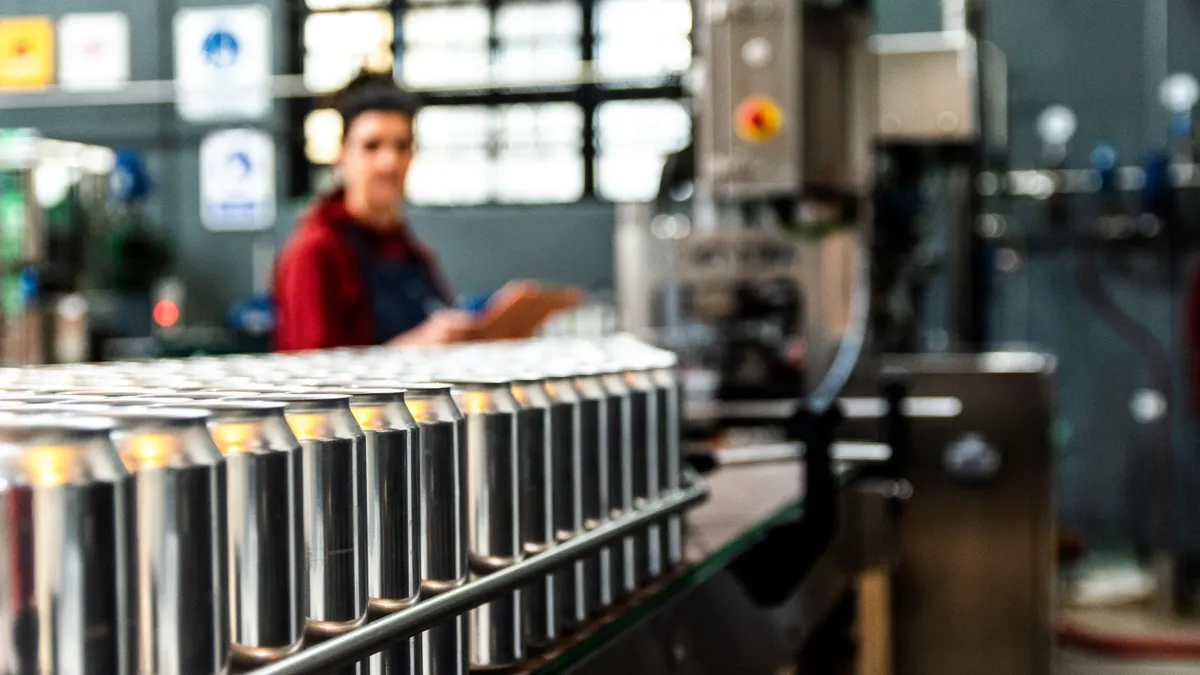
U.S. craft beer is becoming further entrenched in aluminum cans, but that shift out of bottles is approaching its ceiling, according to 2025 data and recent analysis from the Brewers Association.
In 2025, aluminum cans accounted for 78% of packaged craft beer volume and glass accounted for 22%, according to the Brewers Association. This reflects the steady rise for cans and fall for glass in recent years, which in 2022 were at 69% and 31%, respectively.
Still, substrate trends vary widely by state.
For Rhode Island, where 92% of craft beer is in cans, “there's not much more space to give. There are some brands that will always be in bottles,” said Matt Gacioch, staff economist with the Brewers Association, which represents thousands of small and independent brewers. Conversely, in states such as Mississippi, Kansas and Louisiana, where cans’ share hovers around 58% or lower, there’s space for more aluminum share growth, he noted.
Tariffs and other operational costs remain tricky for brewers. “There's high switching costs if they were going to try to package something other than cans,” he said, noting that many brewers have their own canning lines. “And so the idea that a cost increase would make them suddenly scrap that and invest in a whole new, say, bottling line or something — it just isn't the reality.”
Craft brewers are in a tough spot, Gacioch said, having to absorb costs or pass some of them to consumers. And the impacts are yet to be fully realized. “A lot of the tariff price increase will be felt when they're re-upping those contracts or placing their next big order rather than going through their inventory of aluminum right now,” he said.
Anecdotally speaking, the glass price premium over aluminum packaging has shrunk, Gacioch said.
While six-packs remain the most common format for beer sales, at 45% share, sales are growing for other formats. Singles now account for 8% of craft beer volume, according to the report. Popularity is also rising for 19.2-ounce cans for individual beer sales. In 2025, these “stovepipe” cans made up 60% of single beer sales, up from 55% in 2024.
On the opposite end, 24-packs also became more popular in 2025. The offering “represented only 2% of overall BA craft volume in 2025, but was the only major pack size to grow year over year,” per the report. The average case price declined 4.6% year over year, and volumes sold rose 6.4%.
Consumers are seeking perceived value, regardless of container size, Gacioch said.
“Going to a liquor store and buying one 19.2 — that costs less than five bucks. That feels kind of good at the time of purchase,” he said. “On the other extreme, we saw a rise in 12-packs and 24-packs, indicating that some consumers are saying, ‘Hey, if I'm going to get beer, I want my unit price to be lower.’”
“If the first couple months of 2026 are any indication, there will continue to be a lot of uncertainty that consumers are feeling. So I wouldn't be surprised if we see further consolidation into these kind of value packs on either the larger pack size or smaller pack size taking share from six-packs,” Gacioch added.
He also anticipates the share between bottles and cans may continue to shift.
“My crystal ball prediction is that we're seeing something of a leveling off. I wouldn't be surprised if cans take one to two percentage points more share, or drops by one percentage point. I wouldn't guess it would drop by much more than that.” Cans’ share in 2026 will likely again be in the high 70s, he said.
That being said, “No one can predict right now [if] there are going to be any further tariffs or other disruptions to a supply chain that could really upend the whole thing.”
Beyond just tariffs, beer broadly and craft beer specifically have gone through a tough period, with consumer drinking preferences evolving and sales volumes down in recent years.
What’s most important is that brewers communicate well with their packaging suppliers, Gacioch said.
“I think making sure those lines of communication are open is the best approach right now to work together through all of this uncertainty.”
Correction: This story has been updated to correct the spelling of Matt Gacioch’s last name.