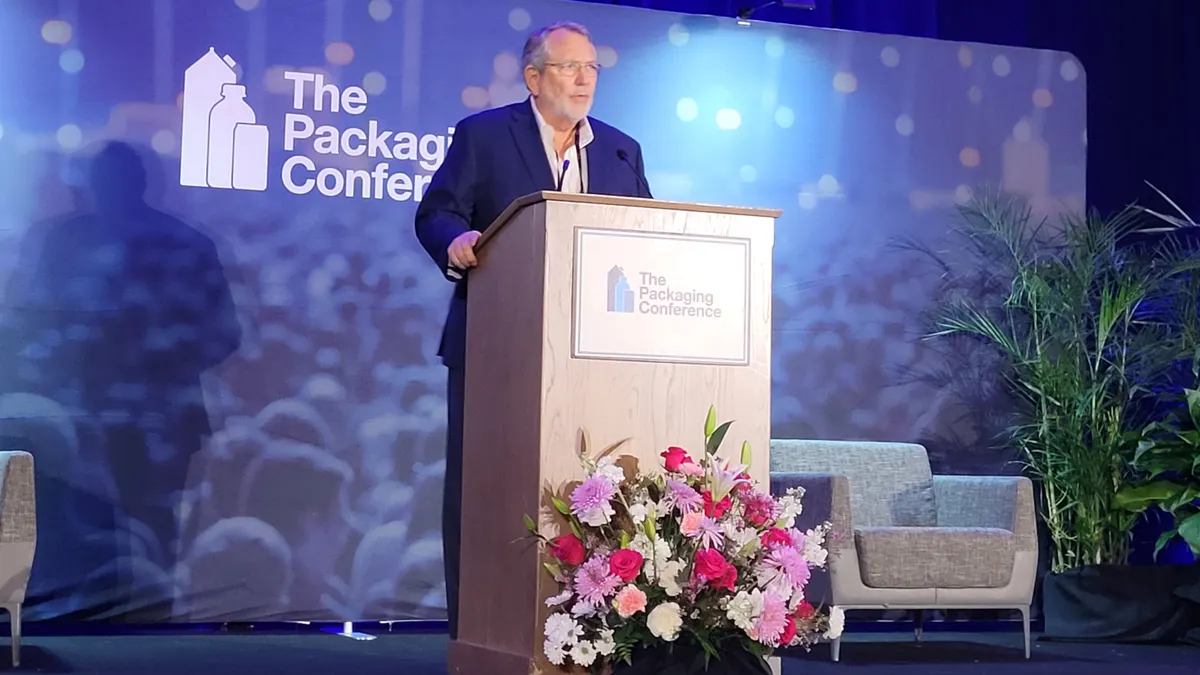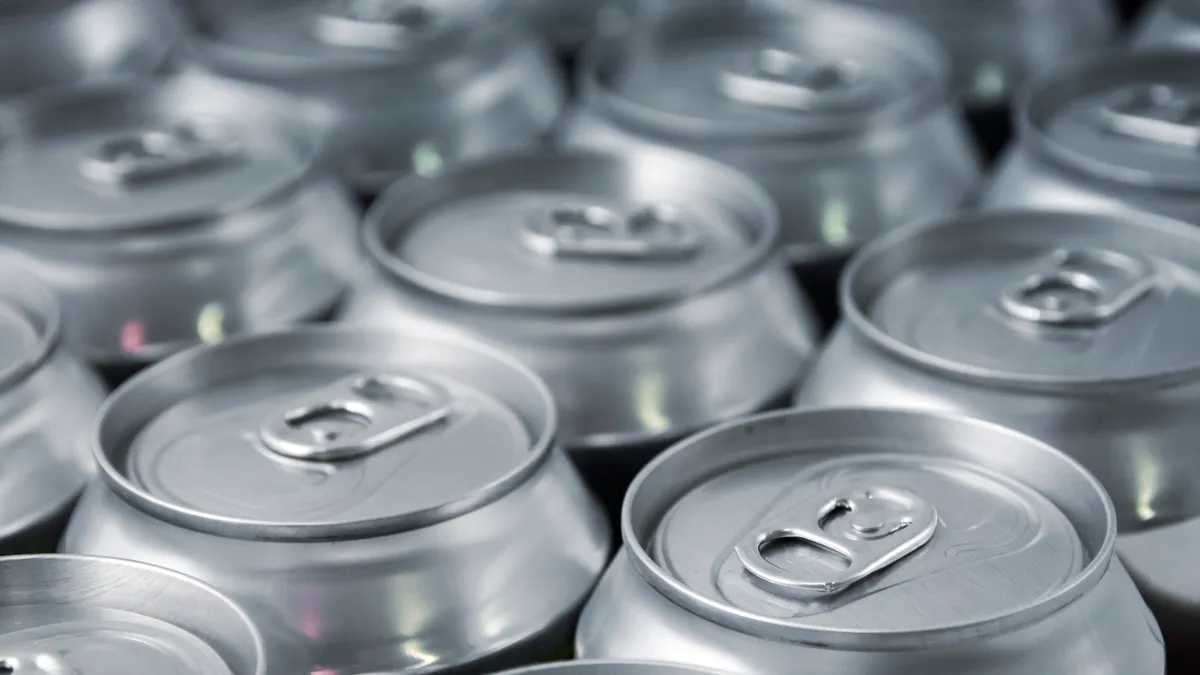
Aluminum food and beverage cans are having a moment, with manufacturers and analysts alike predicting a strong year for the sector. Crown Holdings aims to harness those timely growth opportunities while simultaneously advancing its sustainability work, said Sandrine Duquerroy-Delesalle, Crown’s vice president of global sustainability and external affairs, during a session at The Packaging Conference on Feb. 10.
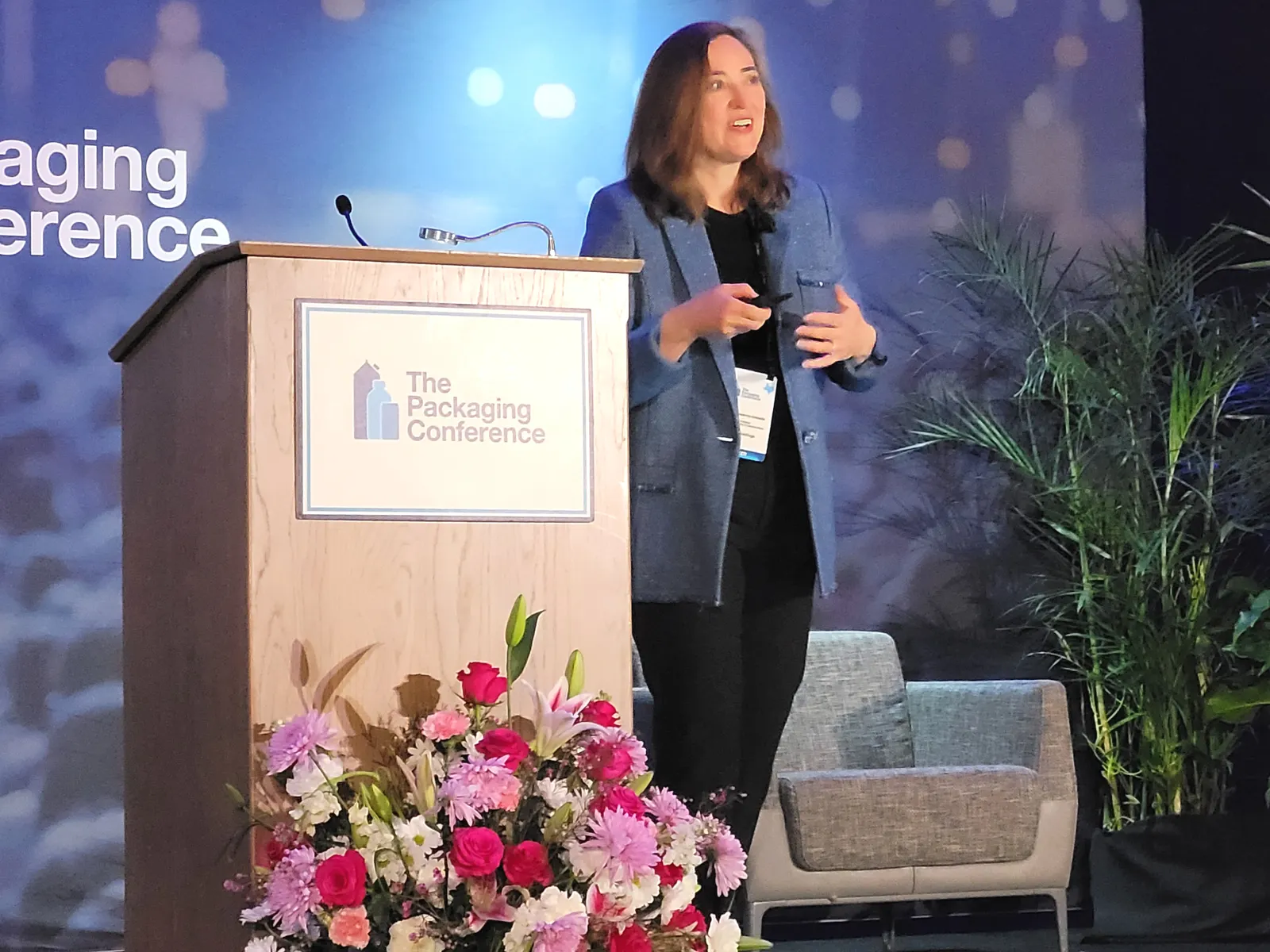
While a different speaker at the conference suggested packaging sustainability efforts are failing, Duquerroy-Delesalle told Packaging Dive that this sentiment is not the full story.
It’s true that more could be done to collect packaging for recycling, decrease companies’ energy use, and overall lower carbon footprints, she said, but companies already have made progress and need to better champion that work.
For Crown, that means discussing headway toward the updated goals in its Twentyby30 program — a set of 20 ESG goals it launched in 2020 to achieve by 2030, compared to a 2019 baseline — and “pushing for more policies, more infrastructure, more consumer awareness to raise the recycling rate,” she said.
“We are on track with the commitments that we made five years ago, and we are even more ambitious now,” Duquerroy-Delesalle said, also highlighting the importance of collaboration across the value chain to promote sustainability. Although certain goals have shifted, overall “people are more and more conscious — I think this is across Europe and the U.S. — about circularity and how can they get their packaging to be collected and recycled. ... Circularity is very important to our business.”
Packaging Dive sat down with Duquerroy-Delesalle at the conference to go deeper on how Crown is approaching packaging sustainability as the practice evolves.
This interview has been edited for clarity and length.
PACKAGING DIVE: During a conference presentation, you talked a lot about the growth in the can market. Can you tell me in more detail about how that is playing into your sustainability strategy at Crown in 2026?
SANDRINE DUQUERROY-DELESALLE: We are including that growth into our strategy, because most of our targets for sustainability are absolute. So if we grow, we still need to reduce our GHG emissions, our water usage by both targets that we defined.
For instance, scope 1 and 2 emissions, we have defined a 50% reduction by 2030, and water usage was a 2025 target of 20%. The more you grow, the more you will use energy and water. So if you need to decrease that in absolute terms, you need to be even more ambitious in terms of production for cans.
We work with our teams in the operations and factories to see what solutions we can implement to recirculate water, to reduce energy usage — electricity, gas usage — to achieve those targets. And then there are always elements regarding recycled content and recycling. To reduce these emissions, we need to increase recycled content in our cans.
Crown is obviously a global company with a strong presence in both North America and the Europe, Middle East and Africa region. In your sustainability strategy, how do you balance the different regions’ places in their sustainability journeys?
Each region has their own pathway. There are commonalities in this pathway, typically regarding the collection of our packaging, the circularity of this packaging and the closed-loop recycling.
We are also an important player in Brazil. The cans there are collected at more than 97%, and the cans that are collected are being recycled into can sheets. We know there are some leaks of material, but the majority of the cans being collected are going back into can sheet. So there, in terms of what we have to do, it's limited. It will be a very different pathway compared to the U.S. or for Europe.
Things are moving in the U.S. There are some states that really want these EPR systems to change the packaging, the waste infrastructure and consumer perception of how waste is working, etc. I think there is potential to make consumers more aware of what they should do to ensure that their packaging is being collected and truly recycled.
In Europe, we’ve had collection systems for many years, and extended producer responsibility. We have a higher recycling rate in Europe compared to the U.S. In the U.S. today, our strategy is to work with different states, and with our brand owners as well, to increase collection. We all need to be aligned in the value chain, from our customers to the aluminum suppliers, to ensure that this value chain is conscious of the efforts that need to be made to collect more cans and to recycle those cans.
Our cans are quite standard, and our factories are quite standard in the way they are built. We have different suppliers of equipment, but in terms of what we need to do, it may be the same. So the pathways may be a little bit different for the region, but in terms of reduction of energy, electricity, gas, it's also similar.
You talked about the innovation occurring with food and beverage cans, but what about other products such as aerosols? Is a lot of innovation occurring there, too?
In terms of innovation of the product, we lightweight all of our cans: food cans, aerosol cans. I would say material usage reduction is the key element.
We also work with our suppliers on something that has been developed more or less in Europe: different alloys for both can bodies and ends. Some of our suppliers in Europe are working at creating a more recycling-friendly alloy.
We are also in discussions with suppliers of steel that have a reduced carbon footprint. You know, “green steel” coming from different type of furnaces, electric furnaces. That’s a material change, not really an innovation in the product itself, but this is the type of innovation within our value chain that we look at.
During an earnings call earlier this month, Crown CEO Tim Donahue noted the impact of tariffs on costs, and also how costs play into sustainability. How are you thinking about costs and sustainability from your position?
I would need look at exactly what he said, but in the U.S. we use a lot of recycled material. This material is already in the country. It is being collected and recycled back. And scrap is not covered by tariffs — it's only primary aluminum that is covered by tariffs.
I think yes, there may be some impact down to the consumer. But at this point in time, I think we have not seen yet any strong concern on prices.
Over the last year especially, we’ve heard some packaging companies comment on certain customers pulling back a bit on sustainability efforts. Have you noticed such a shift?
Some of our customers have changed or adapted their targets. We've seen that on recycled content for plastic packaging. But overall, what I see day in and day out is more and more questions about the carbon footprint of the product, our pathway to net zero and renewed commitments.
Especially in the food and beverage sector where they are consumer facing, they cannot suddenly say, “OK, we are not following that anymore.” The question of carbon footprint is very, very, very important.
Sometimes we have questions around water as well. At Crown, we have some water replenishment goals. We are monitoring that, but most projects around water replenishment are really difficult to implement because you need to work with NGOs and make a long-term commitment. These projects need time to develop, right? But this is something very important for us to be working on.
We've talked a lot about recycling at end of life for your products, but reuse often is forgotten. How does that play into your sustainability strategy?
At Crown, all our products are single-use products. So what we believe is that there is a space for reuse, for refillable products and packaging, and those two systems really can be complementary.
I think here in the U.S. it's a bit different, but in Europe there is a push towards refillable packaging. We say, yes, it's good to have refillable systems. But for some consumer spaces, some types of consumption, you need one-way packaging. And that packaging needs to demonstrate, really, that it is sustainable.