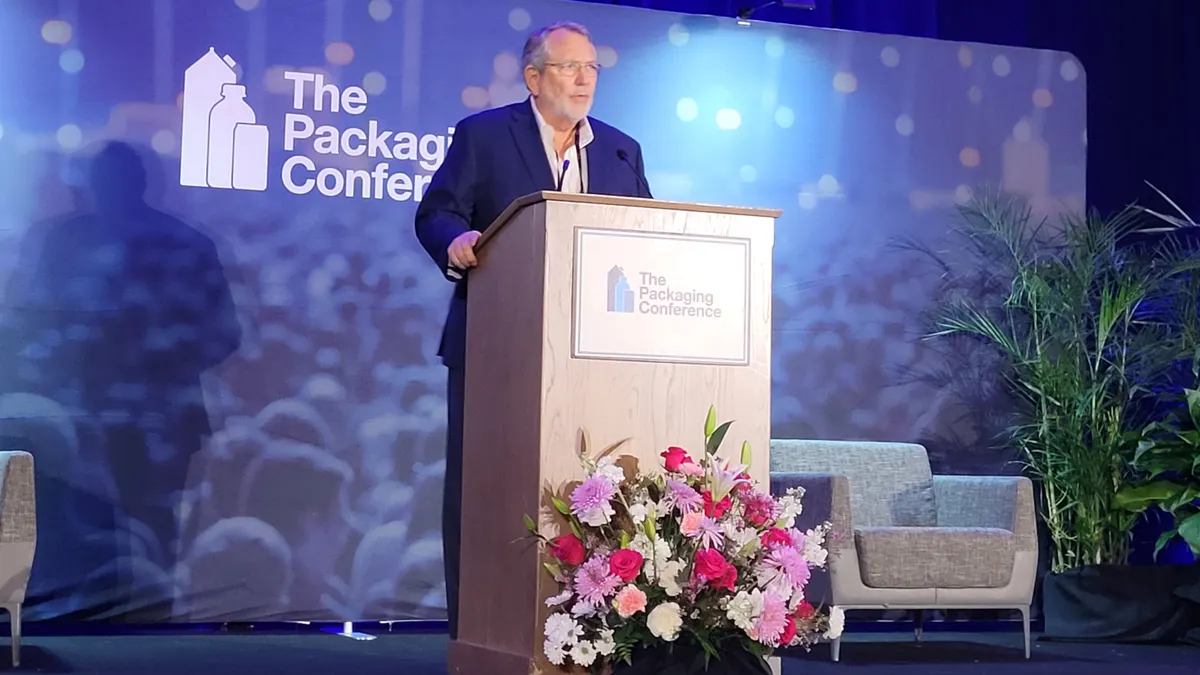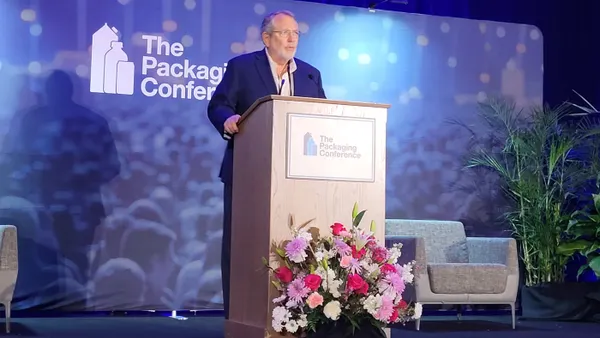
Packaging Corporation of America’s $5.2 billion worth of investments in its mills and box plants over the last decade — at a time when it says many competitors didn’t commit to such investments — is paying off now, said CEO Mark Kowlzan on Feb. 26 during the Bank of America Securities 2026 Global Agriculture and Materials Conference.
“The industry hasn't recapitalized at the rates that we have,” he said.
Kowlzan said he predicted in 2018 that “if you were not prepared to take care of your own technical and engineering needs, your own capital spending needs, you would be out of business probably in 20 years,” he said. “That was, say, eight years ago. And look what's happening to the industry.”
PCA’s January corrugated shipments were up 4.5% per day compared with last year, with a 3% increase in February through the third week of the month. “Bookings remain incredibly strong, and the business is very robust,” despite some setbacks from winter storm impacts in January, Kowlzan said. “We feel good about March.”
Kowlzan said PCA intends to fully implement the company’s announced $70 per ton price increase for containerboard that was set to take effect March 1. “If you went back over the last 25 years, within three or four months we've always captured that full price,” he said.
Here are four key insights from the event.
Winter storm disrupts business
Similar to numerous other packaging companies, PCA executives had projected during a Jan. 28 earnings call that there would be negative financial effects from the January storms, but they didn’t provide firm numbers. Kowlzan laid out more details Thursday, estimating a $6 million impact.
“It hit our corrugated shipments by a little more than 1% in January, and caused higher freight and operating costs at some of our mills, particularly the Counce, Tennessee, mill and the Riverville, Virginia, mill,” he said. “The good news is that we operated safely. Our equipment held up, and we did not lose significant production.”
Lauding the efforts of Counce employees, he said that mill was the only entity that had power “probably in that whole part of the world for the better part of a week.”
Greif mill upgrades take shape
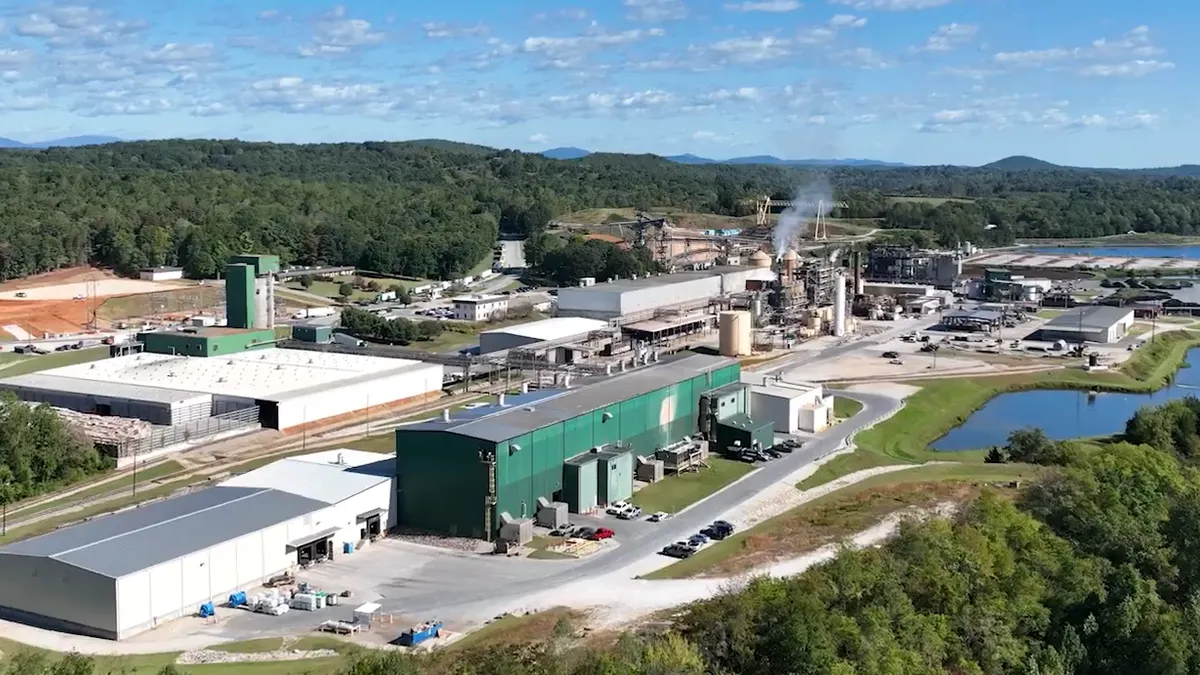
PCA has been working to upgrade and integrate the mills it gained via the company’s $1.8 billion acquisition of Greif’s containerboard business in September. Upon that deal’s close, “we immediately moved in our technology and engineering people into both mills, at Massillon [Ohio] and Riverville,” Kowlzan said.
Since then, PCA has rebuilt Massillon “all the way down to pumps and motors and bearings. So that mill is in tip-top shape,” he said. Combined, the mills previously were producing at an estimated 600,000 tons run rate, but with the improvements that can easily bump up to 800,000 tons, he explained. The upgrades improved operating efficiency in addition to productivity.
“We’re in a very good place now, and the mills are doing just what I hoped they would,” Kowlzan said. “As we used to say in terms of the Boise acquisition, it was the gift that kept on giving. We look at the Greif acquisition in the same way.”
Energy projects move forward
Kowlzan gave some additional details about PCA’s announced projects to install gas turbines to make certain facilities independent of the energy grid.
“I think everybody in this room understands what electric rates are doing, and the demand for electricity,” he said, discussing the sharp upturns for both. For instance, electric rates in Washington state increased 89% in about two years, which is partly why PCA recently decided to shut the No. 2 machine at its containerboard mill in Wallula, Washington, he said; that closure occurred in February.
While examining the consistent increases in energy costs, “It dawned on me that we actually needed to be proactive and figure out what we were going to do to insulate ourselves out of this situation,” he said. The plan involved buying three 50-megawatt turbines “for pennies on the dollar, and we're in the process of getting them ready to move.”
During the January earnings call, he noted the plan to install a gas turbine at the Riverville mill in Gladstone, Virginia, and another at the mill in Jackson, Alabama. The third location was in the process of being finalized at the time. Kowlzan disclosed Thursday that it will be DeRidder, Louisiana.
Optimism for nearshoring
Kowlzan responded to a question about whether the federal government’s push for re-industrialization in the United States will be fruitful. “I think it happens. It is necessary if we’re to be a significant player in the world,” he said.
“We gave away a lot of our industrial base in the 1980s. But the problem is, it doesn't come back easy,” he said. “It's not going to happen next year [or] year after next, but it will start. We're already seeing that.”
The nation has experienced nearshoring over the last decade, “but part of the obstacles, you can imagine, is the capital cost of any industry,” Kowlzan said. “In my view, if at the state level and the federal level there's support and that is clearly defined, then that will take place. And that will be very positive for the corrugated products industry.”