Dive Brief:
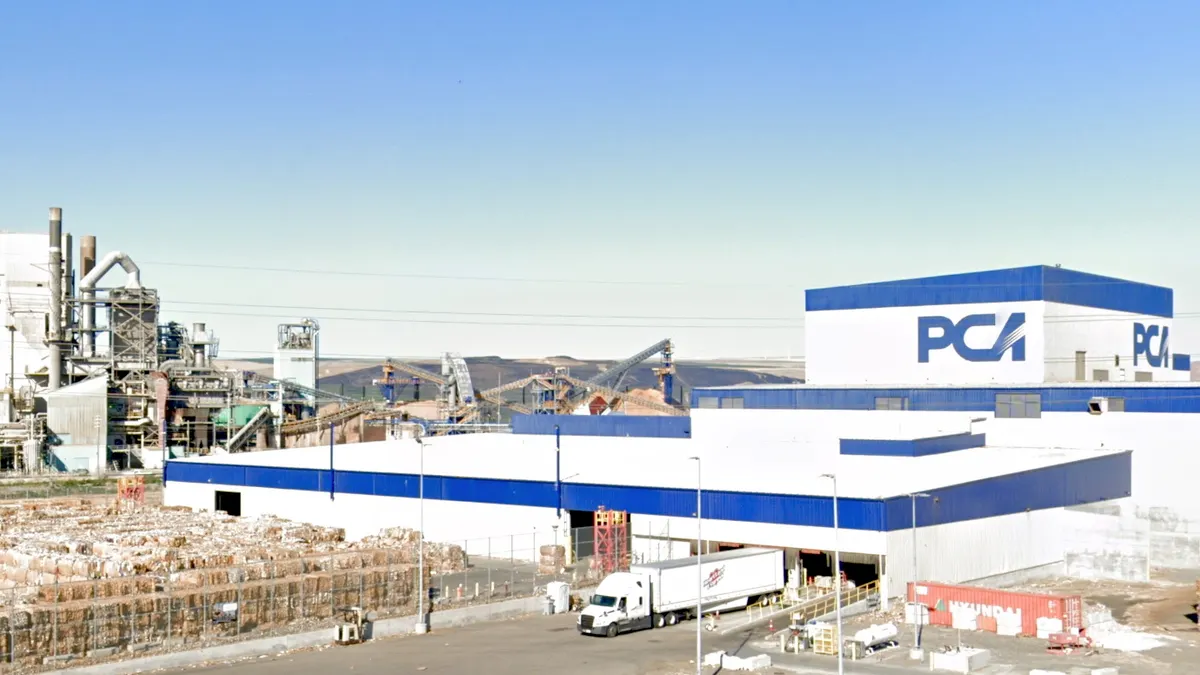
- Packaging Corporation of America will permanently shut down the No. 2 paper machine and kraft pulping facilities at its containerboard mill in Wallula, Washington, the company announced late Wednesday. The mill’s No. 3 paper machine and the recycled pulping facilities will remain operational.
- The machine closures are expected to result in layoffs for 200 employees in February 2026, a spokesperson said via email. PCA anticipates shutdown changes will result in pre-tax restructuring charges totaling $205 million, largely to be recorded in the fourth quarter of 2025 and first quarter of 2026.
- PCA anticipates the 250,000 tons of reduced capacity will be replaced by production enhancements at other mills, including in Alabama and Tennessee, starting in Q4 2026.
Dive Insight:
The Wallula closures add to the notable fiber capacity loss that the industry has experienced in 2025. Packaging Corporation of America said in a news release that it faces “a challenging and worsening cost environment at the Wallula mill.”
“Wood fiber and purchased power costs are by far the highest in our system, making the currently configured mill no longer competitive,” PCA said. Transforming Wallula into a single-machine mill that handles recycled material will “streamline operations at the facility and significantly lower our cost of production, while continuing to produce high quality containerboard for our plants and customers,” it says.
PCA expects the improved utilization rate and cost structure under the new configuration will lower production costs at the mill by approximately $125 per ton from 2025 levels. This year, the mill is expected to produce roughly 400,000 tons of containerboard; after the changes are implemented next year, the W3 machine will have capacity to produce 285,000 tons per year of recycled linerboard and corrugating medium.
The company cited in-progress projects that should augment the lost capacity in Wallula. For instance, it plans to bring online in Q4 2026 approximately 140,000 tons per year of lightweight linerboard capacity at its mill in Jackson, Alabama. Upgrades also are slated for the mill in Counce, Tennessee, and at mills newly added to PCA’s network with the acquisition of Greif’s containerboard business in September.
PCA intends to provide assistance to the 200 people whose jobs will be cut in Wallula, the spokesperson said. “We are currently in the process of scheduling time to discuss details with the Union that represents many of the employees at the mill.”
“We recognize the impact of decisions like this on our employees and will provide support through this process. We greatly appreciate their efforts and our decision is not a reflection on their performance,” CEO Mark Kowlzan said in a statement. “We are taking these steps to support the future viability of the mill and improve our efficiency and cost position, while continuing to invest in our future growth.”
The company has undertaken various actions in Wallula over the last two years, idling it repeatedly. In spring 2023, PCA announced it would idle the mill, affecting an estimated 300 employees. During an earnings call that October, executives said their optimization plans had resulted in a more favorable quarterly outcome, and they would begin restarting operations at Wallula within days.
At that time, the No. 3 machine came back online first, and the No. 2 machine followed in early 2024 as demand increased and PCA aimed to build inventory. The company again idled the No. 2 machine this year, in May, according to the news release. That machine had about 140,000 tons of annual capacity to produce corrugating medium.
PCA says that it has “significantly invested in the W3 machine” since converting it to produce containerboard in 2018. In addition, the company reopened the two machines at its Jackson mill in Q1 2024; it began converting that facility into a linerboard mill starting in 2022.
The announced moves collectively will be capacity neutral, said Michael Roxland, senior paper and packaging analyst at Truist Securities, in a Dec. 3 memo to investors.
“Our sense is that these capacity adjustments are being driven by cost and not due to any incremental demand deterioration,” Roxland said. “Our sense is that the tons transferred elsewhere could see an even greater cost improvement than the remaining Wallula capacity, given they will replace downtime and increase throughput at other mills.”
During PCA’s third-quarter earnings call in October, executives reported a 38,000 ton year-over-year reduction in corrugated production, as well as a 2.7% YoY decline in corrugated sales — although demand improved as the quarter progressed.
Executives also discussed recently announced closures for what they called underperforming assets, specifically a full-line plant in Allentown, Pennsylvania, and another in Salisbury, North Carolina, collectively affecting 168 employees. In January, the company announced that it would close a full-line plant in the Atlanta area, impacting 103 employees.
The North American containerboard manufacturing sector has experienced a challenging 2025. Recent closures by numerous companies have resulted in an estimated capacity loss of nearly 10%, according to multiple analysts. An analysis from Fastmarkets RISI on Oct. 29 called these containerboard capacity cuts “historic” and said they will “result in the largest annual downward adjustment the sector has seen.”
A quarterly containerboard report released by RaboResearch on Wednesday similarly says that 2025 “has been one of the most challenging years in the containerboard sector’s recent history” due to the capacity closures and weak sales volumes. RaboResearch analysts project that in 2026 the industry will be “entering its third year of downturn, with little prospect for a meaningful recovery before 2027.”