The only constant in life is change, and in 2026 the packaging industry will once again need to flex its adaptation skills.
For many companies, the year begins with reset portfolios, fresh leadership and eyes on a still-changing tariff situation. Customers are shifting strategies to align with cost-stressed consumers’ spending habits as well as evolving regulatory attitudes in key markets such as food and beverage.
As always, packaging suppliers have the opportunity to stand out as innovative and resilient partners, including as extended producer responsibility programs shape brands’ next era of sustainability efforts.
Here’s a look at some of the factors likely to impact the packaging industry in 2026. Which other packaging industry trends are you tracking? Send us an email at [email protected].
M&A pace to pick up, but deal types could shift
The modest pace of packaging mergers and acquisitions is projected to at least hold steady, or more likely pick up a bit in 2026, analysts say. But they expect the type and size of deals to shift.
“We think 2026 is going to be a pretty busy year for M&A,” said Xinnan Li, senior analyst at RaboResearch.
Lower interest rates, as well as waning holding periods for assets currently owned by private equity, are expected to drive an uptick in M&A, she said. Plus, public companies' struggling stock prices put pressure on leaders to "do some other things now that they've done everything they can internally."
M&A in the United States could be prevalent for companies that work with “more distressed substrates, such as glass,” according to Bain & Co. In addition, organic growth is "limited and partially muted by trends like 'lightweighting,'" prompting companies to explore M&A as an alternative growth strategy, the firm predicts.
Still, factors such as excess capacity in certain packaging segments and a still-dampened demand outlook mean only companies with the necessary "balance sheet capacity" are expected to pursue acquisitions this year, BofA Securities predicts.
Megamergers proliferated during the last two years, from the likes of International Paper, Amcor, Novolex, Sonoco and others. This consolidation has shrunk the number of large players in the market, resulting in fewer opportunities for megadeals in 2026, analysts say, and shifting focus to smaller players.
North America had more paper and packaging M&A in 2025 than other regions, according to Bain, but there’s still room for consolidation in Europe. There is a greater expectation for more consolidation downstream in packaging, and areas such as containerboard and flexible packaging are prime targets, the firm says.
And streamlining is in, which is further engaging private equity, among other buyers. Numerous major packaging players divested non-core assets in 2025 – think Sonoco’s sale of its ThermoSafe temperature-assured packaging business, or TriMas getting out of aerospace to focus on packaging. Amcor is still looking for alternatives for its North American beverage business.
The rubber hits the road with US packaging EPR
Things are getting real with extended producer responsibility for packaging in the United States. A year ago, producers were preparing for the first state program to kick off in Oregon. Today, thousands of companies are reporting data and preparing for invoices for multiple state programs.
After rapidly scaling in 2025, Circular Action Alliance, the producer responsibility organization active in most U.S. packaging EPR states, is growing more sophisticated and trying to harmonize the producer experience across states.
One example this year is an aligned reporting deadline of May 31 for six different states. CAA also plans to publish 2027 fees and dues schedules later this year to help producers budget. As programs advance, more state details and producer strategies around ecomodulation are expected to emerge.
By the end of 2026, there should also be more evidence of where EPR fees are starting to be reinvested and at what scale. Already in November 2025, a few months after launching Oregon’s program, CAA said it had ordered thousands of recycling carts and distributed $8 million to recycling sorting facilities to support upgrades and “stabilize market fluctuations that raise costs.”
Meanwhile, on the legislative front, other states are expected to weigh packaging EPR programs or needs assessments bills during sessions this year, including New York, Tennessee and Wisconsin.
Labeling conflicts coming to a head
In 2021, California passed an ambitious “accurate recycling labels” law aimed at homing in on which materials are truly “recyclable,” meaning collected and processed for 60% of the state’s population. Five years later, SB 343’s compliance deadline for products made after Oct. 4, 2026, now looms for companies that sell across the U.S.
The onus is on producers to assess and maintain records to verify recyclability claims. Yet as California plans to crack down on the use of the chasing arrows, dozens of other states actually require the symbol.
Ahead of 2026, California’s law already influenced voluntary labeling programs. The How2Recycle label, used by hundreds of CPGs, shifted multiple materials from “widely recyclable” to “check locally” to align with California’s stricter rules.
That complexity inspired the introduction of the Pack Act in Congress in the final days of 2025 to standardize packaging labeling protocols nationally. The bill would preempt state laws and call on the Federal Trade Commission — which still hasn’t updated the Green Guides in more than a decade — to require certain parameters such as third-party certifications for recyclable, compostable and reusable claims on consumer products.
But it remains to be seen how quickly a federal solution could gain steam. While some recycling bills saw traction in Congress in 2025, none became law.
Containerboard sector retools
Packaging demand has been uneven across the board, and fiber companies have been particularly affected — “the pain is very, very real,” Smurfit Westrock's CEO said in October. This was evidenced by the flurry of facility closures in 2025 and North American containerboard production capacity shrinking by roughly 4 million tons, or nearly 10%.
Analysts generally anticipate at least a couple more containerboard facility closures this year — whether due to lagging demand or companies consolidating operations into more modern facilities — but nothing like the historic pullback that occurred in 2025. Rather, 2026 is considered a year for containerboard companies to retool.
Some analysts suggest glimmers of a “recovery,” although potential gains aren’t expected to be steep. Others believe a recovery trend might look more like a plateau, which would still be an improvement from recent losses. Overall, various analysts' expectations for containerboard demand growth hover around 1.5% for the year.
"I think everybody's expecting a pretty slow recovery, but nobody's really expecting demand to keep going down" throughout 2026, said RaboResearch's Li.
With so many containerboard facility shutdowns, "operating rates have begun to move higher, towards the low 90s," said George Staphos, BofA Securities analyst. The expectation is for operating rates to reach the mid-90s this year. Analysts also project higher operating rates and demand will result in producers implementing a price increase later in the year.
Changes to boxboard also are on the fiber bingo card for 2026, although they're not likely to significantly impact containerboard markets. "There's some overlap, but it's not a tremendous amount of competition" between containerboard and boxboard, Staphos said.
Fiber packaging executives recently expressed the desire to focus on different grades to adjust to shifting supply and demand dynamics. For example, Smurfit Westrock is transitioning more customers away from coated recycled board and toward solid bleached sulfate and coated unbleached kraft. Meanwhile, Clearwater Paper halted its exploration of adding coated unbleached kraft swing capacity to one of its solid bleached sulfate machines in response to oversupply of the latter.
More consideration of AI and automation opportunities
Amid President Donald Trump's push to bolster domestic manufacturing and add American jobs, manufacturers continue to struggle to fill existing roles: The Bureau of Labor Statistics recently cited nearly 400,000 open manufacturing jobs.
Recruiting and retaining workers was the top business challenge for 65% of the 200 manufacturers surveyed by Deloitte and the Manufacturing Institute in recent years. Referencing the labor shortage seen in packaging and throughout manufacturing, the partners predicted that up to 1.9 million jobs could go unfilled by 2033 if workforce challenges are not addressed.
“Who is going to work these manufacturing jobs? That's just not something that we are seeing an easy answer to, and certainly not something we think is going to get solved in 2026,” said Ryan Fox, corrugated packaging market analyst at Bloomberg Intelligence.
So far, although some announcements have trickled in, renewed manufacturing expansion efforts for packaging have been tepid. The administration's focus has been on select sectors, like tech. Fox pointed to manufacturing for data centers and semiconductors among the sectors getting attention, but "not necessarily a move towards consumer products ... that normally go in corrugated boxes.”
Even though some packaging manufacturers could expand their footprints this year, industry observers are cautious about predicting what that means for labor. Manufacturers’ added job numbers in recent expansion announcements often have been in the dozens, as opposed to the hundreds or thousands.
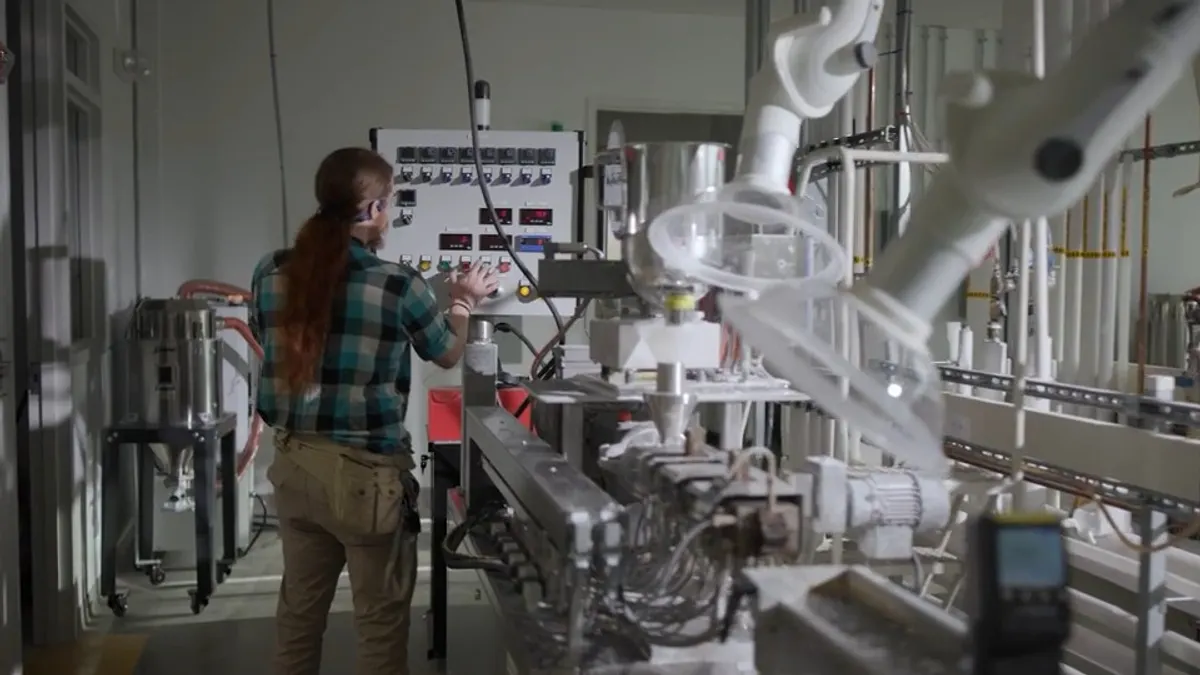
One factor is that manufacturers increasingly have incorporated more efficient, high-speed technologies. “You can actually get a whole lot more done with a whole lot less," Fox said.
Although some worry about automation replacing human workers, many companies have turned to automation to fill labor gaps. Automation also offers opportunities to upskill workers, whether to operate new, high-tech machinery or to move employees into higher value-add roles.
The dynamic will take on heightened importance as packaging manufacturers increasingly tout their incorporation of new technologies, including artificial intelligence tools, for packaging design and manufacturing along with equipment maintenance.