It sounded simple: If brands used more recycled plastic in their products and packaging, it would strengthen U.S. recycling systems.
Yet rising volumes of imported recycled resin and weakening demand in some areas are putting pressure on domestic producers, with the challenges expected to continue in 2026. Tariff uncertainty, strained consumer spending and the cost difference between international and American material all factored into a soft and unstable U.S. postconsumer resin market this past year.
There are several pressure points that Kate Bailey, chief policy officer at the Association of Plastic Recyclers, sees contributing to the “perfect storm of problems arising all at the same time.”
Virgin plastic is cheap and plentiful. “Whenever you have too much of something, you charge less, so that’s further driving down the price,” Bailey said.
Some brands and manufacturers have been backing off sustainability targets, meaning lower demand for recycled resin. And when they use materials like recycled PET, they’re largely importing it, especially in California, which is geographically closer to large Asian markets.
Plastic scrap imports to the United States have climbed, according to ICIS
In 2024, the U.S. imported 492,101 metric tons of scrap plastic, continuing a somewhat steady rise in imports over the past five years. Nearly half of it was PET, at 49%.
In the Wall Street Journal, the National Waste & Recycling Association also cited ICIS data, noting that volumes of imported PET and rPET, which are reported under the same Harmonized Tariff Schedule code, rose 8% in 2025. In Q2 alone, 910 million pounds of PET and rPET were imported — an 11% increase year over year.
“Part of the challenge with those imports is also the larger market conditions under which it’s happening,” Bailey said. “There’s a lack of committed, stable buyers for recycled content and we can’t grow plastics recycling if we don't have people buying recycled content on a consistent basis.”
Emily Friedman, recycled plastics senior editor at ICIS, said late last year that she didn’t foresee much change in the interplay between imported and domestic in the near future. She added that rPET is the only resin market severely impacted by imports.
“Some of those pricing nuances, we’ll have to wait and see, but even if domestic has the price advantage, there are still cases where people will choose to import because of quality,” she said. “Tariffs don't necessarily change that aspect of why people import, which is why I suggest we’ll probably continue seeing this.”
“What pretty much every resin market needs is some level of global rationalization,” she added. “There’s too much virgin in these markets.”
The price difference between virgin and recycled content also likely won’t budge in the next year, Friedman said. As brands walk back sustainability commitments and adopt a wait-for-regulation approach, recycling facilities are under pressure. “If you don’t invest in these players now, they might not be there at this rate,” she said.
Alasdair Carmichael, program director at the National Association for PET Container Resources, said 2025 saw four PET reclaimers close — an unprecedented number.
“There are only about 30 plants, and if you have four of them close in a year, that is a big chunk,” he said. “I think that in itself tells us that the business is not good, and a lot of that business is not good because of increased imports.”
That total included Alpek Polyester closing down operations in North Carolina and Phoenix Technologies’ partial closure in Ohio. In California, Evergreen and rPlanet Earth shut up shop, the latter of which held 4% of U.S. rPET processing capacity, according to NWRA.
Carmichael said one bright spot is that the California Evergreen facility has been taken over by Blue Polymer, a joint venture between Republic Services and Ravago Holdings, and will continue to take rPET flake and convert it to pellet.
But already in 2026, Alpek has announced another closure: this time a PET recycling facility in Pennsylvania.
The tariff effect
Some of the pricing story started in spring 2025. The reciprocal tariffs implemented in April caused widespread confusion about whether plastic resin moving between the U.S., Canada and Mexico would be affected, Friedman said. That confusion had more of an impact than anything else — even though that trade was ultimately exempted under the United States-Mexico-Canada Agreement.
“We’ve seen very minimal, honestly no impact on that kind of trade,” she said. But it sparked conversations that may make supply chains more robust going forward.
“It doesn’t mean it’s changed orders or actual demand, but at least those pathways are maybe more established now and can be used in the future where they weren't before,” Friedman said.
Carmichael said the tariffs have caused “a certain amount of disruption” and have “definitely hurt the industry” overseas, but he also didn’t see as strong an effect as expected.
Sellers seem to be absorbing much of the price hit, he added, though it wasn’t a totally clear picture; the federal government shutdown in late 2025 delayed import and export data.
The debate currently happening at the U.S. Supreme Court level about the legality of the Trump administration’s tariffs has added to that instability. Looking back over the year, “more than the actual financial impact, it’s really the uncertainty piece that drove a lot of what we saw as market trends,” Friedman said.
That included companies stocking up on rPET and PET in March and April ahead of tariff implementation, which led to oversupply when summer demand was weaker than anticipated. That pushed those same companies to do significant destocking in the late summer, especially as consumer goods sales dipped.
“The uncertainty they’ve introduced has affected every single market, not just those that touch recycled plastics,” Friedman said.
There’s been a marked slowdown in demand for raw materials, and particularly for premium-cost raw materials, such as rPET, Friedman said. Companies might decide to dial back the amount of recycled resin in their products to the minimum regulatory requirement, for example, whereas before tariffs they were hitting higher voluntary targets.
“That has been difficult for this market to adjust to, especially considering the initial expectations for 2025” were that it would be a landmark year, Friedman said. “Instead, it really has let down in more ways than one and set up 2026 to be rather flat, if not even a little soft.”
Bailey said she’s noticed that particularly for food packaging companies, the focus has shifted to chemicals, additives and health concerns, which “is taking some of the air out of the room on plastics.”
Another point of confusion is that PET and rPET imports under the HTS code 3907 were given a special exemption from reciprocal tariffs in the spring, “for what reason the industry still isn’t entirely sure,” Friedman said. Then the exemption ended suddenly in September, and “the industry was again kind of shocked to see an overnight removal of that exemption,” she said.
In response, many international recycled resin sellers have offered significant discounts, to the point where import prices now are comparable to pre-tariff prices, she added. Raw material contract negotiations, which are usually finished in the late third quarter or early fourth quarter, also dragged on longer in 2025, showing a reluctance for both buyers and sellers to lock in an agreement “when they just don't know what leverage they may or may not have,” Friedman said.
“We’ll see if that changes next year when demand does improve and maybe that gives more leverage to sellers to try to pass along more of that cost. But in the short term, because of the price parity, we've seen very little incentive for buyers to switch from their import source to domestic source, which I think is the ultimate goal of this tariff program,” Friedman said.
Bailey said while the tariffs on PET and rPET imports may help bolster domestic players, “we know it’s not solving the problem” fully.
She pointed to a recent anti-dumping case in Canada as an example: After an investigation in 2025, the Canada Border Services Agency determined in September that subsidized virgin PET had been dumped — meaning large quantities imported at below-market prices — into Canada by Chinese and Pakistani producers, putting pressure on Canadian production.
“If virgin PET is getting even cheaper, it's even harder to do recycled PET,” Bailey said.
International export capacity prior to the tariffs has also been growing, Carmichael said. Over the past few years, there have been a number of announcements of new plants in Asia, specifically Vietnam and India, and most of them were built to meet U.S. Food and Drug Administration and European Food Safety Association requirements.
“Those are not requirements that are needed in their own countries. So it’s a very key indicator that export was a primary, if not the primary, part of the business plan,” Carmichael said. “And sure enough, that’s what happened.”
Policy as a solution
What sort of policy should address these multifaceted issues? “More,” Bailey said.
“We need to see more policies on the books across a broad range of categories,” she said. “I also think we may need to have a little bit more teeth and a little bit more transparency on the policies that we do have today.”
Washington state, for example, publishes which companies are not in compliance with its recycled resin requirements and also fines those companies. Bailey said fines can help moderate the cost difference between virgin and recycled resins.
States including Washington, Maine, New Jersey and Connecticut will increase the percentage of PCR required in beverage containers to 25% in the next two years, which is “mildly encouraging,” Carmichael said, and all the new laws concerning PCR and recycling are “certainly going to help increase the amount of PCR that is being consumed.” However, if nothing changes from how the industries operate today, all that will mean is even higher import tonnages.
“We feel there is a strong legislative potential for change,” he said. “Even though a lot of this legislation has only recently been imposed or introduced, circumstances are really overtaking the legislation and we need something to help or to incentivize the use of domestic rPET rather than just sourcing more and more imported rPET.”
In California, SB 633 would have changed the current reporting requirements around PCR in beverage containers to also include the resin’s country of origin and third-party validation. The bill passed out of the state Senate but stalled in the Assembly.
State Sen. Catherine Blakespear, a Democrat who introduced SB 633, intends “to push the bill along in 2026.”
“SB 633 is one attempt to get a handle on the issue of importing PCR into the U.S. and displacing domestic PCR,” she said in an emailed statement, adding that in its current form, it's a “data-gathering bill to understand the scope of the problem.”
As one root of the PCR imbalance is price — much like the virgin versus PCR imbalance — Blakespear said manufacturers will naturally “follow the path of least resistance/expense.”
“Bottle manufacturers were naturally not thrilled about the bill, but we have worked with them to address concerns as best as possible,” she said. “The ultimate goal is to make domestic PCR robust enough that market forces take over to create a circular economy of plastic, where inputs and outputs of plastic are balanced such that material stays in the loop relatively indefinitely and only a minimal amount of new plastic needs to be generated.”
Blakespear acknowledged that “a lot needs to happen to create the conditions for that to be true, and SB 633 is one step in that direction.”
Bailey also said that disclosure is just the beginning: “It’s helping us better understand the problem,” she said, pointing out that states have limited legal jurisdiction over international trade, making disclosure one of the few tools available at the state level. APR is also exploring several federal options to promote stronger domestic content.
From NAPCOR’s perspective, Carmichael said SB 633 is a good initiative, “but I’m not sure it's going to do enough to really move the needle.”
NWRA called for the creation and enforcement of traceability standards for all rPET, including third-party certification and country-of-origin reporting; prioritization of domestic content in recycled material mandates and procurement policies; and requiring transparent reporting on recycled content sourcing.
Many companies are aware of the possibility of domestic requirements, Friedman said, and “most buyers who are leveraged to import have enough irons in the fire that they've mapped out domestic supply.”
“They've gotten samples, but they’re just not buying,” she said. “I think if needed, they would turn those switches on — but right now it's not needed.”
Friedman has seen more interest in mapping international volumes of other resins beside rPET, and “eventually imports of these other resins could become more popular, especially as the U.S. is very limited in its own volume and collection of food-contact approved natural recycled HD, recycled film, and recycled polypropylene.”
Bailey said she’s been pressing brands and producers to see that now is the time to be asking where their material is coming from, before more laws or public scrutiny come into force.
“You don’t want to be caught red-faced and saying, ‘Oh, I didn’t know my material was coming from Thailand,’” she said.
Extended producer responsibility programs in the U.S. haven’t had substantial effects yet, Friedman said, given that Oregon is the only state to fully implement a program so far.
“In theory, EPR should help boost supply — more supply, in theory, would mean more moderate pricing, because we often see very significant volatility when there’s not enough available supply,” she said. “But from a demand perspective, the bonuses and maluses structure is still very state dependent and being fleshed out, so it’s been difficult to see a very strong, clear correlation of: EPR starts up, PCR demand increases.”
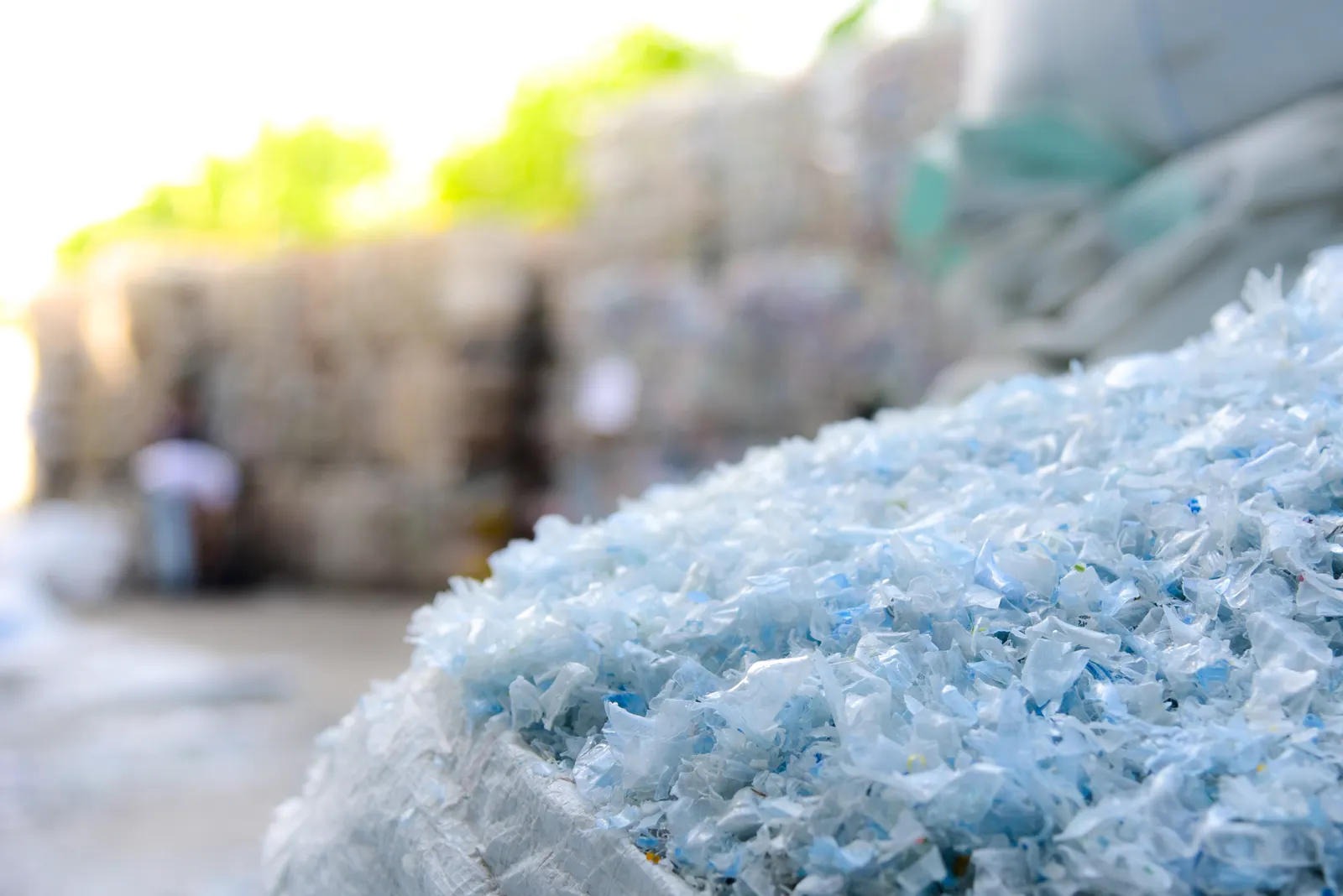
While EPR programs will prompt collection of larger volumes of plastics, Bailey cautioned that collection is only part of the equation — domestic processing capacity must be available, too.
“It's not just enough that we collect more recyclable plastic, but that it makes its way back into new products,” she said.
Collection and processing capacity need to be built out hand-in-hand, Carmichael noted, and “the industry will put in capacity if it has been determined that that capacity will be required.”
America first?
In an effort to do just that, the National Stewardship Action Council introduced its ReMade in America pledge. It asks businesses to sign on and “commit to using recycled content recovered and remanufactured by our recycled materials industry — turning what was made in America into what’s remade in America.”
NSAC CEO Heidi Sanborn said that the oversupply of rPET from Asian companies will prevent California’s EPR law from being implemented correctly and “we’re in a crisis.”
The glut of material is “completely undermining our existing infrastructure and American companies,” Sanborn said, and companies “which say they want to make things in America and support America first, are buying Asia first.”
Already, infrastructure is being lost, she said, pointing to recent facility closures, and once it’s gone “we will not get it back in any short order.”
There has been some good news globally with domestic recycled content legislation and incentives adopted in Brazil, France and Colombia, Bailey said, and APR is looking to mirror that success in the U.S. However, U.S. processors are struggling to build out needed infrastructure amid the uncertain rPET market.
“We should be complaining we can’t build facilities fast enough and instead we’re saying, ‘Hey, I can’t go to the bank and get a loan and add more capacity because my buyer backed out, or my buyer is now buying from Thailand,’” Bailey said. “It's not just about: can we keep the industry where it is? It’s: This is a time where we need to be growing the industry because states have invested in growing recycling.”