Dive Brief:
- The American Forest & Paper Association on Monday filed to join a lawsuit, initiated by the National Association of Wholesaler-Distributors, that challenges Oregon’s extended producer responsibility for packaging law. AF&PA “requested the same temporary pause the court granted NAW,” the group said in its announcement.
- In addition to AF&PA, other groups filed motions on Monday to intervene and for a preliminary injunction, including the Northwest Grocery Retail Association and the Oregon Business and Industry Association (OBI).
- NAW first levied the lawsuit last July. In February, the group secured a preliminary injunction blocking enforcement of Oregon’s packaging EPR program against NAW members specifically, at least until a trial.
Dive Insight:
There’s been much speculation that NAW’s action could lead to follow-ons in Oregon and other EPR states.
The challenges to Oregon’s program come as Circular Action Alliance, the producer responsibility organization in the state, is already re-investing in recycling enhancements. Following NAW’s preliminary injunction, CAA had clarified that everything else was moving forward as planned.
Oregon launched its first-in-the-nation packaging EPR program last year and CAA began collecting producer fees. According to a mid-February update from CAA, the organization had already contributed $19.5 million to support recycling facilities, distributed $3.1 million to communities for contamination reduction programs, and ordered more than 50,000 recycling carts and 14 trucks for communities that lacked access to recycling services, among other actions.
CAA’s reporting deadline in Oregon this year — May 31 — aligns with initial reporting deadlines in multiple other states launching packaging EPR programs. The annual supply report covering calendar year 2025 will inform Oregon’s program in 2027.
In Oregon, the per-pound fees for paper and fiber products are largely lower than for other substrates, according to the 2026 producer fee schedule from CAA.
“Paper’s strong recycling track record demonstrates that effective systems already exist. AF&PA continues to urge policymakers to support recycling policies that are fair, effective, and grounded in data,” President and CEO Heidi Brock said in a statement Monday. According to AF&PA’s revamped methodology for recycling rates, an estimated 69% to 74% of cardboard was collected in the U.S. in 2024.
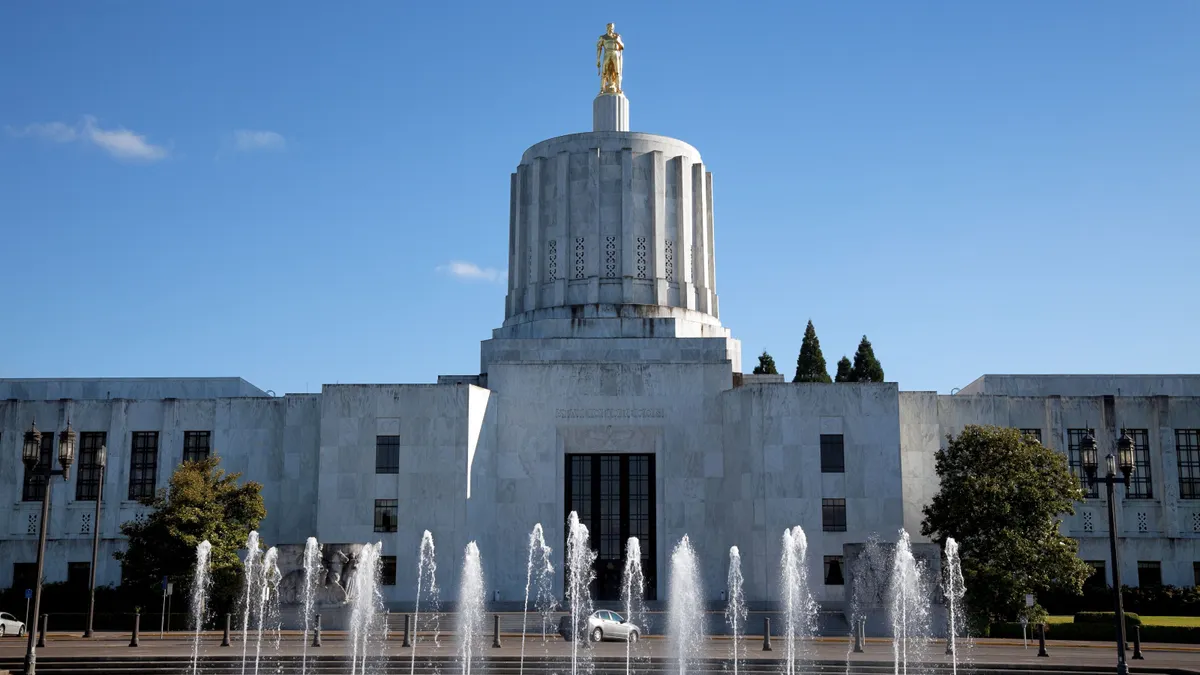
The Oregon Department of Environmental Quality, which oversees the Plastic Pollution and Recycling Modernization Act and is a key defendant in NAW’s lawsuit, responded in February to the court’s decision on NAW’s preliminary injunction.
“Oregon is known as a leader in recycling and is the first in the nation to implement this approach to recycling that brings many parties together to share the costs of recycling improvements,” said DEQ Administrator Jen Parrott, noting that EPR programs “are prevalent in Oregon and around the world, and we’re certain it can work for recycling.”
AF&PA previously sought exemptions from the program, including for paper bags, B2B cardboard, tertiary cardboard and printing and writing paper. DEQ recommended against those exemptions.
In a separate ongoing exemptions pursuit, OBI has backed an amendment bill in the Oregon House that seeks to carve out new exemptions for certain food packaging.
As far as next updates in the NAW lawsuit, the court requested that NAW “substantively” respond to defendants’ earlier motion for reconsideration by March 20, and final reply is due by April 3. Following AF&PA’s motion for intervention, the defendant is asked to respond by March 23.
A five-day court trial was previously scheduled to begin July 13.