Dive Brief:
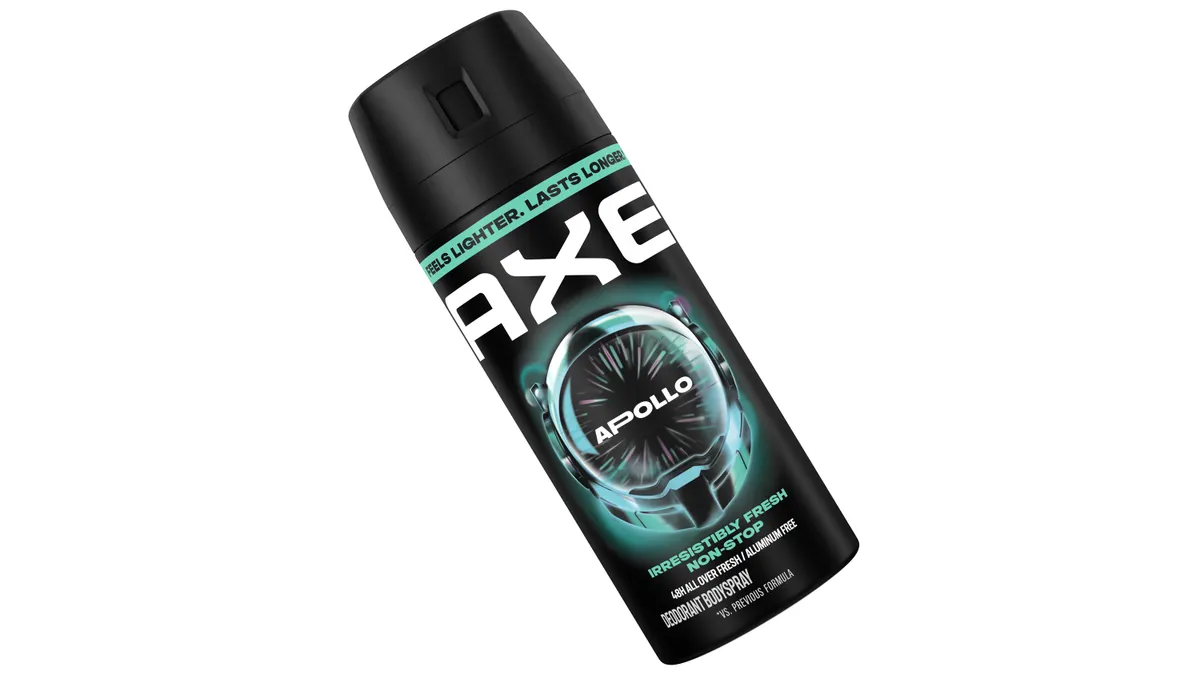
- Unilever brand Axe last week introduced a redesigned aerosol can with a patented system that provides a more controlled, lighter application of its body spray. The new design prevents overspraying and enables 10% more product sprays throughout the can’s life.
- An in-house team reworked the individual components including the valve, aerosol actuator and spray insert, “which really focuses on the pattern that it releases so that you get that more targeted application,” said Brajin Vazquez, Unilever deo formats technology senior manager.
- These next-generation Axe cans began hitting U.S. Walmart stores last week and soon will replace all legacy cans nationwide.
Dive Insight:
The revamped can launch coincides with Axe’s new marketing campaign, dubbed “The History of Overdoing It.” It centers on the redesigned sprayer’s targeted application while providing a humorous nod to the brand’s legacy reputation as a body spray product that teens and young men sometimes overapply.
Unilever first launched Axe in 1983 in France, with the United Kingdom and other European markets soon following. Introduction to the United States market occurred in 2002.
The new aerosol can propellant technology is the “first time we've changed the spray in almost two decades. So it's really significant for us,” Vazquez said. “It was definitely time to bring kind of a new generation of technology.”
The packaging materials largely remained the same: aluminum can, plastic actuator and a valve with both aluminum and plastic components. However, designers changed the material for the rubber gasket inside the valve to be compatible with the new ingredients in the reformulated body spray, Vazquez said.
“That is really important for us to get an airtight lock when the valve is crimped up,” he said. “It all has to work together in synergy.”
The R&D team working on the can “rebuilt it from the inside out,” Vazquez said. But at the same time, any changes had to be based on consumer testing and feedback “so that our loyal users wouldn't feel like we were changing their product in a way that they really were not looking for.”
The can is the same height and diameter as the previous version, but the fill weight is different due to the new spray technology. The updated system’s propellants include nitrogen, which is very lightweight.
“One of the very interesting behaviors of nitrogen gas is ... it fills the same amount of space within a container as other propellants, but it has a molecular weight that's almost five times lighter,” Vazquez said. “What we've seen is actually that if our old generation product had a 4-ounce fill weight, our new generation has a 2.9-ounce.”
The system’s targeted spray pattern isn’t as heavy, so the user won’t feel as wet after application. And the product isn’t delivered as widely.
“They’re going to apply it directly to where they need it,” Vazquez said. “Our consumer testing showed that our Axe users said that they were seeing superior performance on fragrance delivery and application with the new generation [aerosol can] versus the previous.”
User experience was at the forefront of the design team’s minds during the rework, Vazquez said, noting the consumer benefits of the lighter mist: “A lot of it is enabled by packaging.”
“We changed all of these parts of the packaging technology, which a consumer — unless they're into the trade and understand packaging development — would really not know or have appreciation for,” Vazquez said. “But that’s OK, it doesn’t matter. It's all about how much they enjoy the product experience at the end of the day.”