Cascades recently released its fifth sustainability plan since 2010, a road map for 2026 through 2030 with 10 measurable targets. The Canada-based fiber specialist says it’s doubling down on closely aligning sustainability efforts with its own business objectives, its capacity to assist customers with their sustainability goals and vetting suppliers’ sustainability credentials.
According to Mélanie St-Pierre, corporate director of sustainable development, “financial materiality served as a foundation for prioritizing the topics covered, ensuring alignment with the company’s overall strategic priorities,” she stated in the strategy. “In this context, risk assessment and mitigation are now integral to our priorities, reflecting the growing importance of ESG risks in organizational practices.”
In the 2025 sustainability report featuring the company’s recent results, CEO Hugues Simon acknowledged progress in the face of geopolitical uncertainty and economic turmoil driven by tariffs between the U.S. and Canada. “While this instability led several companies to question their commitments to sustainable development, Cascades chose instead to reaffirm its leadership and values,” he said.
Hugo D’Amours, vice president of communications and public affairs for sustainability and environment, noted learnings from the 2021-2025 plan as to how environmental, social and economic factors integrate in business decisions — considering not just lower environmental impact, but “operational resilience” and “procurement security,” he said.
Packaging circularity
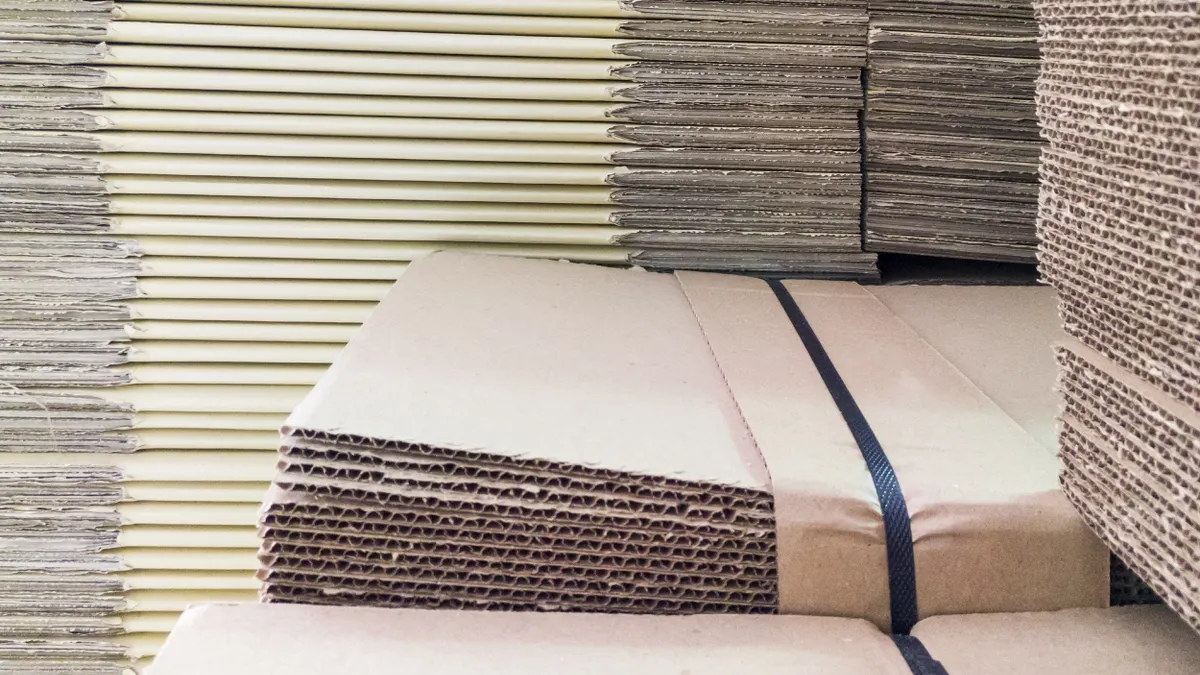
As its primary circularity target, Cascades continues to strive to make 100% of its packaging — which includes molded pulp products and cardboard boxes — recyclable, compostable or reusable, now by 2030. While 2025 goals were pegged to a 2019 baseline, updated 2030 goals are now pegged to a 2025 baseline.
According to its 2025 sustainability report, the company progressed on that target from about 91% in 2019 to nearly 98% in 2025. Regarding the remaining gap in recyclable packaging, the company related this to plastic food packaging and waxed boxes used in the produce sector. Cascades said it’s working to develop alternative coating solutions that create moisture resistance while maintaining recyclability and pulpability.
But in the 2026 sustainability plan, Cascades adjusted data, indicating a bigger gap. It shows that about 88% of products met the threshold, due to excluding joint ventures with Sonoco from the scope of the targets.
Cascades also said it’s working to improve product data from sheet plants. “Therefore, all products from these facilities are, for now, considered non-recyclable, non-compostable, or non-reusable, following a very conservative approach. We will work to improve our visibility on these products over the coming years, which could increase significantly our annual result,” the company reported.
Its other targets include continuing to reduce greenhouse gas emissions, making available the detailed carbon footprint of all “priority products,” and ensuring that 85% of its spend is with suppliers that meet Cascades’ ESG requirements.
As of 2025, Cascades’ vetting of suppliers involves signing a code of conduct alongside purchase agreements, plus potential assessment by EcoVadis.