Packaging companies’ attitudes and actions on leveraging generative AI are changing fast, according to recently released results from a McKinsey survey.
“It is truly becoming a big focus area,” said Partner Abhinav Goel. “They are walking the talk in many ways.”
While there’s been plenty of buzz around the potential for artificial intelligence to transform material discovery, design for packages and their artwork, and end-of-life sorting, McKinsey’s most recent report explores how packaging companies are thinking about using it for commercial optimization. This could apply to sales and marketing, procurement, and supply chain and logistics.
The most recent survey of 110 senior leaders at packaging companies in the U.S. and Europe was conducted in August and September 2025. The firm reported that the survey covered all major substrates (flexible and rigid plastics, glass, metal and paper) and end markets (cosmetics and beauty, e-commerce, food and beverage, industrial products, pharmaceuticals and medical and retail).
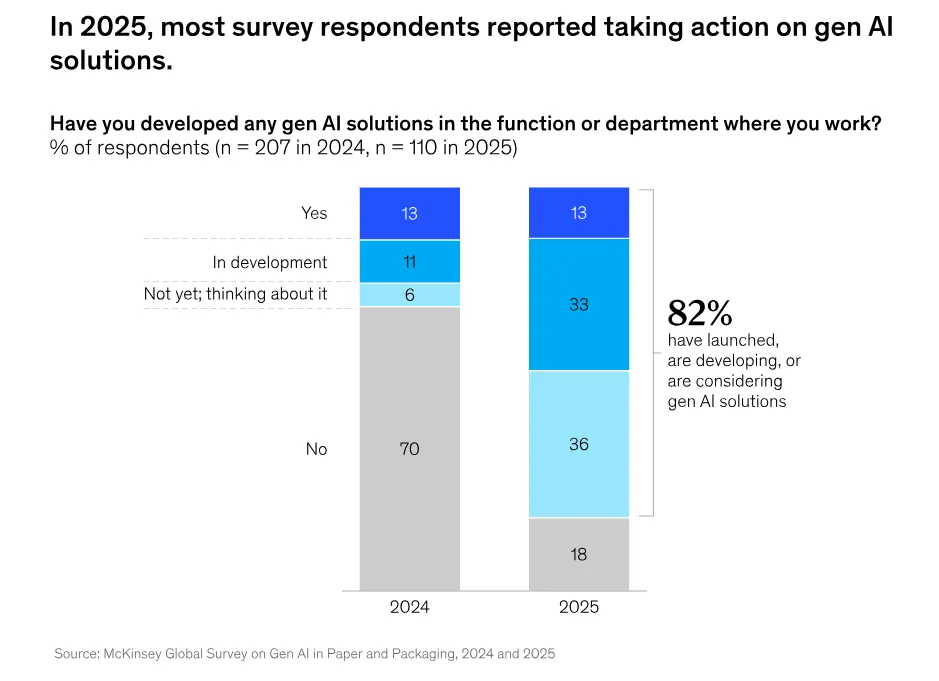
When McKinsey conducted a larger version of the survey in 2024, a majority of respondents reported not having yet taken action on gen AI solutions. Yet come 2025, a majority of respondents reported that they were considering, developing or had launched such efforts.
One area where AI could transform competition in the packaging space is with contracts and pricing.
AI is enabling more efficient and granular analysis of customer segments across different product types and time horizons, allowing companies to zero in on price points that make sense for different customers, Goel noted.
AI can also help analyze how a company’s product stacks up against competitors. “All of that used to be desktop analysis [and] through word of mouth and things like that,” said Senior Partner Gregory Vainberg. “Think about how much quicker that is with gen AI.” That competitive intelligence could be especially beneficial when bidding for contracts.
One factor that’s helped packaging companies advance more quickly is the growing understanding that they don’t necessarily need well-organized, structured data to start. “You could actually train your models on unstructured forms of data, contracts, websites, things like that,” Vainberg said.
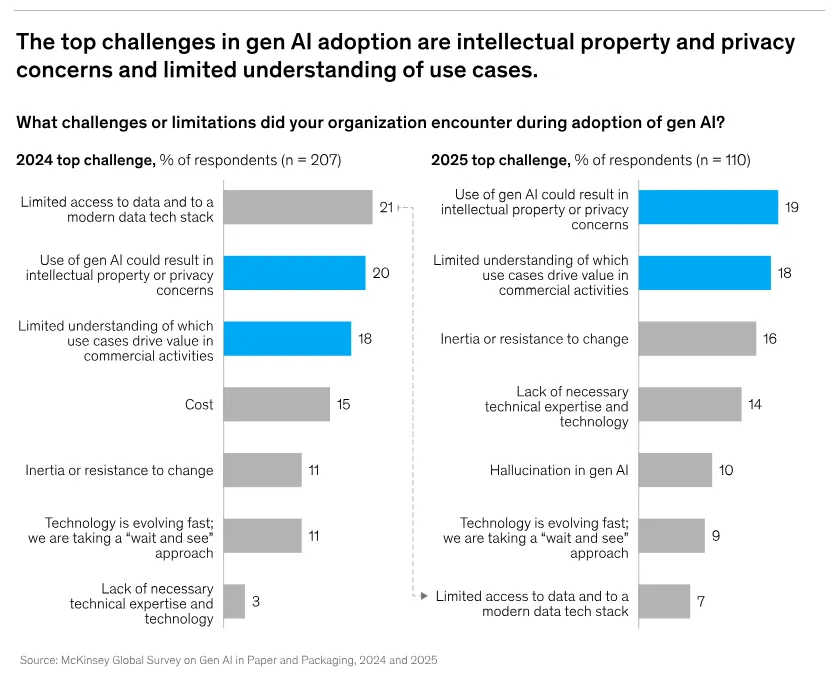
Still, other barriers to adoption remain. The most commonly cited ones are intellectual property or privacy concerns, as well as limited understanding of which use cases drive value in commercial activities.
So where are trends heading in 2026?
“Our expectation is that 2026 will be all about at-scale deployment,” Goel said, moving beyond episodic or opportunistic discoveries in 2025. “Companies will become more bold and will actually start rewiring their functions end to end.”
While it didn’t come up in McKinsey’s most recent report, AI is also expected to play a bigger role in managing data that has historically been scattered for applications like extended producer responsibility compliance and other tracking for sustainability metrics.
“Based on our research, we are seeing some early evidence of it, but we see a huge potential for it to go even more,” Goel said.