AUSTIN, TEXAS — Packaging sustainability is failing. Or it isn't. Or maybe it’s just changing.
Discussions about that hot-button topic unexpectedly wove through multiple sessions at The Packaging Conference this week after one of the first speakers, Tim Burns, senior advisor at Perella Weinberg Partners, declared: “We've been talking sustainability, we've been talking recycling, we've been talking composting, we've been talking all this stuff. The bottom line is: We're failing.”
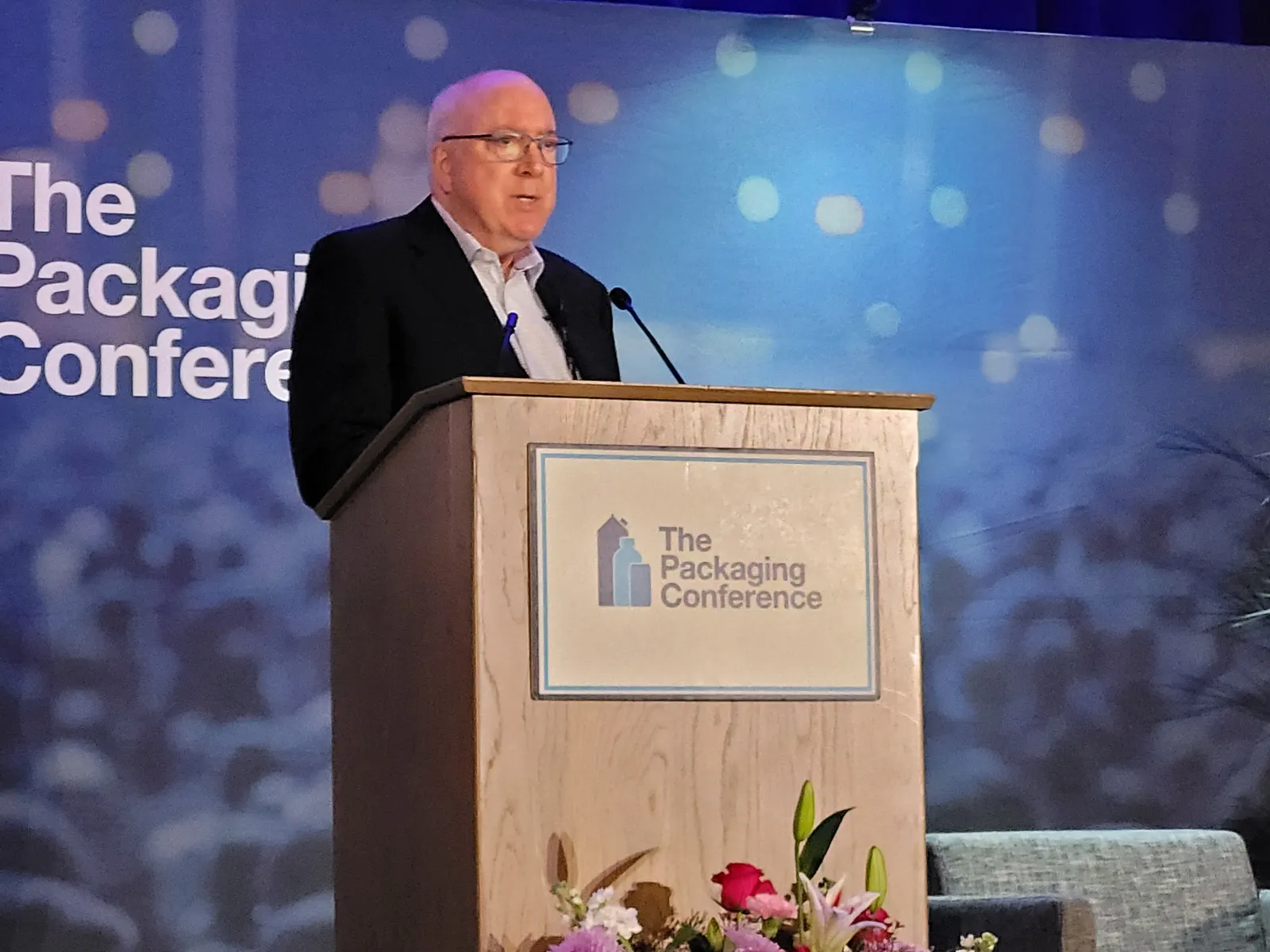
Burns made the claim during a session he co-led about M&A in the packaging industry, noting the impact of sustainability pursuits on material choices and sourcing — and the correlation to companies’ earnings and valuations. The claim largely centered on end-of-life management for plastic packaging.
He cited lagging material collection in both Europe and the United States. But he pointed to a winner among the losers: Japan.
“The recovery rate in Japan is not anywhere different from ours. But what they're recovering is the stuff that makes money for them, and can be done in the systems out there,” Burns said, adding that the country is “not afraid of incineration.”
“My argument is the Chicagos of the world, and New Yorks of the world, the L.A.s of the world, Houston, you name it: They ought to take on what Tokyo is doing,” he said. “I'd like to say we can pull out of [this failing position]. But I'm telling you right now: I don't see it. And I think the Japanese are doing the very best job.”
The wave of companies and organizations eliminating, reworking or extending the deadlines for their sustainability commitments hasn't helped perceptions of failures.
Still, multiple conference speakers suggested that sustainability isn't failing, per se, but rather it’s in a transitional period. Yet that idea, too, was up for debate.
“You won't like me for this, but I think sustainability is not just at a crossroads,” Burns said. “I hate to say it, but we're going to be in neutral for a long time trying to do the sustainability act that we're doing today.”
Transition, not demise
Reports of packaging sustainability's death may have been greatly exaggerated, if you ask other conference speakers. Some said companies have made progress toward their goals, but more work is still needed.
“We are indeed not good enough in terms of collection, carbon footprint, decreasing our energy usage, etc. So we need to continue working on all those elements to really demonstrate the efforts of the industry,” said Sandrine Duquerroy-Delesalle, vice president of global sustainability and external affairs at Crown Holdings, during an interview with Packaging Dive. “We need to continue working on all those elements to really demonstrate the efforts of the industry.”
Part of the ongoing work should be to get louder about championing what has been achieved, she suggested.
“At Crown, we've been doing a lot of work on commitments. We have the Twentyby30 program, and so far we are on track with the commitments,” said Duquerroy-Delesalle. “I think we need to probably better demonstrate what we are doing.”
Others were more emphatic in their opposition to Burns' characterization of sustainability as failing.
“I'm obviously biased, but I don't think sustainability is dead,” said Scott Byrne, vice president of global sustainability at Sonoco, during an interview with Packaging Dive. “I think sustainability is transitioning.”
Noticeable strategy shifts occurred in 2018 when a multitude of companies and organizations introduced sustainability targets, he explained, and again partway through 2023 when many realized they wouldn't achieve at least some of those goals pegged to 2025. Those recognitions prompted groups to rework their strategies over the last 18 months.
Numerous packaging companies recently have been transitioning from the first generation of sustainability awareness with voluntary claims to the next generation where compliance will be mandatory, Byrne said. The trend is driven by emerging regulations such as extended producer responsibility for packaging laws.
“There was friction in that transition. But certainly in the last few quarters, I've seen a lot more activity kind of bubble back up,” Byrne said.
While certain companies continue to focus on long-term goals like decarbonization, “I think those packaging-specific goals have changed a good bit, and they're much more specific,” he said. “Where before it was very gray, there was a little bit more area to play in some ways, now it's like you have to fit into a category.”
Other speakers also backed the perception of an industry evolving how it views sustainability.
“Fundamentally, we're transitioning from the idea of sustainability targets to results,” said Jesse Medlong, attorney at DLA Piper. “Not what would we like to see in terms of recycled content and recyclability, but how much is being recycled? How much recycled content is ending up in bottles, as opposed to through mass balance approaches?”
The verdict
So are packaging sustainability efforts actually dead?
Burns remained critical of plastics, noting that many companies have switched away from those packaging materials and toward substrates like fiber and metal that are often perceived as having more advantageous sustainability profiles. That's not the only factor, though, said David Ambrose, managing director at Perella Weinberg Partners.
“I would take maybe a slightly different spin on that. I think a lot of it is really going to come down to cost,” he said, noting that plastics are in a different pricing realm than fiber and metals. “Product shifts [are] going to come down to, what is the cheapest alternative that you can shift volume into sustainably?”
Regulation is another major driver of material costs, Medlong said. Still, sustainability innovation is happening with plastic packaging. For one, biobased materials — including corn starch, fungus and chitin, a material in shrimp shells — continue to emerge as alternatives to fossil-based plastics.
“Plastic innovation, I don't think it's dead yet,” Medlong said.
Softening his stance a bit, Burns said, “It's not recognized, but innovation continues.”