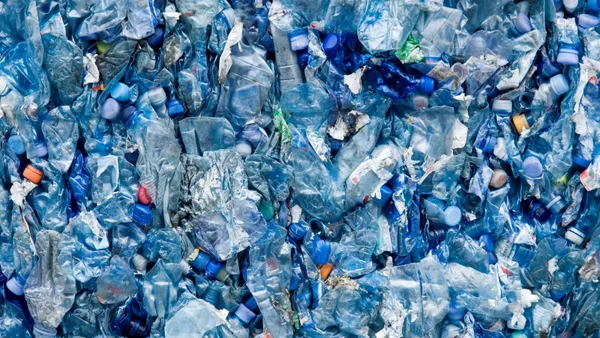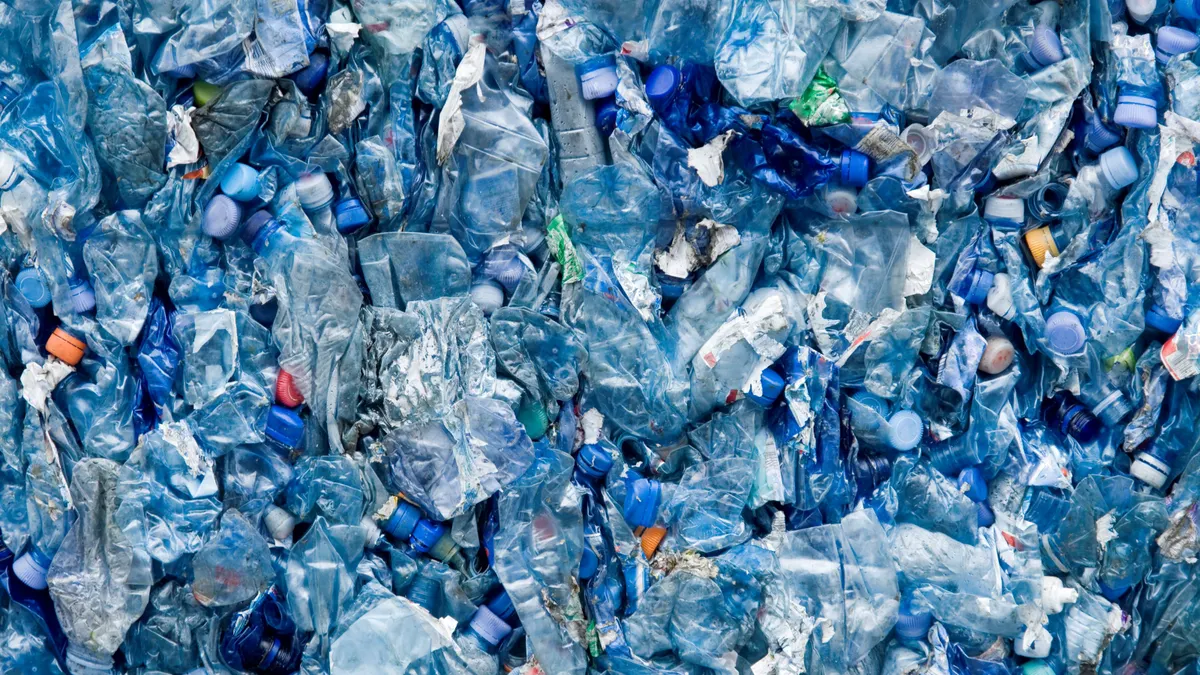

The PET recycling system in the United States continues to face mounting pressures, and trade disruptions due to the conflict between the U.S. and Iran are not likely to offer favorable price changes in the long term, said speakers during an rPET market webinar hosted by The Recycling Partnership on Thursday.
Recyclers and reclaimers continue to grapple with weakened end market demand due to cheaper overseas imports and stiff competition from virgin resin prices. This prolonged pressure on the rPET industry is leading to further reclaimer closures — most recently two Evergreen facilities in New York and Ohio — and could prompt MRF operators to consider stockpiling or landfilling as a result, speakers said.
The industry knows how to collect, sort and process recycled plastics into flake and pellet for sale to end markets, said Kate Bailey, chief policy officer for the Association of Plastic Recyclers, during the webinar. The issue, she said, is that those end markets aren’t buying domestically sourced postconsumer rPET.
Speakers urged packaging producers to prioritize domestic sources of recycled PET in products and pointed to market drivers like recycled content mandates and extended producer responsibility policies to maintain market demand. And, in the short term, producers of packaging like thermoforms could be encouraged to use more domestic rPET in products, they said.
“We need buyers. That’s where the system is breaking down,” Bailey said.
Continued cost imbalances and foreign import effects
North American rPET markets continue to battle against two main price factors: the very low price for virgin resin and the increase in imports of rPET from overseas.
“There is more new virgin PET plastic being produced than there ever has been in the history of the world,” and it’s being sold at notably low prices, Bailey said. “The price of virgin PET earlier this month was the same price it was in 2019,” she pointed out. “At the same time, PET recyclers are all facing increased costs, and yet we’re competing against an industry that has somehow gotten cheaper over time.”
Pete Keller, vice president of recycling and sustainability at Republic Services, noted that the recent conflict between the U.S. and Iran has restricted shipping lanes in the Strait of Hormuz, which may create ripple effects that drive up import costs for virgin resins, making costs more competitive for recycled resins. But speakers noted that such international trade factors are likely temporary, and more permanent market drivers are needed.
At the same time, some major brands are still buying recycled PET to meet recycled content commitments in packaging. But many companies have been choosing imported sources over domestic options, which further destabilizes the domestic market, speakers said. rPET imports now account for about 25% of the market, according to data from NAPCOR.
Reclaimer closures and market interruptions continue
Prolonged challenging market conditions have led to the closure or partial closure of seven of the 30 major PET recycling facilities in the country in the last year, said Adam Gendell, director of material systems at The Recycling Partnership. Recent reclaimer closures have reduced domestic recycled PET capacity by about 25%.
Evergreen Recycling announced the closure of two of its facilities in February: one in Albany, New York, and another in Clyde, Ohio, which was expected to affect a combined 247 workers.
Other reclaimer closures this past year included Alpek’s Fayetteville, North Carolina, facility in July; rPlanet Earth, which closed in California in September; and Phoenix Technologies’ Ohio facility, which closed in December. Another of Alpek’s PET facilities in Pennsylvania closed in January.
Each disruption affects the PET recycling market in different ways, Gendell said.
“These facilities are not all the same. They're not interchangeable. They have very different characteristics. Some of them are designed only to touch PET from those deposit redemption programs. Other facilities are equipped to handle curbside,” he said.
These closures had varied regional effects, he added. PET reclaimer capacity in California is down 30%, with just four reclaimer locations left in the region. Only one of those facilities is equipped to handle curbside PET, with the rest taking mainly recycled PET that comes from container deposit programs, Gendell said.
In the Northeast, overall capacity is down 40%, while two-thirds of the curbside PET capacity is now shuttered, he said.
MRFs are managing supply and stockpiling possibilities
Without market changes, recyclers may face the “regrettable option of stockpiling material to wait for better times,” Gendell said. “We also know that the market is at a critical point now, where, if it goes any further, we are going to see risk of landfill PET,” which would create public distrust in the recycling industry and drastically reduce recycling rates for the material, he said.
Companies like WM have spent millions of dollars on MRF investments in recent years to be able to collect and sort a higher volume of recyclable materials, including PET.
“We’re taking in more [recyclables] than we ever have before in the history of WM, so that’s the good news,” said Brent Bell, vice president of recycling. “But on the PET side alone, we move about 700 loads a month, so that's about 700 trucks in a month that have to find a home.” Bell did not say whether WM would need to stockpile PET long-term, but noted that each time a reclaimer closes, “that puts more pressure on this system.”
Meanwhile, at Republic Services, Keller agreed that material management for collected PET is becoming a bigger factor, though he said his company’s vertical integration puts it in a “singular position” in the PET marketplace.
Republic processes curbside bales at about 80 recycling facilities, and its two polymer centers process that material into clear, hot wash flake. “We're as integrated in the space today as anybody, from curbside collection all the way through pellet production. It’s traceable, transparent, 100% postconsumer domestically sourced,” he said.
Volumes continue to increase at the polymer centers, and the company is on track to build its third location in Allentown, Pennsylvania. But challenging market conditions led Republic to announce during a recent earnings call that it would temporarily pause plans to build a fourth polymer center.
Short and long-term remedies needed
Though no one single solution will be able to magically turn market conditions around, urgent interventions are needed, speakers said. One place to start? “I think the thermoform segment deserves more attention,” Gendell said.
Thermoform manufacturers can run on flake, which is a less processed and cheaper rPET form than bottle‑grade pellet, “so for short-term solutions, it’s hard not to look at the thermoforming community as one that could be doing more,” he said.
Thermoforms once used a much larger share of rPET in North America — between a quarter and a third of rPET about a decade ago, he estimates — but that share has dropped to about 10% today. “We don’t know what share of that 10% comes from overseas,” Gendell added.
Speakers reiterated that brands also need to commit to choosing domestic sources of rPET to meet recycled content goals. Keller said there’s a mismatch between brand owners’ interest in recycled content and the resulting sales. “They're interested in the transparency, the traceability, the domestic supply. But they haven't figured out how to value it,” he said.
On the policy front, Bailey said the U.S. could also look to inspiration from regions like the EU, which encourage packaging producers to purchase domestic sources or from facilities abroad that meet equivalent labor and environment standards. In addition, adding certification and traceability elements to the domestic rPET trade is an important future step to ensure that imported PET labeled as recycled content can truly be verified as such, she said.
The continued rollout of EPR programs in seven U.S. states is also expected to funnel more recycled PET into the system, yet the systems for turning the material into new products are shrinking.
“Minimum content requirements are the best tool we have in our toolbox to solve this problem,” Bailey said, noting such requirements are already baked into EPR laws in places such as Colorado and Washington. “EPR also has bonuses in the form of ecomodulation incentives that can reward producers for buying more recycled content.”
Recycled content mandates typically include penalties for brands that don’t comply, but Bell said those penalties may not be enough to drive brands to change their procurement practices.
“Sometimes it could be so immaterial that a business person would say, ‘just pay the fine and move on,’” he said. “Folks need to understand the economic gap that the brands are challenged with right now… a $100,000 penalty is not going to hurt them and it doesn't drive incentive. You've got to get some policy that really drives behavior changes if you want the domestic, recycled PET markets to survive.”