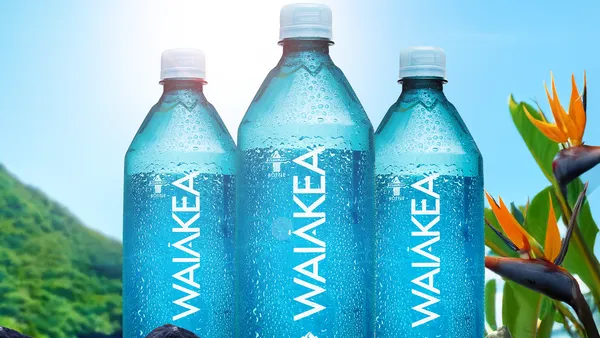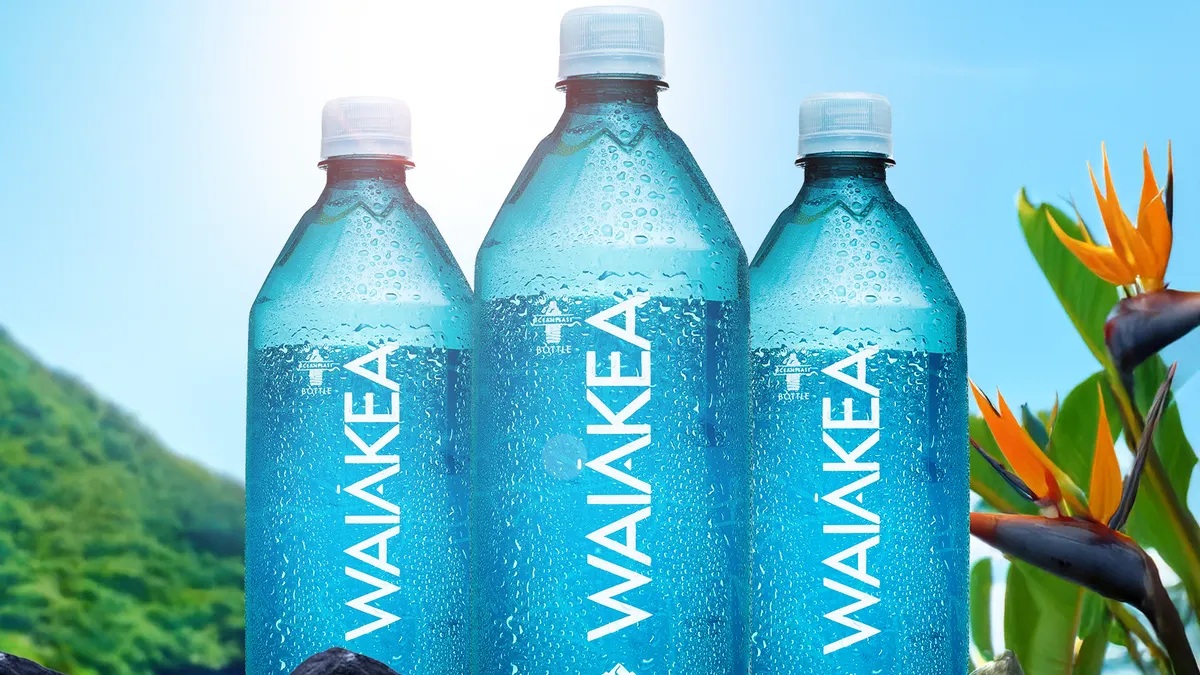

Waiākea Hawaiian Volcanic Beverages wants to be more than just a bottled water and small batch coffee company, with an aim to revolutionize how the beverage industry approaches sustainability.
After becoming the first beverage company to use 100% postconsumer recycled plastic in 2012, it's now pioneering another first more than a decade later: labels printed with algae-based ink. Hawai'i-based Waiākea said it's the first in the world to implement and commercialize labels with the pigment, which was developed after four years of research in partnership with Living Ink Technologies, Actega and NextGen Label Group.
“For us, innovation extends far beyond the traditional sense, where we’re always at the drawing board, coming up with creative products or marketing solutions,” Waiākea CEO Ryan Emmons said in an email. “Our goal is to use Waiākea as a catalyst for change and better standards for not just bottled water but beverage and CPG overall.”
Traditional carbon black-based ink is derived from petroleum, and a significant portion of the 33 billion pounds produced each year is used in printing, Waiākea said. It's also commonly used as a colorant in black plastic packaging. If the global supply of black pigment were replaced with Waiākea's ACTExact UV Black Algae Ink, it would be the equivalent of taking roughly 25 million cars off the road, the company said.
Waiākea is declining to maintain exclusivity or intellectual property rights over the technology, instead open-sourcing the ink through its partners and giving brands across industries access. It plans on scaling additional pigments over the coming years.
Waiākea's project partner Living Ink has extensive experience in the algae-based ink space. Last year it worked with EcoEnclose to provide the algae-based and CMYK-compatible ink for boxes of Crocs shoes, in what the partners called a “first-of-its-kind commercial application.”
The company has also described testing feedstocks other than algae for its ink, such as spent yeast and grain from beer fermentation and biomass from pharmaceutical fermentation.
Emmons, who founded Waiākea in 2012 with his cousin Alex Preston and friend Matt Meyer, said the company created the first commercialized recycled polyethylene terephthalate (rPET) bottle. It also developed a tracking software to help minimize its products’ transportation footprint.
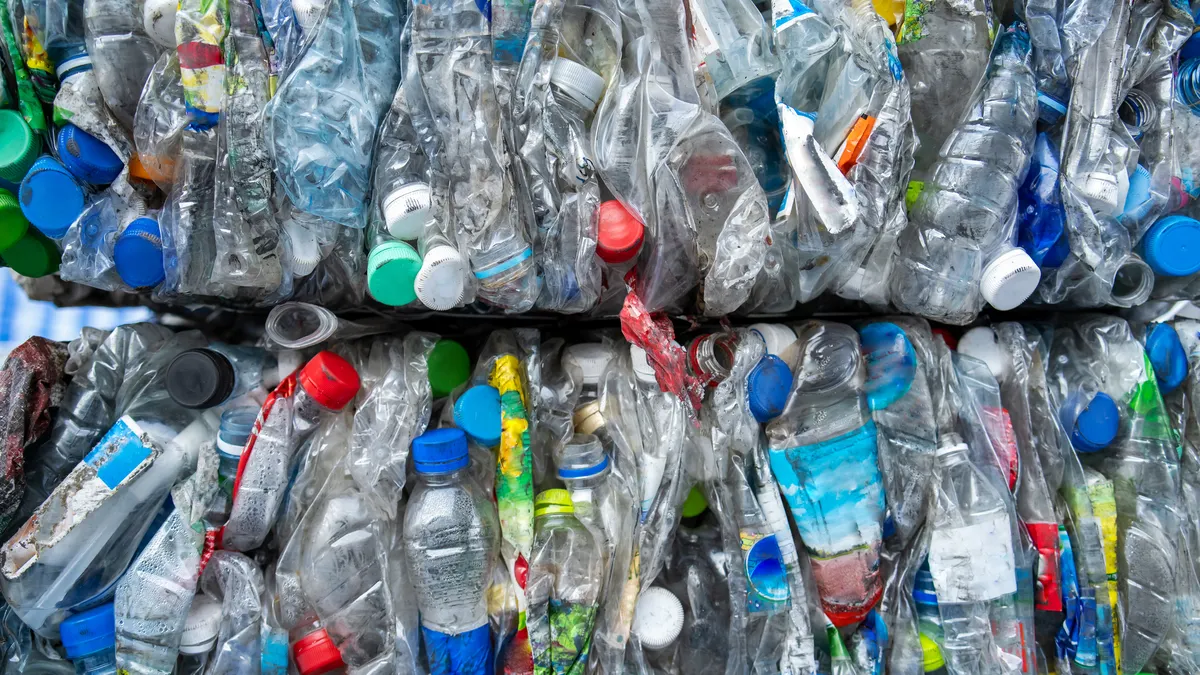
The material for Waiākea’s Oceanplast bottles comes from coastal communities, which Waiākea said means the plastic is at high risk of entering the ocean. The plastic is cleaned and broken down until it's transformed into the rPet pellets which ultimately gets remade into new bottles.
Bottled water is the largest beverage category by volume in the U.S., and is largely dominated by Perrier, Aquafina and Dasani.
While other upstarts have tried to make inroads against these competitors by focusing on functional ingredients or other unique features, Waiākea is looking to stand out with sustainability. Later this year, the company also plans to launch a limited glass line with recycled content designed for reuse, Emmons said.
“We really want to establish ourselves as the enviro-tech leader of our category,” Emmons said.
While sustainability is a main focus, the brand also incorporates electrolytes and other hydration benefits trending with consumers. The water is naturally filtered through 14,000 feet of porous volcanic rock, making it alkaline and electrolyte-rich.
The company sells regular and sparkling water as well as small batch coffee in 45,000 retail locations across the continental U.S. and Hawai'i. The brand is eying international distribution in Australia and Japan.
At the beginning of the year, Waiākea closed an $11 million funding round, which included investments from a group of professional athletes including Tetairoa McMillan of the Carolina Panthers, Devin Williams of the New York Mets and Jerami Grant, formerly of the Portland Trail Blazers.
Waiākea’s other athlete investors include Aaron Judge, Myles Garrett and Klay Thompson, plus a slate of Hawai'i-based players. Partnering with athletes allows the company to reach customers it wouldn’t ordinarily who also share the company's sustainability mission, Emmons said.
Waiākea has consistently doubled down on its sustainability practices even as more companies are keeping them quiet in a polarizing political climate. Emmons said the company’s sustainability efforts are a reason consumers choose the brand, because they want a product that matches their values.
“It's a lot easier to stay consistent when it's baked into your company’s ethos vs. when you are a large public company that focuses on quarterly earnings,” Emmons said.
Katie Pyzyk contributed to this article.