A type of bioplastic that’s been decades in the making in Massachusetts is starting to scale, thanks in part to investments from a South Korean food company.
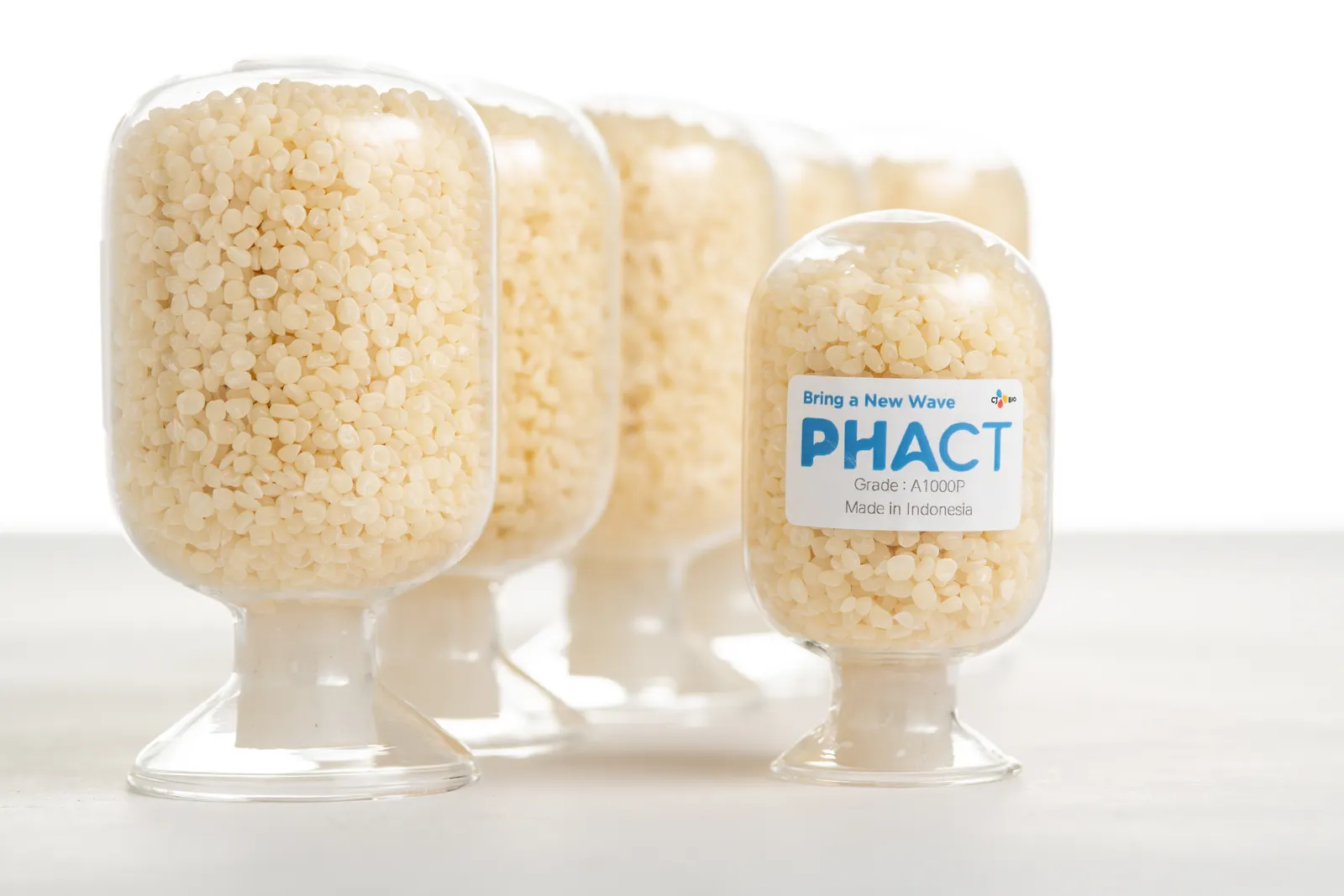
CJ Biomaterials, part of the global CJ Group, has ramped up investment in its proprietary blend of polyhydroxyalkanoates, known as PHACT, with an eye to the packaging market. The company’s evolution illustrates how complex it is in bioplastics to prove commercial viability, get to market, convince composters to accept products and then scale adoption among packaging companies and their customers.
The product traces it roots back to a startup called Metabolix, founded by Massachusetts Institute of Technology students in the early ‘90s, which used fermentation and bioengineering to create a product that could replace conventional plastic. While Metabolix made a lot of headway, including commercialization of the technology in the early 2000s, the company didn’t reach full viability and sold its technology to CJ Cheiljedang for $10 million in 2016.
“Looking back on it, the technology was 15 years too early, but it really grew from a lab project to a commercialized product,” said Max Senechal, chief commercial officer at CJ Biomaterials and a former employee of Metabolix, during a recent facility tour. “CJ was already a very well-established biotechnology player — not in PHA, in other industrial products — but they were able to take all that experience and really bring that into the PHA platform and bring it to the next level.”
This helped evolve the strain engineering and fermentation technology itself, and bridge the cost delta with petroleum-based plastics.
“There were things at Metabolix that we thought were established science, theoretical yields, theoretical performance that would not be exceeded based on what we knew the science was at that time. ... Fast forward to today: We've blown through some of these things,” he said. “We're no longer four or five times more expensive. We're getting much closer.”
Bioplastics pivot
CJ didn’t initially put a major emphasis on its acquired PHA technology but has recently evolved its approach.
The company revived its focus in 2021, brought its first PHACT application to market in 2022 and launched a 5,000-metric-ton PHA production facility in Indonesia. Its first product was amorphous PHA, which is considered unique to CJ and suitable for flexible packaging, straws and other applications.
In 2024, CJ also commercialized semicrystalline PHA, which can be used in cutlery and other applications. CJ has found that both are best suited as a modifier to other materials — such as polylactic acid, or polybutylene adipate co-terephthalate — at a rate of anywhere from 10% to 30%. In some cases, PHA can also be paired with petroleum-based plastics such as PVC. CJ is still working on full PHA products that combine semicrystalline and amorphous PHA.
Amid this progress, the broader biotech sector remains challenging. Fellow PHA producer Danimer Scientific recently declared bankruptcy and sold to a competitor last year.
CJ also considered selling its broader biomaterials division, attracting plenty of investor interest, but ultimately said in April 2025 it would keep the business.
Soon after, CJ Biomaterials named a new CEO and made further product announcements. Some of its latest offerings include a PHA-based extrusion coating and masterbatch, as well as a non-packaging agreement to use PHA for infill at European artificial turf fields.

The company is also looking at ways to increase the use of PHA-based products in its own portfolio of food businesses, such as straws at CJ Group-owned Tous les Jours cafes.
Additionally, CJ has worked with the likes of South Korean convenience store chain CU to make PHA-lined ramen cups, Banila Co. to make cosmetic jars and Pregis to make film packaging for frozen foods.
Part of the company’s investment in the PHACT brand was a rethinking of Metabolix’s former facility in Woburn, Massachusetts, to focus on polymer science.
The site previously was set up for strain development and fermentation, but CJ moved those capabilities to its Blossom Park facility in South Korea. That site, which employs an estimated 800 people, works on a broad range of food and biotechnology research.
Senechal said the company previously did testing at the Korean facility and third-party labs, adding a lot of time to the development process. Now that cycle has shrunk from six months to just one in some cases, which further helps reduce costs.
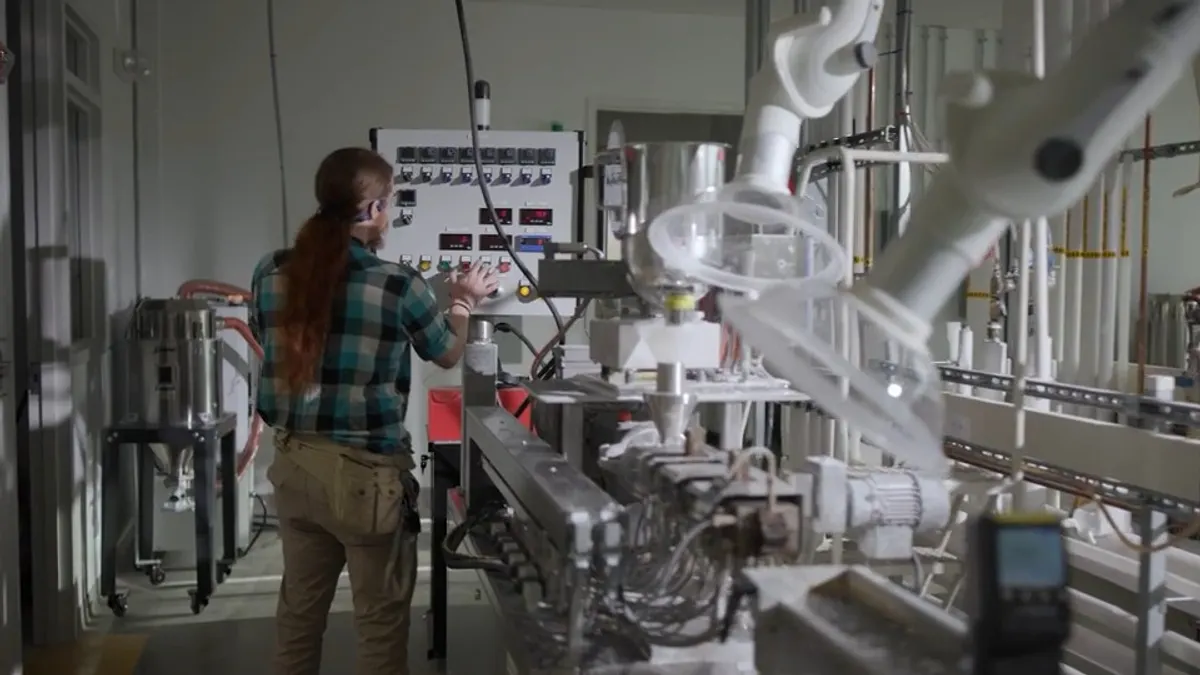
The Woburn facility now includes a twin-screw extruder with strand pelletizer; a mono-layer blown film line; an injection molding unit; and material and end-use property analysis capabilities. The site employs an estimated 32 people focused on polymer science, applications engineering and commercial sales.
“We needed a facility that allows us to show potential customers how to use this material,” said Senechal. “Brands have come here to see the product working. Converters have come here. Compounders come here. And then we help them set up processing conditions so that they can then more easily onboard the material in their facilities.”
Compostability and adoption
The growing landscape of extended producer responsibility for packaging regulations, as well as compostable packaging labeling requirements, has resulted in a unique moment in the biomaterials space.
CJ is a member of the Biodegradable Products Institute, which is asking the U.S. Department of Agriculture to update the definition of compost in a way that’s favorable to certain compostables. This week, the company signed on to a letter to the agency about this issue, along with numerous other packaging companies, trade groups and composters.
Meanwhile, upcoming enforcement of a compostable labeling law in California, as well as EPR for packaging policies in multiple states, could affect the market for these products.
While some people have said that brands’ initial EPR compliance focus should be on recyclability, and compostables can come later, CJ’s leaders believe their products can be part of the solution now.
“We're all in this for sustainability, and if we're only designing for recycling, we’ve missed the boat on food waste diversion,” said Leah Ford, director of marketing at CJ Biomaterials.
CJ hired Ford from NatureWorks in 2024, expanding its focus and expertise in compostables.
Ford added that unlike certain types of plastic packaging, which are increasingly in the news over toxicity concerns, compostables are often more heavily tested before hitting the market
“All of the screening on materials is done before it goes to shelves, before it goes to consumers,” she said, citing screenings for ecotoxicity, PFAS, heavy metals and other factors. “With recycling there's no pre-screening. It's only done at end of life.”
Both types of PHA, sold under the PHACT brand, are TÜV Austria-certified for home and industrial compostability, as well as for marine and soil biodegradability. The company also has a biodegradation testing setup in Korea where it can assess conditions before sending materials to TÜV for official testing.
Still, some composters don’t want to deal with compostable packaging due to concerns about how it could affect their finished product. Ford recognizes this concern, but said others have seen good results.
Massachusetts-based Black Earth Compost regularly works with CJ, and other companies, to test compostable packaging at its Manchester-by-the-Sea facility. Andrew Brousseau, a partner and compost manager at the company, said this involves three weeks of aerated turned pile processing to break down food and compostables.
“At that point, the material is pulled out of the building and run across a conveyor belt where the trash sticks out like a sore thumb against the black compost background. The concept here is ‘get the trash out while it’s still big,’ because if we wait until the screening process then trash has fragmented and is more work to remove,” said Brousseau via email, noting that CJ’s material “works great” in terms of compostability.
Proving this out to composters, regulators and brands will be key to CJ’s growth, especially as certain EPR ecomodulation structures could favor compostables in certain categories.
“Ten years ago, the challenge with our industry was the technology we needed to engineer microbes. We needed to find a way to scale it up to large industrial-scale production. And naively, we thought this was the battle,” said Senechal. “But then today we spend more time, effort, resources, on certifying.”