For years, U.S. extended producer responsibility for packaging fees were theoretical. Now, those costs are very real for businesses selling in Oregon and Colorado, with more reporting deadlines and invoicing on the horizon.
That paradigm shift demands new ways of communicating internally with corporate leadership: The Sustainable Packaging Coalition is rolling out a “conversation companion” tool to assist packaging and sustainability leaders as they seek buy-in.
It aims to help walk C-suite leaders through the costs of complying with EPR laws or recycled content mandates, as well as legal and reputational risks related to EPR compliance or greenwashing litigation.
“Today’s convergence of regulation, litigation risk, and product and supply chain transformation will require strategic business transformation and board-level oversight,” SPC outlined in the resource, noting that significant changes and lead times are required. “Leadership needs to understand the EPR fees they’ll pay for their packaging portfolios,” and how they can reduce those fees by moving toward different materials.
Risks that are obvious to packaging professionals may still be unclear to brands’ senior leadership. “Companies that treat packaging solely as a sustainability or compliance issue may find themselves locked out of key markets entirely, if they rely on packaging that is not considered recyclable in that market,” SPC wrote.
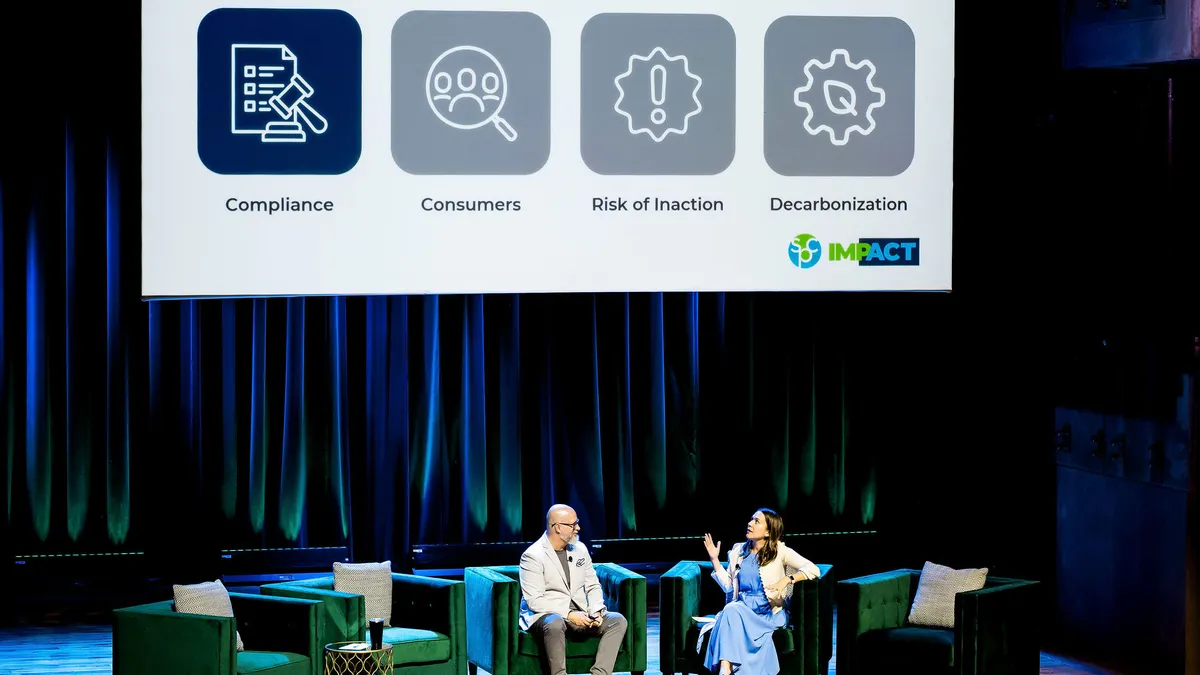
This moment is a huge opportunity, explained SPC Director Olga Kachook. “I firmly believe that if you can move packaging to the C-suite for the strategy to happen there, that's going to be the big win,” Kachook said on April 23 at SPC Impact in Nashville, Tennessee. So SPC is trying to equip the packaging community with talking points.
“The idea is to help you talk through when someone says, ‘We don't need to worry about EPR ... there’s all these lawsuits, it's not going to go anywhere,’” she posed. “What do you say when someone says, ‘Consumers don't care about sustainability, they're not willing to pay more.’”
Circular Action Alliance, the producer responsibility organization that’s setting and charging fees in numerous U.S. states, has seen budgeting elevating the packaging EPR issue.
“This has been one of the topics that has probably created the most escalation within our producers,” said CAA’s Geoffrey Inch, senior vice president of producer services, during a panel on the real impacts of packaging EPR laws to date. When it comes to budgeting and paying the bill, “the finance leadership wants to come in and understand this for the first time deeply.” Like SPC, CAA offered to be a resource if companies are struggling with internal messaging.
Inch said CAA is doing what it can to offer predictability where possible and assist businesses, despite companies’ varied calendar year and fiscal year systems. “We try to do our best to give several months notice for budgeting,” he said.
Producers have also started to learn which strategies are most useful in budgeting for EPR fees. Amanda Humes, director of packaging stewardship at Conagra Brands, offered advice from the frontlines.
“Do what you can to get the EPR fees onto the P&Ls for the products that are causing the EPR fees,” she said, versus creating a broader EPR bucket.
“It was a lot of work within our company to figure out how to actually take the individual EPR fees that are assessed on 2023 data, reported in 2024, paid in 2025” and place them accordingly. “But do what you can to do that, because if we are going to have to change our packaging design to lower our fees or to improve other EPR-related attributes, those individual brands and SKUs have to be accountable for those dollars,” she said.
SPC intends to expand the buy-in resource to address other forces shaping the case for sustainable packaging, including consumers, risk of inaction, and packaging as a decarbonization tool.