Dive Brief:
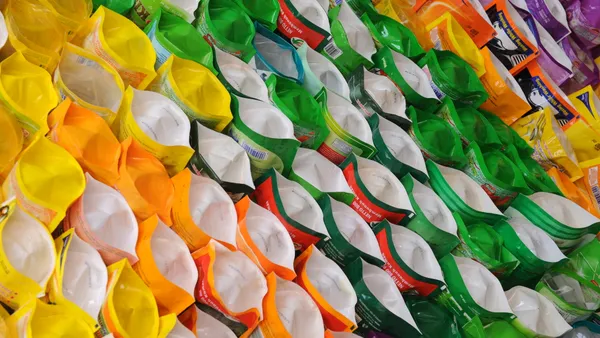
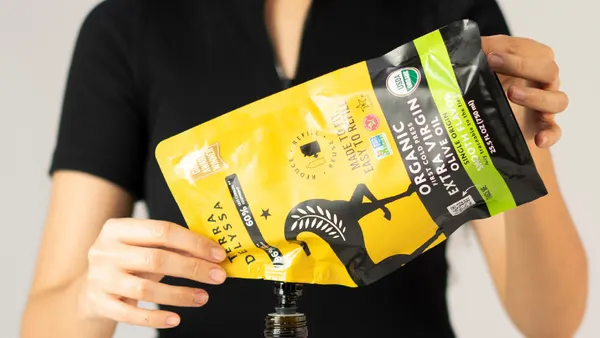
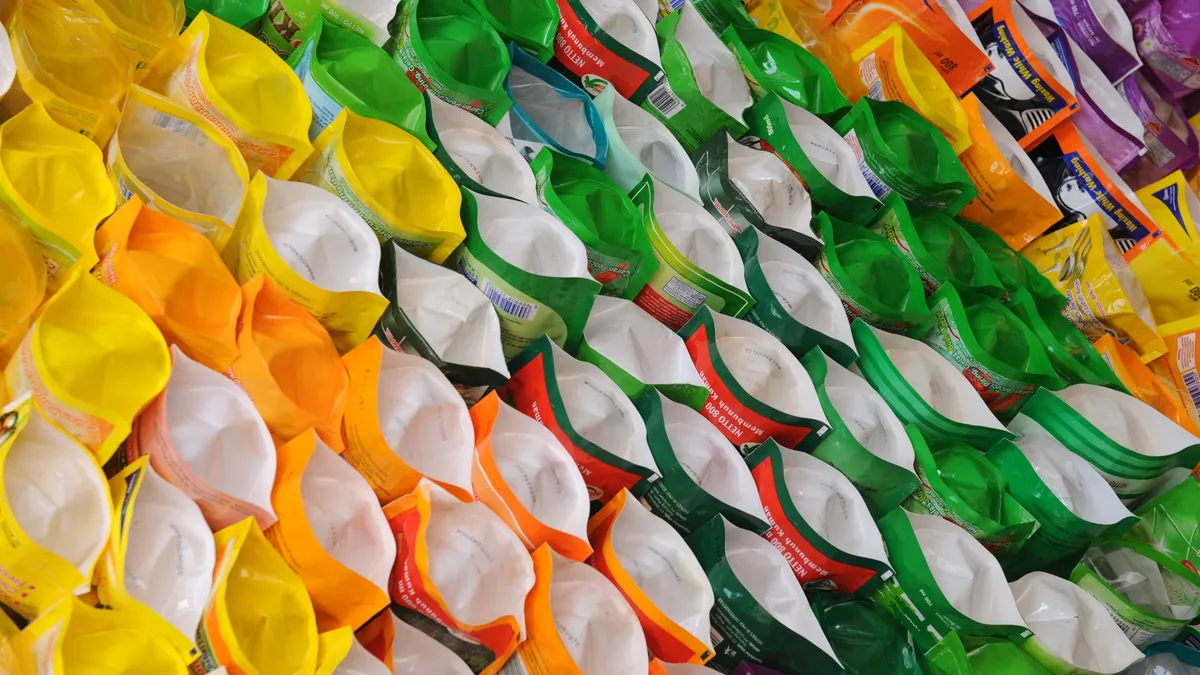
- Researchers are exploring how machine learning can play a role in advancing recyclable materials for multilayer film packaging, which is known for its performance benefits but is not easily recycled.
- An open-access article was authored by partners from across the Bottle Consortium and published in Nature Communications this month. “By challenging the status quo of MLF design, we advocate for circularity in food packaging, inspiring innovation at the intersection of sustainability, material science, and artificial intelligence,” the paper states.
- The process involves studying structure-property relationships of current multilayer film polymers. Properties of known polymers are fed into ML models such as PolyID to predict polymers, particularly polyesters, that have similar properties. Researchers concluded that “there is significant opportunity for computational tools to guide the development of next-generation MLFs,” but there are limitations, including a relative lack of public data linking polymer structure to performance attributes.
Dive Insight:
Researchers are considering a critical question: Is it possible to redesign multilayer films, which have been meticulously engineered to keep food fresh, with recycling in mind?
The consortium is working to ensure that multilayer film packaging could be managed through mechanical recycling, chemical recycling or composting, and is using machine learning and AI tools to drive redesigns, explained co-author Katrina Knauer, the chief technology officer for the Bottle (“Bio-Optimized Technologies to keep Thermoplastics out of Landfills and the Environment”) Consortium, a plastics recycling research initiative backed by the U.S. Department of Energy.
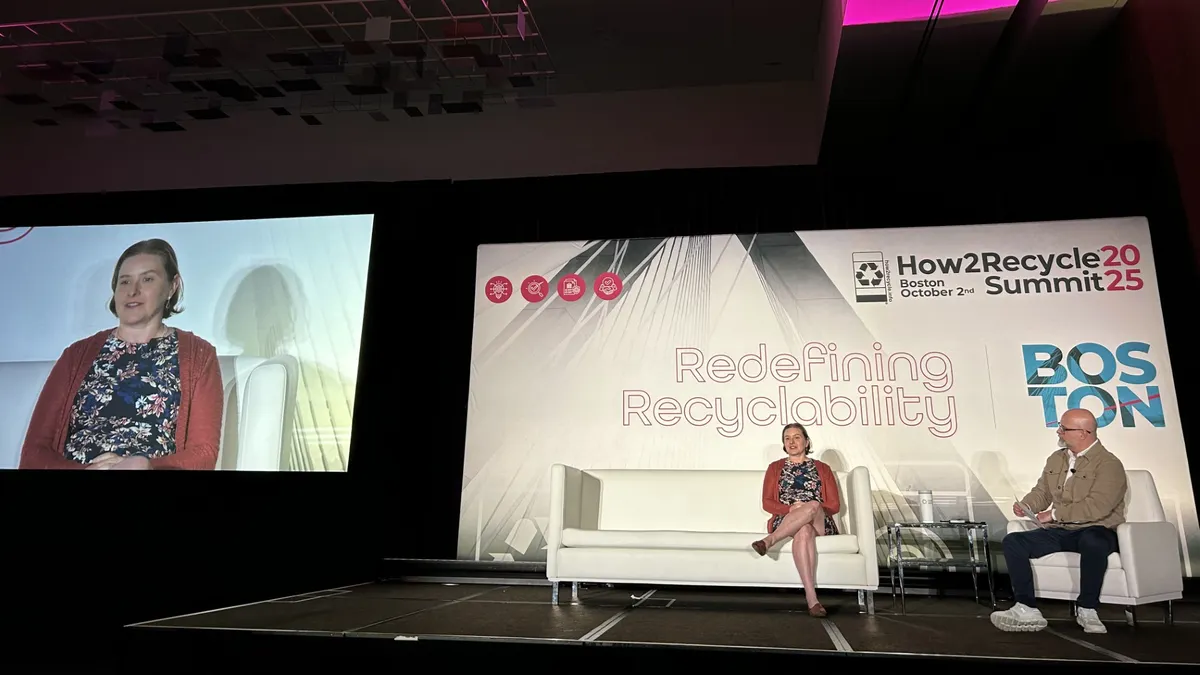
“We really wanted to get a combination of chemists, plastic processing engineers, machine learning experts, and then folks that are in the trenches working with companies and consumers to make recycling better,” said polymer scientist Knauer, a senior researcher at the National Laboratory of the Rockies.
Today, these films might include 10 or more discrete layers, the paper notes, including laminated polymers such as polyethylene (PE), polyvinylidene dichloride (PVDC), polyethylene terephthalate (PET), polyamides (PAs) and ethylene vinyl alcohol (EVOH). But there’s a central conflict with performance films.
“Such films, often composites of polymers and metalized species, integrate barrier layers for low oxygen and moisture permeation, structural layers for mechanical robustness, and tie layers that serve as the adhesive during lamination,” the paper states. “The complex engineering that has yielded such technological significance is ultimately becoming overshadowed by incompatibility with recycling pathways and damaging environmental persistence at end-of-life, both of which demand urgent attention.”
In trying to redesign, “the primary challenge is meeting the exceptional barrier performance provided by aluminum, PVDC, and EVOH (respectively and in combination),” the paper states. “These polymers are frequently incompatible when melt blended by mechanical recycling, and the physical separation of discrete layers remains functionally impractical.”
Yet chemical recycling isn’t a silver bullet, either. “Chemical processing technologies like selective dissolution and precipitation have demonstrated the effective separation and recovery of discrete polymer components of MLFs. However, these processes frequently yield polymers with diminished thermal properties and remain economically and energetically intensive, therefore limiting adoption at scale,” researchers note.
The Association of Plastic Recyclers also collaborated on the research, given its expertise in guidelines for recyclability.
“We see every day the amount of time and effort and resources that goes into the brands and converters who are trying to move to more recyclable products,” said co-author Rebecca Mick, program director for film and packaging innovation at APR. The organization frequently hears about challenges with replacing PVDC and aluminum foil; companies struggle to find materials with comparable barrier levels that are compatible with recycling.
While there’s been plenty of excitement around AI for end-of-life material management and sorting, it’s still more novel when it comes to design and even creating new polymers or structures, she said. Machine learning could speed design “exponentially.”
“With the right data inputs, you can potentially expedite that process,” Mick said. “The more data we feed into these types of models, the more we can get out of them in terms of designs that are closer to what we accept in the stream today.”
Early work in this area suggests that “there are chemistries out there, that are non-chlorinated or fluorinated, getting closer and closer to that barrier performance that PVDC has dominated for decades,” Knauer said.
More funding is desired for future prototypes. “A lot of testing still has to go into that,” Knauer said, but hopefully could “show the world that a new polymer doesn't have to be super scary.”