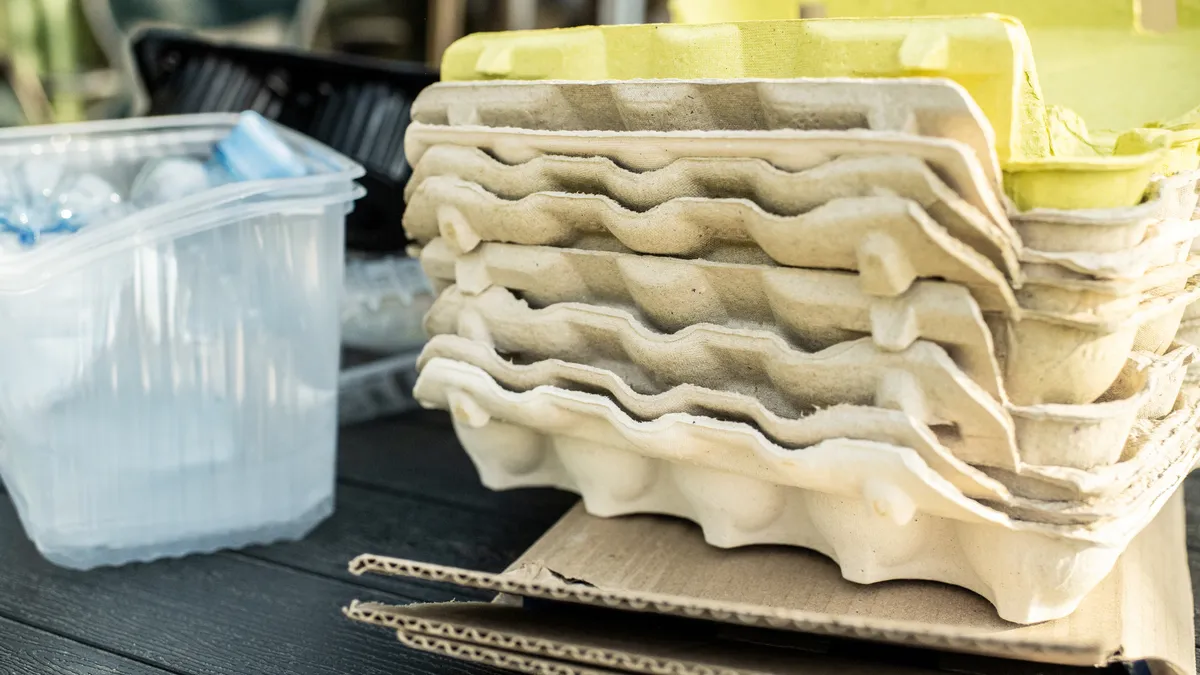
Molded fiber producers are approaching a bump in the road: A California regulation set to take effect in October could render their products unrecyclable. A trade association is working to round up data to prevent that end-of-life packaging barrier — “truth in labeling” law SB 343 — from stunting industry growth. Meanwhile, producers are pushing ahead to innovate in materials and production.
“We're hearing optimism from our members about the future of molded fiber, and overall things are trending in a positive direction for our industry,” said Tom Hendrickson, industry affairs manager at the International Molded Fiber Association.
After conducting a survey of manufacturers earlier this year, IMFA released its inaugural benchmarking report in June. Nearly 80% of participants said they expected to increase production in 2026, and almost 75% plan to make capital investments to increase production capacity in the next two years.
Molded fiber constitutes a small part of the global fiber packaging market, roughly 3%, but has notable growth potential, according to January data from engineering and design consulting firm Afry. By comparison, containerboard makes up nearly three-quarters of the global fiber packaging market.
China leads in both molded fiber supply and exports, while the United States is a major importer due to demand exceeding capacity by about 50%, according to Afry. Demand drivers include e-commerce growth, plastic substrate substitutions and regulations targeting single-use plastic.
In IMFA’s survey, nearly 70% of respondents reported that regulations are positively influencing demand for molded fiber products. That includes from the European Union’s Packaging and Packaging Waste Regulation, implementation of which begins Aug. 12. “We’ve seen with PPWR in Europe, where there’s bans on single-use plastic, molded fiber is coming in as a plastic replacement,” Hendrickson said.
While molded fiber “is not usually a material targeted for higher scrutiny” in such regulations, these measures’ provisions for other materials “can have a spillover effect” into the molded fiber space, said Josep Nicolás Bellot, legal consultant at law firm Steptoe. For instance, certain rules exist for materials such as PFAS and barriers or coatings that affect molded fiber manufacturers.
Packaging producers are similarly swapping out plastics for molded fiber in the United States, especially as states pass extended producer responsibility for packaging laws that favor non-plastic substrates. Overall that creates opportunity for molded fiber manufacturers, Hendrickson said, but some regulations, especially SB 343, “are not particularly favorable to molded fiber, currently.”
“As of October, when that law comes into effect, molded fiber will not be allowed to be labeled as recyclable,” he said. And if the packaging isn’t OK in California, that likely will have ripple effects across the country. “We're not going to have California-specific packaging.”
California conundrum
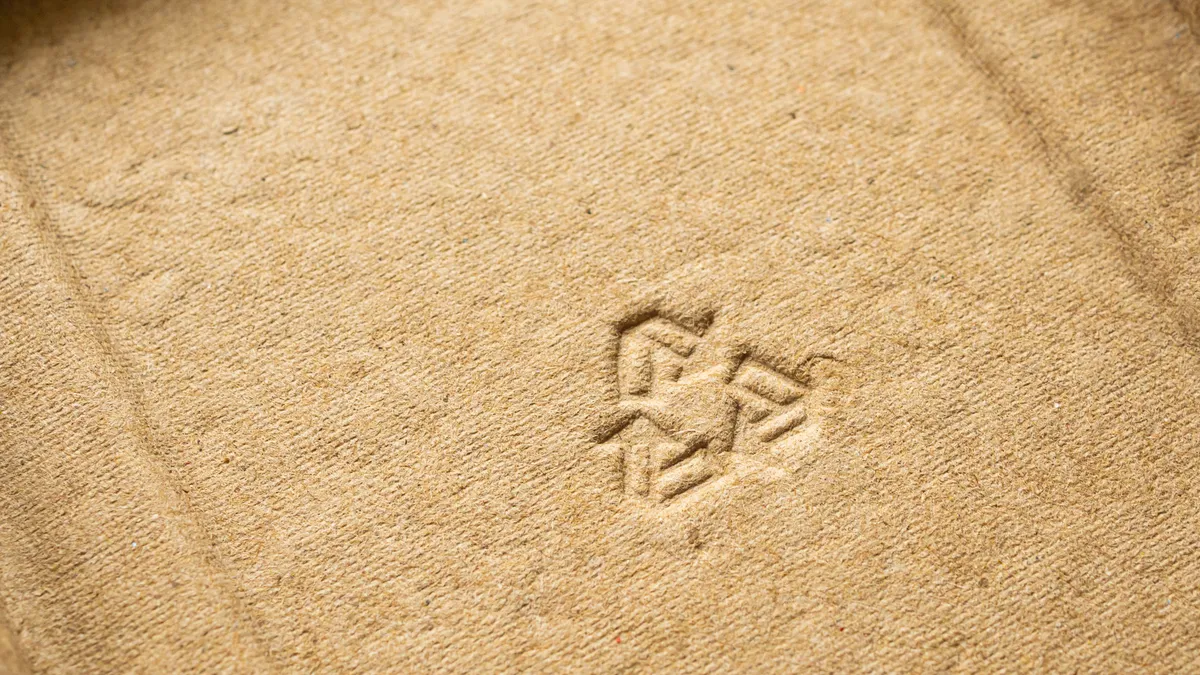
To be considered “recyclable” under SB 343, products or materials must meet a 60% threshold: 60% of Californians must have access to collection, and the material must be sorted by MRFs that serve 60% of Californians. Molded fiber is falling short on the latter criterion, according to CalRecycle’s data.
“Molded fiber has over 90% collection access, but according to CalRecycle’s data, we have 0% sortation,” Hendrickson said. That would mean MRFs aren’t sorting the material into a stream for end use, but rather landfilling molded fiber en masse. “We don't believe that that number is correct.”
“Molded fiber is just paper … and we are not able to be labeled as recyclable or compostable, which we find to be pretty frustrating.”

Tom Hendrickson
Industry affairs manager at the International Molded Fiber Association
CalRecycle’s most recent data, from Dec. 31, 2025, about materials covered under parallel extended producer responsibility for packaging law SB 54, shows that molded fiber is recycled — but at a stark 7% rate. While the law requires that materials go to a responsible end market to be considered recycled, “initial recycling rates are based on limited information about responsible end markets,” a CalRecycle spokesperson said via email.
“With implementation of SB 54, responsible end markets will be identified allowing for a more accurate reflection of actual recycling. In addition, implementation of SB 54 will encourage investments and education to increase recycling rates for most packaging, including fiber,” the spokesperson said.
IMFA is reaching out to MRF operators in California to discuss their molded fiber sortation. The association hopes to bring evidence to CalRecycle demonstrating that the material is sorted at the threshold level and that products can continue to be labeled as recyclable.
Molded fiber is not alone. Other material groups, such as for cartons, have had to work hard to prove SB 343 thresholds. Additionally, California’s AB 1201 is affecting compostability labeling for molded fiber and other materials due to unresolved issues with federal standards implicated in the law.
“Molded fiber is just paper … and we are not able to be labeled as recyclable or compostable, which we find to be pretty frustrating,” Hendrickson said. “We're made from recycled materials, we are recyclable, we are compostable. But under these regulations, we can't label our products as such.”
Producers are eyeing potential future effects from California’s laws, said Dustin Ziegelman, director of pulp and paper engineering at food packaging manufacturer Sabert. He explained that many elements related to complying with the legislation are still up in the air, and added time and costs will likely hit small producers the hardest.
“What are the next steps? Do we have to make new tooling for it, for the molded fiber space?” Ziegelman said. “It could get very expensive for producers [if] tooling has to be changed. You have to re-engrave things. It's not an easy change.”
Investing in innovations
While molded fiber manufacturers navigate new regulations, they also continue to innovate and bolster their footprints. Hendrickson said molded fiber is still “an ascendant industry,” and Ziegelman acknowledged the sector is growing.
“We’re trying to keep pace with that and expand the facilities,” Ziegelman said. “It's definitely exciting for us, but it's not without challenges.”
One pain point is the elimination of per- and polyfluoroalkyl substances from molded fiber products. While that's been an issue for years, attention has risen recently, Ziegelman said, noting that Sabert does not intentionally add PFAS. It's especially a concern for food-contact items, which is a huge market for molded fiber.
“One of our biggest challenges is trying to come up with an economical way to address consumer needs for oil and grease resistance,” Ziegelman said. “There’s the technology out there, the chemistry, but the materials struggle to compete with the properties you would get from PFAS. It can be done, but that can sometimes negatively impact the machine performance or the cost of the product.”

Sabert produces coated molded fiber at its plant in Greenville, Texas. Because fiber can be molded into nearly any conceivable shape, “you can imagine a whole other complexity in trying to apply a barrier coating” that covers all the nooks and crannies, Ziegelman said. By contrast, PFAS were easier for producers to incorporate because they were added to the slurry prior to molding.
Suppliers that put molded fiber packaging on the market in Europe are also monitoring how PPWR will influence coatings and barriers. Under that framework, polymeric coatings that constitute more than 5% of the packaging’s weight would be considered plastic and therefore would be subject to the same rules as plastics, explained Bellot of Steptoe. “This is a contentious point in Europe for industry, especially the industry of paper-based packaging like molded fiber."
Production equipment also is advancing, said Jon Hursey, senior business and innovation director at Jabil Packaging Solutions, during a session at the Packaging Recycling Summit on June 16. He described new dewatering technologies that reduce cycle times by up to 80%, calling this advancement a “game changer” that boosts efficiency while reducing energy consumption.
With traditional wet molding systems, “you spend a significant amount of time breaking down dry material into a wet slurry that's 0.5% solids and 99.5% water, you feed that back into a mold, and you spend the rest of your [time on] vacuum, heat and pressure to get the water out,” Hursey said. “It's super energy intensive.”
In addition, dry molded fiber technology is “starting to level up,” he said. Dry molding reduces the resources needed for water removal, and producers tout it as a faster, more energy-efficient process. While that is true, Hursey said, there had been concerns about product quality, such as strength, from dry molding processes within the last six to seven years.
But now, some of the main dry molded fiber players are testing innovations such as the addition of biopolymers into the fiber material, or adding a small amount of water to create strong hydrogen bonds like those that occur with wet processes, according to Hursey. “We're seeing some nice, rigid, strong bonds. So dry fiber molding could be coming into its heyday.”
Sabert has investigated dry molding technologies but thus far hasn’t invested in any. One reason is that the company has significantly reduced the amount of fresh water it uses in the wet process, Ziegelman said. Plus, while cycle times are faster with dry molding, he said, the overall number of pieces produced each day lags due to the size of the machinery.
Instead, Sabert continues to invest in capabilities for its Pulp Plus and Pulp Ultra product lines, both introduced within the last three years and made via wet molding. The company is “trying to stay at the leading edge to make sure that we're growing the right way,” Ziegelman said. He also cited equipment with faster cycle times and higher production per square foot of facility space.
“I like seeing people get excited about new packaging and sustainable packaging. I've been seeing more of that over the last couple years,” he said. “That keeps me encouraged, and it keeps me engaged in trying to continue to push the boundaries.”