People say the only constant is change, and Sonoco has been going through a lot of it.
Two years ago, the company launched a variety of business unit changes, creating four core businesses: metal packaging, rigid paper containers, industrial packaging and the then-newly combined flexibles and thermoforming unit.
It subsequently acquired European metal packaging heavyweight Eviosys and divested its flex-therm business. Last year also brought restructuring progress, various leadership departures, and the divestiture of its temperature-assured packaging business.
Then, Sonoco again reshuffled its business units, consolidating metal packaging and rigid paper containers, and splitting that segment into two geographies with their own leaders.
One of those leaders is Ernest Haynes, who became the president of consumer packaging for the Americas late last year, his latest step in a career with Sonoco since 1997. Previously, Haynes served as president of metal packaging for North America, and earlier was general manager of rigid paper containers in North America.
Haynes says he’s energized to lead a business unit that combines his background in different sectors.
“I'm uber excited about managing the Americas,” he said. “I think my experiences in both paper and metal have prepared me well.
Haynes spoke with Packaging Dive about some goals in his new role, and being a leader in a company undergoing major transitions.
This interview has been edited for clarity and length.
PACKAGING DIVE: Do you feel like things are settled out now at the start of 2026, or is Sonoco still in transition? Also, how do you want outside observers to view Sonoco now?
ERNEST HAYNES: I do believe, in large part, the structural transformation that you've seen us undertake over the past four or five years is largely complete. I think we're through that structural change, and we will lean into a really high performance culture in the go-forward.
But when you think about a $7.5-plus billion company, nothing ever stays the same.
In terms of the portfolio that we have today, in terms of a really big can business that supports both paper and metal cans and the aerosol and food space, if you think about what we do in the industrial space, I think that's kind of the foundation of who we are in 2026.
But that certainly doesn't belie that there won't be things that happen over the course of the next several years as we continue to try to grow out our platforms. Whether it's organic growth with existing customers and brands that we serve today, whether it's M&A action. I think those things are always evolving.
Is there anything in particular that you are doing as the Americas leader to ensure that employees remain engaged and maintain morale amid all the changes?
As a global enterprise, we have somewhere around 23,000 employees that are working under Sonoco’s watch every day. And for the consumer Americas unit, there are about 3,500 folks that support my business. I think about them every day, and I recognize what level of uncertainty the change brings.
But it's our job to try to put the company in a position, not only for where we're at today, but where we need to be tomorrow. I think my job has been to over-communicate the underpinnings of why we've made some of the changes we've made, to talk about the markets we serve, to focus on earning the right to serve our customers every single day.
Our employees understand the commitment that Sonoco has made to the marketplace. I think we're through a period of uncertainty, and now it's about executing on performance and delivering the value — not only to our shareholders, but to our customers in the future.
Explain in more depth the strategy behind combining metal and rigid paper cans into one substrate-agnostic business unit, especially after they were just separated out into two of the company’s four business units less than two years ago.
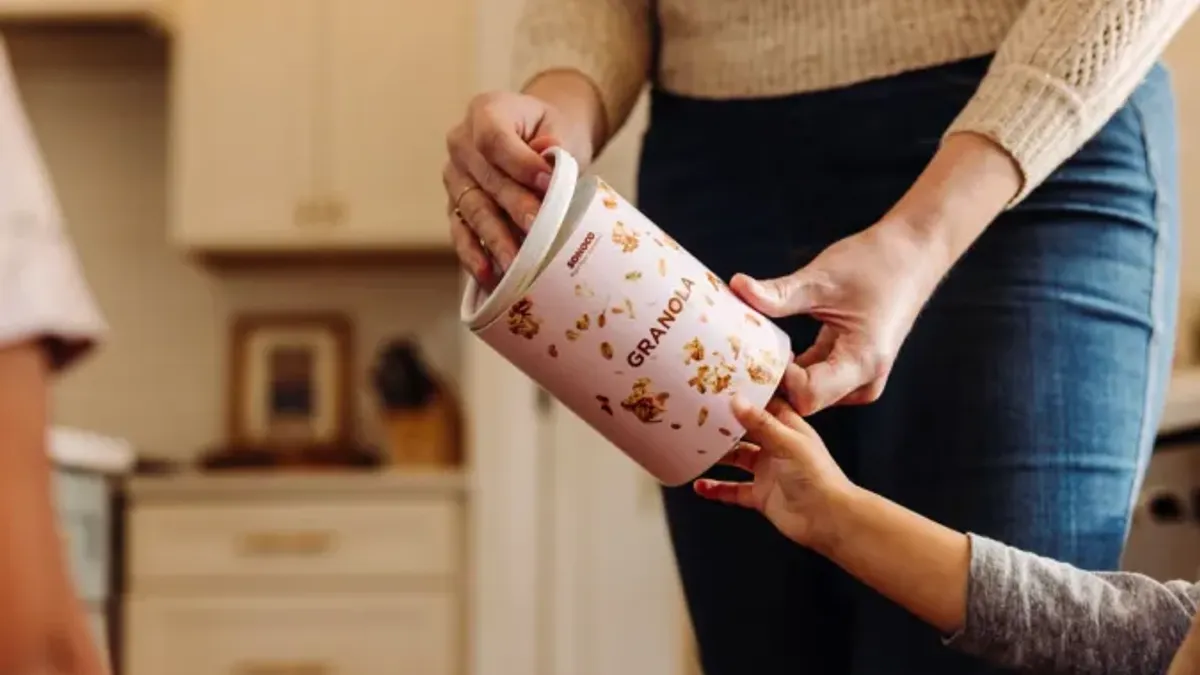
It starts with how we serve our addressable markets and being agnostic about the cans we make. For generations, we've made paper cans and associated metal components that go with paper cans. And obviously now we offer an array of what I call paper bottoms and all-paper cans.
The thesis was we wanted to be in highly defensible markets, markets where we knew we had the operational chops to perform. So in bringing those together, I think it was a really natural fit.
We have a really big can business, we just offer different substrates that support that marketplace. I think what it unlocks is a really focused effort on on behalf of our commercial organization, because we're about the customer.
The focus on the customer makes it easier for people to do business with us. I think we have a simpler format when it comes to making decisions, and I think that in those ways, we unlock a lot of value. When I think about our technology platforms, when I think about our engineering platforms, all of that kind of focuses on the can, regardless of substrate. I think that makes us better, and certainly more nimble, for a challenging macro-environment that we all face today in trying to serve the marketplace.
Do most of your customers buy RPCs or metal cans separately, or are most mixing the substrates they purchase?
You see some of both. A lot of it is about the fit, form and function of the package we provide.
Certainly in the metal can space, we deal a lot with processable foods. The specifications and the technical complexity of that can is different than, obviously, a paper can where we serve powdered and formula markets where we serve nuts, snacks, that kind of segment.
There's some natural differences in those addressable markets, but I think the essence of your question is that individual buyers for the major CPGs and customers we serve generally deal with both sets of cans. So having a really simple go-to-market strategy for us I think really simplifies our approach.
You’ve had leadership roles at Sonoco in both metal and fiber can sectors, so you bring skills from both. But is there anything specific that you aim to learn in your new position in the coming months?
I'm super excited about understanding more about our South American and Latin American marketplace.
I was just in Brazil a couple of weeks ago, and super excited about the growth vector that I think Brazil offers to Sonoco. It's largely our paper can portfolio that plays in that region. The economies of scale, the addressable markets, the customers that are served are a little different than what we would traditionally see in North America.
So it'll be a great opportunity for me to lean into the strength of that leadership team we have in South America and learn more about that marketplace. I think it will enhance my skills as a leader within Sonoco, and at the same time, bring different thought partners to the table that we might not have had beforehand with this kind of joint structure.
I have noticed over the last year that a lot of U.S. companies are paying more attention to the countries in South America, specifically Brazil, as it relates to economic conditions, especially tariffs. Do you anticipate tariffs are going to be a big deal for Sonoco in 2026, particularly in that region?
I think tariffs will be a big deal for everybody in 2026.
Specific to Brazil, the mouse trap is a little bit different in terms of the components that make the cans, where we source the key raw materials for the can. But the formula is the same. We want to do our best to try to insulate incremental costs to our customers. But we certainly have to respond when those cost challenges come about.
I think part of the globalization of Sonoco has really helped us. We can tap into kind of a global market of substrates, whether it's tinplate, whether it's paper, whether it's adhesives. I think we have now the scale and buying power to present real solutions that are cost effective and ensure supply continuity for our key customers.
So regardless of the region — South America's dynamics are a little bit different, obviously, than North America’s — I think our first charge is around supply continuity, and secondly, trying to mitigate costs where we can. I think we've done a really effective job of that with tariffs.
Besides tariffs, what other external conditions are you watching in 2026 that could affect the Americas business?
Simply put, macroeconomics has an outsized impact — certainly over the past five or six years — on all industries, particularly those in North America.
The way I think about it is, we're really focused on the consumers, and affordability is a big part of that equation. We know that affordability impacts the cost of goods to the end consumer, and we want to do everything we can to mitigate those costs.
Shoppers vote every single day with how they put items in their basket and what they're willing to spend dollars on. Our role in that is to make sure we're delivering on the quality and service and cost for the packages we provide to our end customers, such that it enables them to win that shopper’s choice.
I hear that you're passionate about innovation. Last year, Sonoco announced that it was going to expand its RPC production footprint as part of its innovation push. Besides that, what other innovation areas are you interested in exploring more in 2026?
I would look no further than a $3.5 million investment we made a few years ago in Columbus, Ohio, with our innovation center. That was a big part of what we want to do to constitute our real footing and entry into the metal can space through the acquisition of Ball Metalpack.
If you look at all of the innovation, from a sustainability standpoint — where we have a paper can today that's absolutely recyclable through every single channel, and 85% of all the tinplate ever produced is still in use today — those innovations are part of what we bring to the marketplace. We have a sustainable footprint of offerings.
We've invested in our network beyond just the M&A and we'll continue to do so. We want to meet consumers where they are and where they're going, and part of that is continuing to innovate our can, continuing to work on making our carbon footprint smaller, continuing to work on making sure every single component of the can is recyclable.
What are you most excited about in 2026?
I'm most excited about our new structure. I think it unlocks significant value for our customers, and that translates into value for us.
I think we're a simpler organization. I think we'll move with greater speed and efficiency at every single level of the company. I think our customers will feel that every day. I think our customers will feel closer to us. I think they'll feel more empowered in how we make decisions and how fast we can react to market conditions. And I really think the best is yet to come for Sonoco.