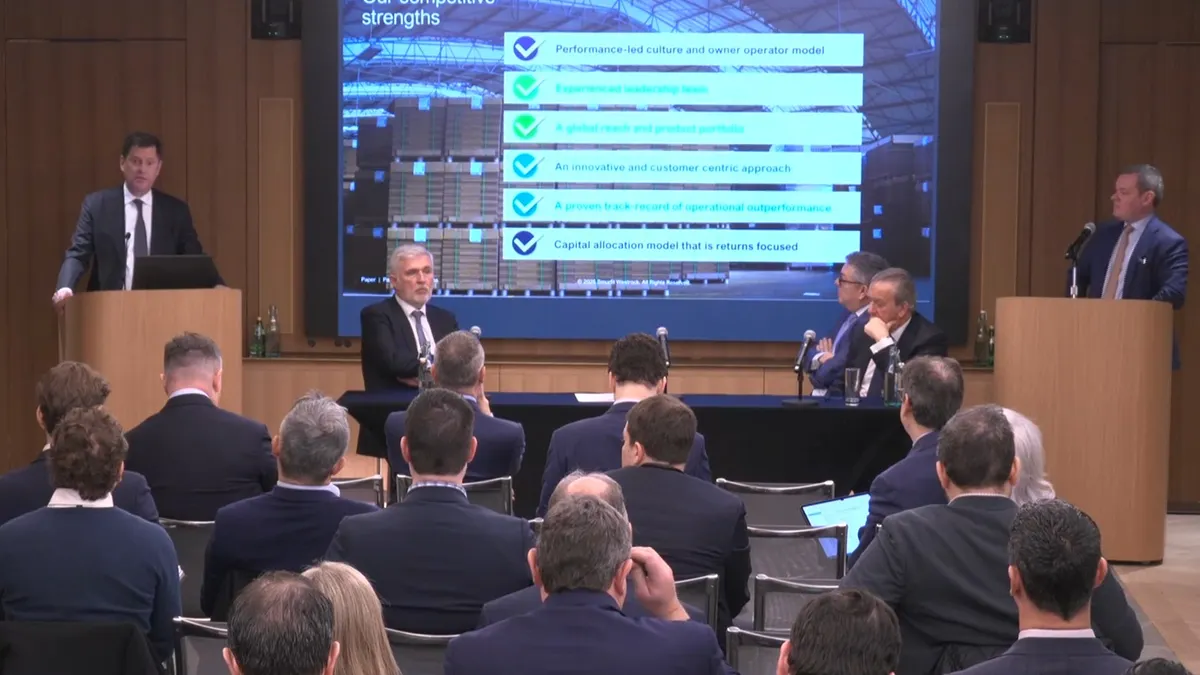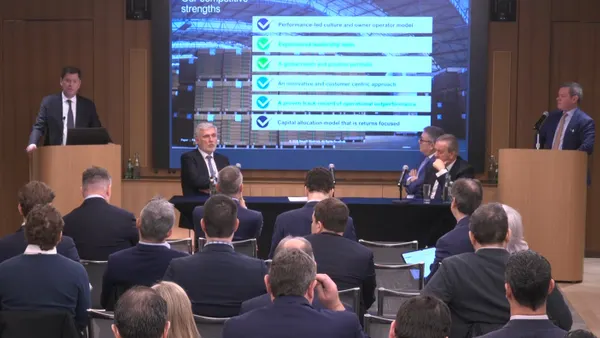
“Our portfolio transformation is complete. And the most difficult part of our journey is behind us.” That’s the first message Sonoco CEO Howard Coker delivered during the company’s investor day event on Tuesday, which followed Sonoco’s fourth-quarter and full-year 2025 earnings release Monday afternoon.
“2025 was a good year, but we were setting the foundation for ‘26,” Coker said during the event, where executives discussed results in lieu of holding a traditional earnings call.
Sonoco’s full-year 2026 guidance projects net sales of $7.25 billion to $7.75 billion and operating cash flow of $700 million to $800 million.
Executives focused on a few main themes at the event, with the company’s recent restructuring taking center stage. Here are the key takeaways.
2025 performance and future outlook
In 2025, Sonoco reduced debt by approximately 40%, lowering its leverage ratio from 6.4x at the beginning of the year to 3x by year’s end. A significant part of that was due to the November divestiture of its ThermoSafe temperature-assured packaging business for $656 million in cash.
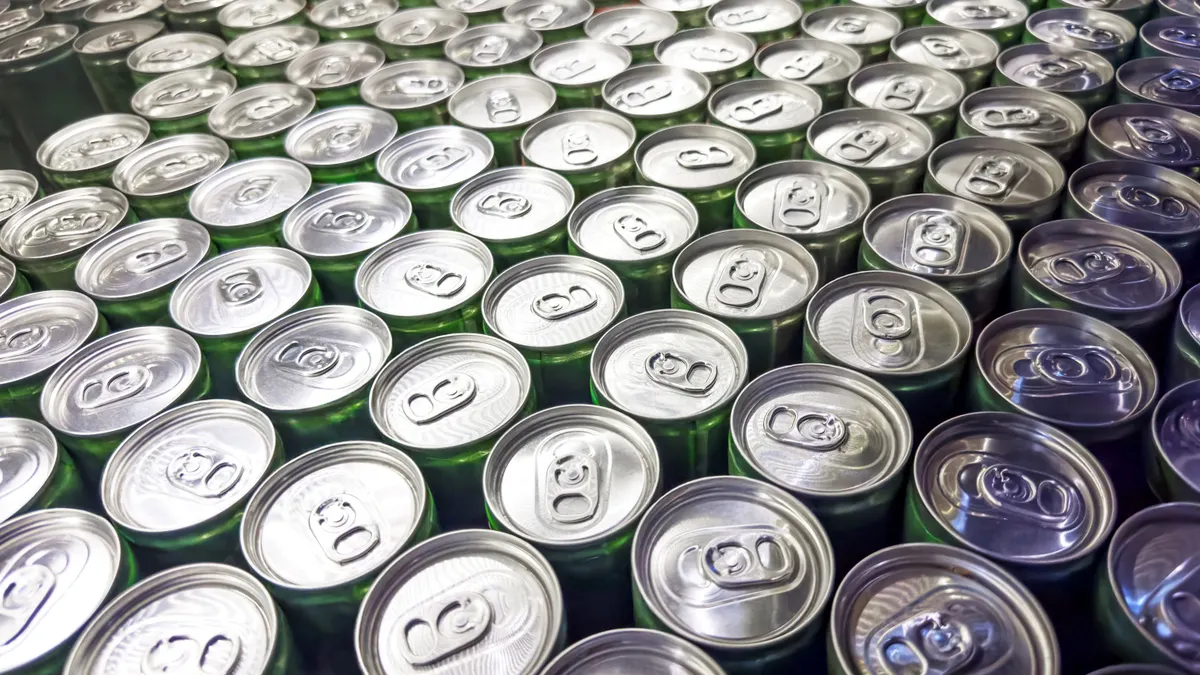
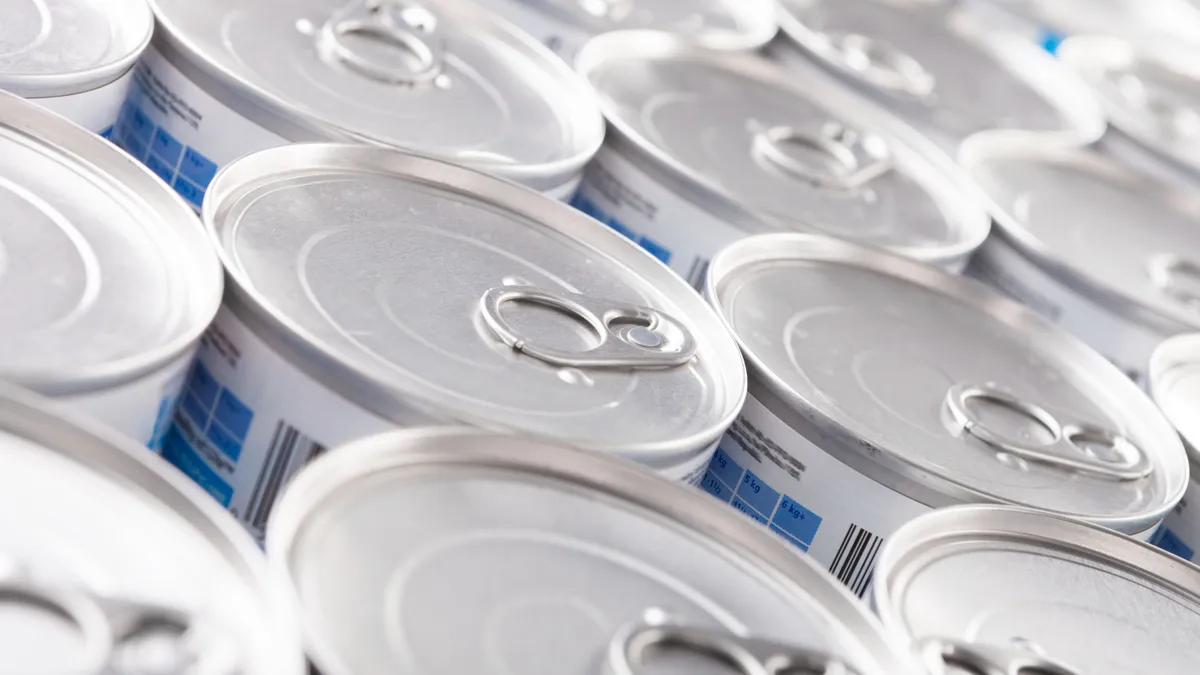
In Q4, the company had a strong October, weaker-than-anticipated November, and better-than-expected December, Coker said. U.S. metal packaging had a record quarter and year, with food can units up 10% and 9%, respectively, he said. Food can units in the Europe, Middle East and Africa region were down about 3%. Rigid paper containers volumes were down in North America and flat in Europe.
Executives outlined a three-year plan. One target is for net leverage of lower than 2.5x by the end of 2028. Executives anticipate capital expenditures will be approximately 4% of sales from 2026 to 2028. The company also targets an additional $150 million to $250 million of cost savings by the end of 2028, resulting in 200 basis points of margin improvement.
Geopolitical uncertainty and tariffs could affect the company’s ability to meet all of its projections in 2026, said James Harrell, president of industrial paper packaging. But growth in data centers and artificial intelligence is expected to boost Sonoco’s industrial sector, he said, as should customer preference for recycled packaging to meet sustainability goals.
Sonoco projects the industrial segment will achieve a 1% to 2% compound annual growth rate through 2028 for uncoated recycled board, and 5% to 8% for wire and cable reels.
All things considered, “We believe we have the right strategy at the right time,” Coker said.
Streamlining and optimization
2025 was a pivotal year for Sonoco in terms of its portfolio transformation, said Chief Financial Officer Paul Joachimczyk.
Sonoco’s multiyear period of changes included reshuffling leadership, divesting business units and restructuring to create four core businesses — metal packaging, rigid paper containers, industrial packaging and the then-newly combined flexibles and thermoforming unit. In November, Sonoco announced another restructuring that again involved reworking its business units; it consolidated metal packaging and rigid paper containers, and it split that segment into two geographies with their own leaders.
The company has pared down its core business segments from 20 to two, executives said. Future results will be reported in two segments, consumer packaging and industrial paper packaging; industrial plastics now will be reported with industrial paper. Consumer packaging makes up 67% of sales and industrial packaging accounts for the other 33%; that’s a dramatic shift from 2020 when consumer was 42% and industrial was 44%.
Since 2020, revenue has grown by 50% and adjusted earnings before interest, taxes, depreciation and amortization increased by 67%, Coker said. “We believe there is much more we can accomplish by focusing on our strategic priorities: sustainable growth, margin improvement and efficient capital allocation.”
Leadership acknowledged the vast amount of change in recent years, and explained the recent restructuring was to create a more focused, simplified business with an optimized portfolio.
“What is different today is not just where we are, but how decisively we will run the business going forward,” Coker said.
Although Coker repeatedly said the company’s transformation is complete, executives described throughout the event how Sonoco intends to rightsize the back office over the next few years to better support the more simplified operating structure. Coker called this an area of “tremendous opportunity.”
The back office streamlining will involve incorporating artificial intelligence tools, which Sonoco already has started doing with its manufacturing operations, said Ernest Haynes, president of consumer packaging for the Americas.
“Leaning into AI technology within the manufacturing network has become the next leg of our operations excellence,” and it will continue to drive productivity while lowering costs, Haynes said.
Innovation
Executives held up investments in innovation as a pillar of Sonoco’s future success.
“We can drive a competitive advantage through advanced material science and technology expertise,” Coker said. “Early in our transformation, we increased investment in technology and innovation in our core operations.”
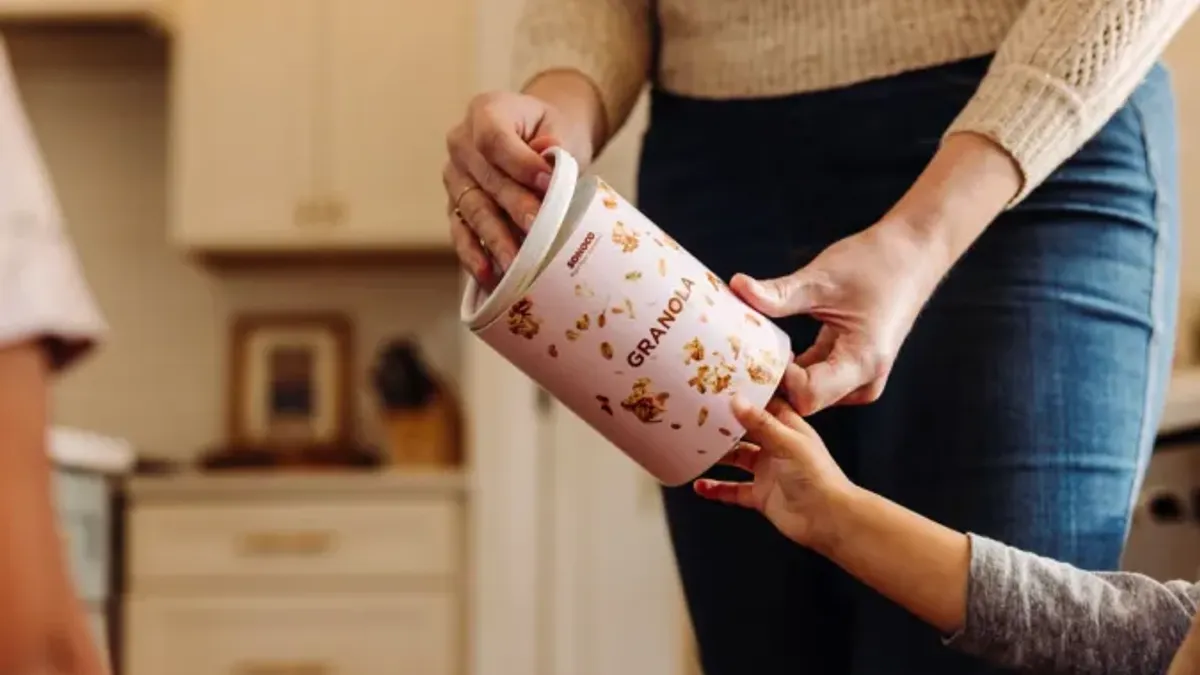
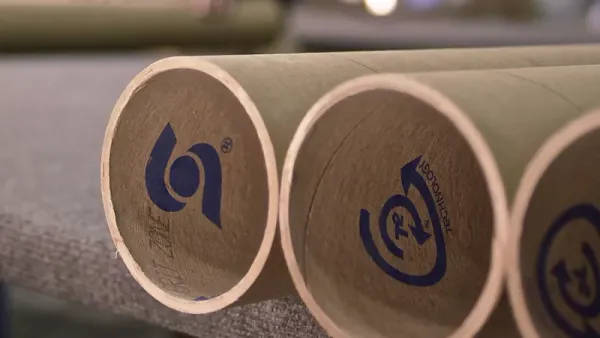
Sonoco is expanding production for all-paper Pringles cans, a sustainability-minded project it launched in 2023.
“This is the single largest change to one of the world's most iconic packs in the past 50 years,” said Seàn Cairns, president of consumer packaging for EMEA/APAC. “We will produce all the world's demand out of two locations, one in Europe and one in Asia.”
A recently opened Sonoco paper can factory in Thailand is actually connected to a Pringles plant, he said, and has the capacity to be the world’s largest paper can production facility.
Cairns also noted a specific innovation appetite within the European market.
“In my 31 years in the packaging industry, I've never experienced so much demand for change. This is mainly driven by the region's unique sustainability demands,” he said. “For Europe, the sustainability drive is huge.”
Sonoco also is developing a URB product that will serve as a replacement for saturated kraft. It will support customers who specialize in high-pressure laminate products such as countertops, flooring, composite board and decorative panels, Harrell said. The company is in the final stages of product testing and should go to market early this year, with a projected market opportunity of 20,000 to 30,000 tons per year.
“This is another great example of how our chemists, our process engineers, our paper engineers can develop new value-added products,” Harrell said.
The growth in private label consumer products presents another opportunity for Sonoco, leaders said. Growth in pet food is another area with potential, especially adoption of paper cans for pet treats.
Although macroeconomic conditions such as tariffs likely will affect business in 2026, innovation efforts will help Sonoco ride out the storm, Haynes said. “Moments of disruption actually create opportunity,” such as Sonoco’s work with brands to “rethink pack sizes, formats and shelf execution” amid threats like steel tariffs.
“Our portfolio matches current consumer trend reporting both in private label growth and targeted premium products in what is expected to be a challenging 2026 marketplace,” Haynes said. “We're ready for market pressure.”