The flow of recycled content from recyclers to new packaging or products is never simple, yet in some ways 2026 feels especially complicated.
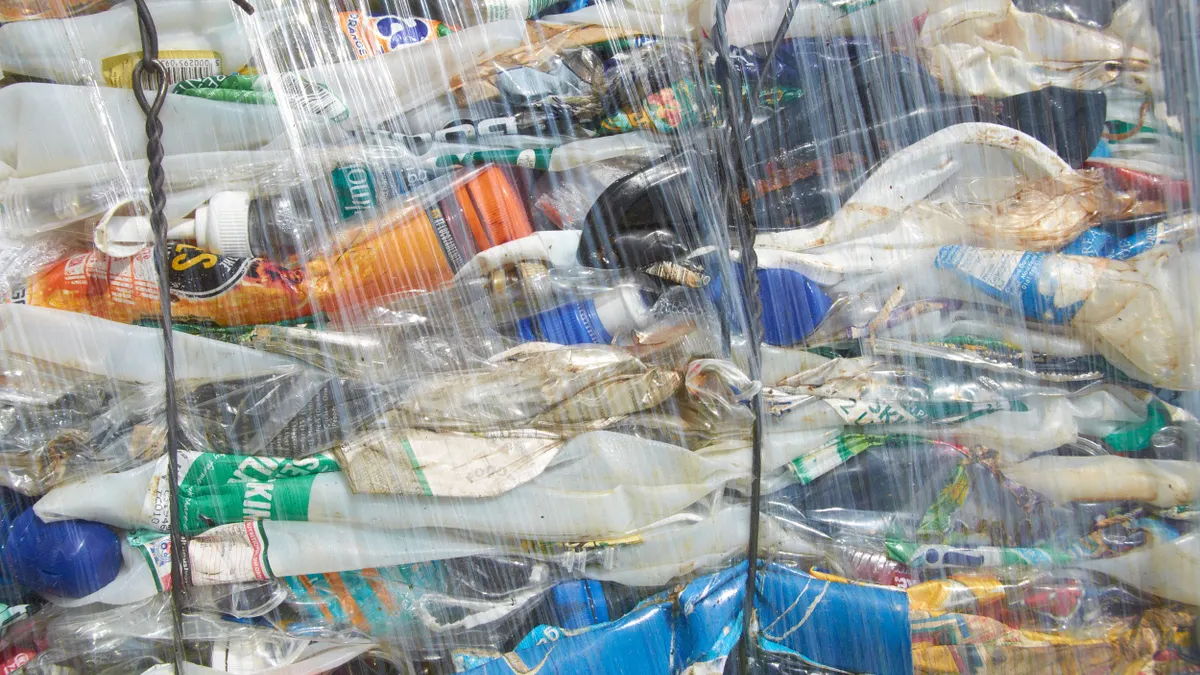
In the last year or so, seven out of 30 major PET recycling facilities in the U.S. closed, wiping out 25% of domestic capacity. At the same time, in just the last few months the Iran war’s impact on oil prices has driven up the price of different virgin resin grades internationally. And all the while, new extended producer responsibility laws are still on the horizon, some of which have recycled content stipulations or incentives of their own.
Conversations about how to navigate this environment and support domestic recycling markets were at the fore across various panel discussions April 22-23 at the Sustainable Packaging Coalition Impact conference in Nashville, Tennessee.
“We really can’t have this boom-and-bust cycle,” said Harrison Nix, vice president at Green Group Consulting. “It's not a sustainable business model for these recyclers.”
Mixed policy landscape
U.S. states have taken a few different approaches to policymaking that spurs recycled content use. One avenue is through recycled content-specific laws that mandate PCR rates and deadlines for specific packaging categories, such as in California and New Jersey. “There is a role for that. It levels the playing field,” said Kate Bailey, chief policy officer at the Association of Plastic Recyclers.
There are also states such as Colorado which have incorporated some more flexible PCR requirements in their EPR programs. And then there’s the option for a state to both consider PCR provisions in its EPR program and in a separate law, as is the case in Washington.
Bailey said she is frequently asked whether EPR is enough when it comes to policy in this arena. “No, I'm sorry, EPR is not enough. It was never meant to be,” she said. Complementary strategies to address plastic pollution are necessary.
However, there’s room for how those policies are negotiated.
“I work a lot with legislators, and they are the last person you want setting a target for you,” Bailey said. To them, 50% by 2030 might sound like a “great slogan,” but it’s a “nightmare for your business.”
Nix echoed those challenges. “You have legislators that are not involved in necessarily the day-to-day life of what's possible for postconsumer content incorporation,” he said. “They don't really understand the lead time, the capital expenditure that's required.”
Even so, “there does need to be some level of urgency around this,” Nix said, again pointing to the 25% PET recycling capacity loss. Bailey described it as “both a sprint and a marathon,” as companies consider where more recycled content can be used now but also long-term.
APR supports discussing data-backed targets with legislators, which could get easier. “We are about to have fantastic data through Circular Action Alliance on the types of packaging coming into states, the amount of recycled content, where that recycled content is,” Bailey said.
Sharing feedback with states about what does and doesn’t work is an important part of this process. “I hear all the time, ‘I love reporting in Washington, it’s easy. I hate reporting in New Jersey, they can’t even figure out their IT system,’” she said.
Ultimately, recycled content requirements remain critical because they ensure recyclers have buyers for their products, Bailey said, which enables them to secure loans for new facilities. It’s become a familiar refrain. “As we look at the recycling targets coming forward in California and other places, we need to build out our plastics recycling infrastructure,” because dependable demand spurs investments, she said.
Untapped potential in secondary and tertiary products and packaging
Packing tape. Pallets. Recycling carts. Nursery pots. Mulch bags. Trash bags.
These are some of the items that conference speakers highlighted could incorporate more recycled plastic. In some ways, companies are making PCR efforts harder than they need to be at the current stage; more challenging applications like food-grade flexibles pouches are “way down the road,” Bailey said.
“I realize we’re at the Sustainable Packaging Coalition conference, so we’re all very packaging-focused, but 50% of plastic goes into non-packaging applications, and a lot of those are the lower-hanging fruit when it comes to recycled content,” Bailey said. “So this is where having some standalone laws outside of an EPR program could actually be really helpful.”
Companies need flexibility to use recycled content where it is most cost-effective, Bailey said. “That might be trash bags right now. It's probably not your flexible pouch.” These non-packaging applications are important in APR’s Recycling Demand Champions program.
An “ideal starting point is to see the increase of PCR in those applications that the consumer doesn’t see as much,” said Neil Menezes, vice president of material services at Circular Action Alliance, in a panel related to film recovery. There’s more leniency there with aesthetic or technical limitations. Hopefully that will eventually give way to more announcements of PCR use within primary packaging, he suggested.
Nix’s group recommends companies take a portfoliowide view. “I think a lot of times there could be a tunnel vision or silo vision on a specific package, or trying to address the problem on a package-by-package basis,” he said.
Furthermore, businesses might not have an up-to-date understanding of how the markets have evolved in recent years. “There's a lot of resin on the market that I think folks are not aware of,” he said.
Bailey implored brands to think about what they can do today, even if it’s just using 5% recycled content. “We're not asking you to use 100% recycled content across 100% of your portfolio. That's not where we are.”
Sourcing risks
Overreliance on foreign resin, and underutilizing domestic recyclers, is a risk to businesses’ PCR plans, Nix explained.
He frequently sees clients testing recycled content sources. Those businesses say that once they need to scale PCR use they can buy it, but that’s a concerning assumption, Nix said. “It’s you and 50 other companies that are doing the same with the exact same source. And once one person presses ‘go,’ that source is gone,” he said.
Especially in light of how turmoil in the Middle East is currently affecting businesses in Europe and Asia, “there's also a case to be made for the supply chain resiliency that you’re going to build by sourcing domestically,” Nix said.
Bailey emphasized that where businesses purchase PCR from matters: “If you are buying recycled content from overseas instead of from the U.S., you are undermining our existing infrastructure.” It’s cheaper to buy from Asian markets than U.S. sources, Bailey acknowledged, which has resulted in more imported PCR.
Bailey used the recent domestic PET market collapse to put in perspective other conversations happening at SPC Impact regarding recycling of polycoated paper or flexible films. “If we can't solve PET recycling, you’re never going to get to those things,” she said. “PET recycling is the backbone of the plastics recycling industry.”
The current procurement trends are causing “some serious challenges right now that are going to really put a lot of us at risk,” she said.