Dive Brief:
- Kenvue, the Johnson & Johnson spinoff company whose brands include Band-Aid, Listerine and Tylenol, is using waste analytics company Greyparrot’s AI-driven technology to track how its packaging moves through recycling systems.
- Greyparrot’s platform Deepnest will provide Kenvue with insights about its packaging in real-world recycling systems and pinpoint how specific components, such as pumps or labels, affect recovery rates.
- Kenvue can then use the insights for purposes such as forecasting the financial impact of design-for-recyclability changes — an increasingly important capability as the packaging regulation landscape widens, according to Greyparrot.
Dive Insight:
AI-driven technologies are cropping up more in the packaging industry as use cases become clearer. Advancing packaging circularity is one of the emerging opportunities.
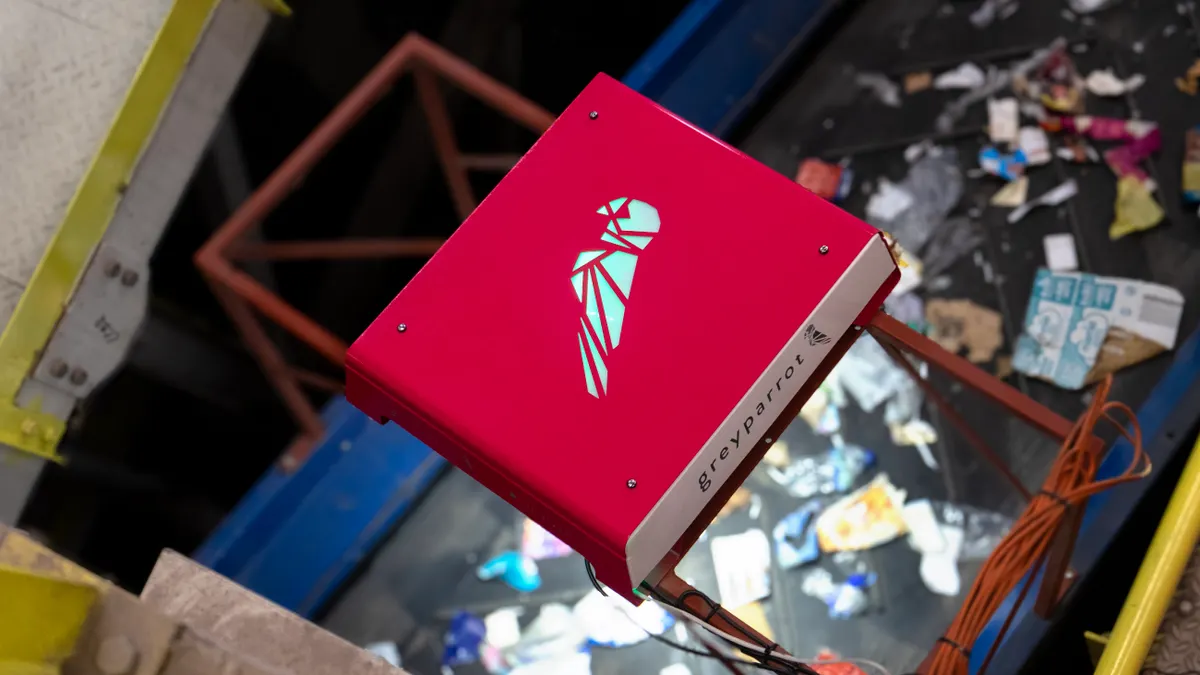
Greyparrot launched seven years ago as an AI-powered waste analytics company, supplying smart camera and software systems that help collect and analyze data for MRFs and other recycling centers. Last year, it launched a new platform, Deepnest, to help consumer packaged goods companies and other brands understand what happens to their packaging once it reaches recycling streams.
“Because of incoming regulation, it means that packaging manufacturers, as well as the brands, need to understand their packaging way more,” said Yaseed Chaumoo, managing director of Deepnest at Greyparrot. “This is about giving them the breadcrumbs, the stepping stones, to make actionable changes very easily.”
He gave an example from the Kenvue collaboration: Deepnest can track how a specific Johnson’s PET shampoo bottle travels through a recycling facility and the ratio at which it ends up in the targeted PET stream. It can also show the percentage of those bottles that still have a cap attached. The data could help Kenvue determine whether to lighten or darken the plastic hue to boost efficient sortation, for example, said Chaumoo.
“What we're doing is saying to these brands: Within the current infrastructure, if you make these incremental improvements, this is how it could change” the capture rate, he said. “On one side, it's providing the data of how well their portfolio items are doing in the U.S. and the U.K., and on the other side it's how to improve sortation.”
Greyparrot views its work with Kenvue as a partnership because they’re sending back data to help improve the technology company’s data capture and use processes. “I definitely see not just a one-way flow of information,” Chaumoo said. Kenvue doesn’t just want to know how its product packaging is behaving at end of life, it has “a real urge to want to do better to improve their packaging on the market, and actually end up being recoverable,” he said.
As far as direct EPR applications, Greyparrot’s Deepnest can help Kenvue assess product performance in key states, and the data could be extrapolated to other states. That could be especially relevant with ecomodulation in the future.
Other AI work in packaging includes Amazon’s use of AI models to reduce and rightsize packaging. And AI can streamline data collection for sustainability purposes, according to specification management company Specright. This takes on heightened importance as producers increasingly have to report data for state extended producer responsibility programs.
AI especially can aid packaging circularity during the design phase, according to a recent report from the Consumer Goods Forum’s Plastic Waste Coalition of Action and consulting firm Bain & Co. This could be to optimize dimensions, reduce material use or improve recyclability. Advanced sorting and material traceability also stood out as opportunity areas in the report.
Colgate-Palmolive partnered with recycling AI and robot company Glacier to develop an AI model to detect and characterize toothpaste tubes at MRFs based on their materials and recyclability characteristics. This helped Colgate-Palmolive understand what happened to its toothpaste tubes at end of life and at what rate they were being captured for recycling.
Glacier also has worked with Amazon to train AI to identify items at MRFs that aren’t yet prevalent in the materials stream, namely bioplastics. Amazon reported that prior to this project, it had limited traceability of its packaging down the supply chain and couldn’t verify it was getting recycled.
Greyparrot also participates in consortiums for AI, part of which involves examining future use cases and complementary technologies.