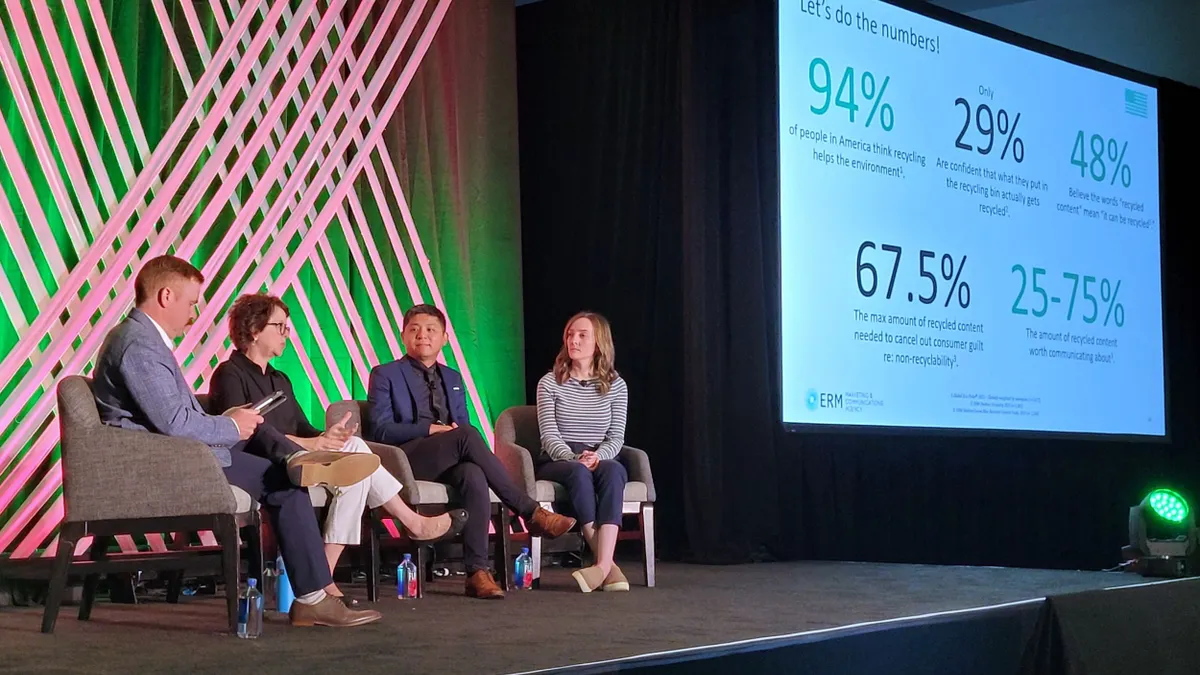
ROSEMONT, Ill. — Extended producer responsibility for packaging has become the talk of the industry, but mandates for PCR, or postconsumer recycled content, also are getting a lot of attention as brands work on compliance.
Despite many brands' stated commitments to add more PCR to their packaging, the needle isn't moving much for PCR demand, according to speakers at the Packaging Recycling Summit in Rosemont, Illinois, from June 15-17.
While multiple states have passed PCR mandates, New Jersey's is considered the broadest, speakers said. While some state mandates apply only to beverage containers, New Jersey’s also covers many kinds of food containers, and numerous brands are designing to its stricter standards.
"Obviously we have a huge focus on EPR. But for PCR, we are very focused on meeting the requirements for the state of New Jersey," said Molly Campbell, manager of packaging sustainability at The Campbell's Co. "As we especially got talking about non-beverage items, it made people uncomfortable." She pointed out that the Campbell's portfolio includes both food, like soups and Prego tomato sauce, as well as beverages, such as V8 juices.
New Jersey's PCR mandate "is the most complicated one," agreed Mike Roxas, packaging engineering manager for own brands at grocery company Ahold Delhaize USA. Data is important to help brands know what to prioritize for compliance, he said.
Ahold Delhaize examines which products are the fastest movers, along with which items have the heaviest use of plastic packaging. "For New Jersey, compliance looks like an aggregate average of the entire brand," Roxas said.
Campbell's strategy has transitioned to cross-category support for compliance.
"Rather than category teams looking at their category packaging and focusing on the very siloed approach, we've had to shift focus a little bit and take a step back and look at it strategically," Campbell said. "You could move X, Y and Z products to 100% PCR packaging tomorrow, [but] that will not get us to that aggregate average that New Jersey requires."
Waning enthusiasm amid challenges?
Cost and capital also have emerged as factors in the equation, Campbell said. That knowledge increasingly is influential for brands' PCR decisions.
"Five years ago, I found a lot of CEOs interested in PCR before they really understood what it would cost and what the impact would be, but I think they saw it as an easy win," said Suzanne Shelton, senior partner at ERM Shelton. "We have seen that enthusiasm wane a little bit."
Still, brands report being interested in figuring out how to incorporate more PCR, she said, cautioning that "interest doesn't always equate to movement."
PCR presents challenges with material sourcing when considering both cost and availability, Roxas said, especially for food-grade materials. That's impactful for companies including Ahold Delhaize, whose own-brand portfolio is roughly 80-90% food, and Campbell's, whose entire portfolio is food, according to the speakers.
Key technical challenges at Campbell's are for hot-fill products that go through the retort process, which causes package degradation. It is "a very, very extensive, high-stress process on the packaging and the product," Campbell said. She pointed to particular issues with microwaveable soup cups.
Roxas echoed the difficulty with microwaveable material, specifically mentioning ready-to-eat meals in polypropylene trays. Recently, the grocery company had to choose between only two options when developing a new product because that's all the packaging supplier offered: a clear PP tray with no PCR or a black PP tray with 25% PCR, the latter of which poses recycling challenges. The company ultimately chose the 25% PCR but is working with the supplier to see if they can provide alternatives, such as fiber options, in the future.
The types of resins and how they're recycled — mechanically versus chemically — matter when incorporating PCR, speakers said.
One reason brands and packaging companies traditionally have targeted PET beverage containers so heavily for adding PCR is that the resin behaves better than polyolefins when balancing recycled content and quality control, Campbell explained.
"It's very difficult to find those containers outside of PET that check all the boxes," she said. "My sensory team will not be happy with any changes in color, odor, flavor."
PET is a more mature PCR market and therefore is easier to purchase, Roxas said. "When you go to polyolefins, that is where the contamination is a great risk. I have worked with a lot of PCR suppliers, and they do have challenges on making it food grade ... so there's no chemical taste that will be imparted to the product."
Should any such negative alteration to packaging or product occur from adding PCR, "watch out" for consumer backlash, Shelton said. "I could see that going like wildfire quickly on social media."
Consumers aren't buying it
Another challenge Shelton frequently has heard when conducting consumer surveys is the expectation for recycled content to cost less. That's contrary to how pricing currently goes for many items that incorporate PCR.
Consumers believe "it was something before, you're just chopping it up and turning it into something else. Like, that should be less expensive, not more expensive" in consumers' views, Shelton said. "It's hard to get a price premium just because it's recycled content."
Education and messaging matter, Shelton said, adding that the "re" words confuse consumers. "We use recycled, recycled content, renew. All these things sort of blur in their minds." But when players across the value chain take time to educate people about what recycled content actually is, they like it, she said.
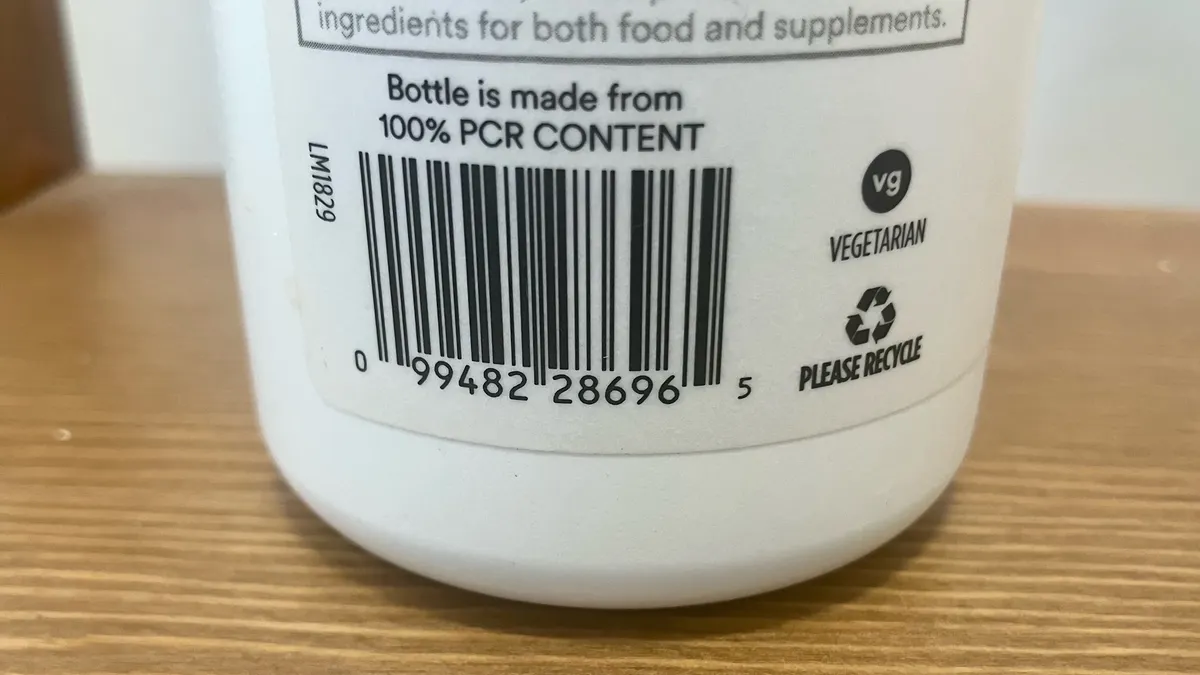
"Your challenge as you message about recycled content is you can't just say '75% recycled content,' because then they're going to think it means 75% of this can be recycled. They're not going to necessarily understand it," according to Shelton.
She suggests additional PCR costs should be interwoven with other benefits, such as enhanced performance, to make the increase more palatable to consumers. Without that, PCR labeling on consumer products could just become another factor contributing to public skepticisim about recycling — and that, in turn, could further hurt PCR markets.
"If they don't believe the recycling system works, then they don't recycle. And if they don't recycle, then we don't get the recycled content that we need so that we can have more PCR," Shelton said. "It's kind of a vicious circle that we've got to solve for."