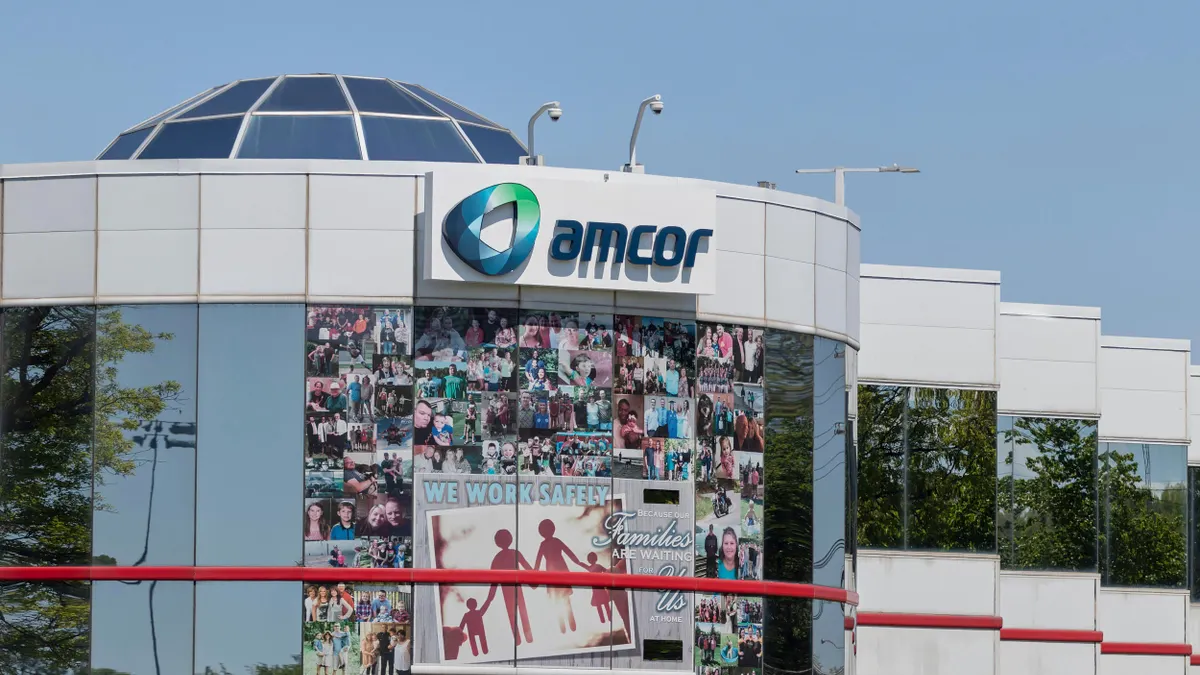
Amcor brought in $23.5 billion in net sales and $1.1 billion in net income for its full fiscal year 2026, which ended June 30.
During the fiscal fourth quarter, the company saw an inflection to modestly positive volume growth across its six core segments, executives said during a Wednesday earnings call. They acknowledged that a portion of the lift might have come as a one-off from consumer demand during the World Cup, namely for the beverage category and some food items.
“But when we add it all up, we don't think that this adds up to anything that would be material to the volume performance of the quarter,” said CEO Peter Konieczny.
Strong volume growth occurred in the food service, pet care and protein categories, while liquids and beauty and wellness volumes were flat. Overall, trends have improved as the year has progressed, said CFO Stephen Scherger. Sales growth for flexibles was primarily driven by the acquisition of Berry Global last year, he said.
These trends observed in fiscal Q4 continued into July, Scherger said.
1 year of integrating Berry
During fiscal Q4, Amcor hit the one-year mark since it completed the Berry acquisition. Integration largely is finished and synergies are tracking ahead of expectations. The company achieved approximately $285 million in synergies in fiscal 2026, about 10% ahead of initial projections. That’s also nearly half of the company’s three-year target of $650 million, with the bulk expected to be realized in 2027, Konieczny said.
Bringing together both companies’ complementary portfolios has helped Amcor win more new business, Konieczny said. Plus, there have been benefits from streamlining the base of customers who previously worked with both legacy companies. “While we have accomplished a great deal over the past year, I believe we are still in the early stages of unlocking the full potential of Amcor,” he said.
The company incurred $290 million of restructuring costs for the year. Executives project such costs will ramp down during the remainder of 2026, totaling about $50 million.
War impacts and cost recovery
Free cash flow for the full fiscal year was $1.3 billion, or $200 million below the low end of the company’s projected range. This was primarily due to effects from the war with Iran, executives said.
The Middle East conflict also contributed to what executives called unprecedented input cost inflation. The company estimates it has sustained a $500 million hit so far from the war. That’s up notably from its original estimate of $300 million.
However, executives expect to get that amount back over the next 12 months via structural improvements to working capital, despite war effects such as cost inflation for resins and transportation. For instance, Amcor has specific targets for days of inventory it’s carrying for raw materials and finished products, Scherger said.
In fiscal Q4, the company passed through “the vast majority of our inflation” costs to customers, to the tune of $280 million, Scherger said.
Coming soon: Fiscal year transition
After Amcor’s fiscal year ended on June 30, the company began a special six-month reporting period as it transitions to align with the calendar year.
Executives expressed optimism for 2027, with Konieczny noting it will be the first full, “clean” year for the combined company. Amcor is just “scratching the surface” on synergies, he said, with more opportunities expected in 2027.
Amcor expects mid-single-digit growth in earnings before interest, taxes, depreciation and amortization during the transition period and into 2027, Scherger said.