Pricing proved to be a central topic during major fiber companies’ second-quarter earnings calls. Executives frequently cited higher transportation and raw material costs as reasons for significant price hikes from companies including Packaging Corporation of America, Smurfit Westrock and others, which have since prompted some blowback. Containerboard producers also noted signs of improving supply and demand dynamics.
Pricing also was a theme for some slightly smaller or international paper and packaging companies. Here’s a roundup of key points from four of their earnings reports.
Clearwater Paper
Clearwater Paper’s Q2 shipment volumes were up 8% year over year. The company reduced net debt by $59 million in the quarter. “We are currently sold out across our network,” said CEO Arsen Kitch during a July 28 earnings call. The company posted a loss of $21.5 million for the quarter.
The Spokane, Washington-based company recently announced its second $60 per ton price increase of 2026 for all products. Executives expect it will take a couple quarters for that to be recognized in Fastmarkets RISI’s index. However, the prior increase should result in a $50 million to $60 million annual improvement in EBITDA, Kitch explained. About half of the company’s volumes are tied to that pricing index.
Regarding the ongoing industry oversupply of solid bleached sulfate, the company is “seeing some meaningful green shoots” in conditions, Kitch said. SBS shipment volumes year-to-date are up 6%. Manufacturers across the industry have reduced SBS production by a collective 300,000 tons since the beginning of the year, and “we're seeing evidence of substitution into SBS from other substrates,” Kitch said.
Higher-than-expected transportation costs, mostly driven by the war with Iran, have had an impact. Clearwater intends to continue actions to reduce costs and improve margins.
That includes restructuring its mill in Cypress Bend, Arkansas, and reducing the number of employees there by approximately 20%. “This action limits our network production to approximately 1.2 million tons per year, balancing supply with our current demand,” Kitch said. The restructuring is projected to reduce costs by $8 million to $12 million on an annualized basis.
In July, Clearwater introduced a new coated recycled paperboard product, Circa, intended for folding carton and beverage carrier applications in the U.S. It complements the SBS portfolio and will enhance the company’s ability to serve customers across more end-use applications, Kitch said.
Huhtamaki
For Finland-based Huhtamaki, which has 18 locations across North America, overall net sales in Q2 were relatively flat year over year at 1 billion euros. But North American net sales decreased by nearly 10% year over year. Adjusted EBITDA was down 2% year over year to 151.7 million euros.
The flexible packaging segment was a leader for the company, with a nearly 11% year-over-year increase in net sales. Fiber packaging net sales increased 6.7% year over year. Foodservice dipped 1.3%, reflecting “a still very challenging market” that’s feeling effects from the war with Iran, including through reduced consumer confidence, said CEO Ralf Wunderlich during a July 23 earnings call.
Wunderlich noted that the war presented numerous challenges, but Huhtamaki was able to secure raw materials to continue supplying customers. The company also ensured employee safety at its six sites in the Middle East, and all sites have continued to operate. He noted steep increases in energy and logistics costs.
Huhtamaki continues work to address “operational issues” in North America, Wunderlich said, mainly coming from starting up expansions in Hammond, Indiana, and Paris, Texas. The company also has cut 140 North American employees in the last year. “Overall, the market in North America isn’t growing a lot,” he said.
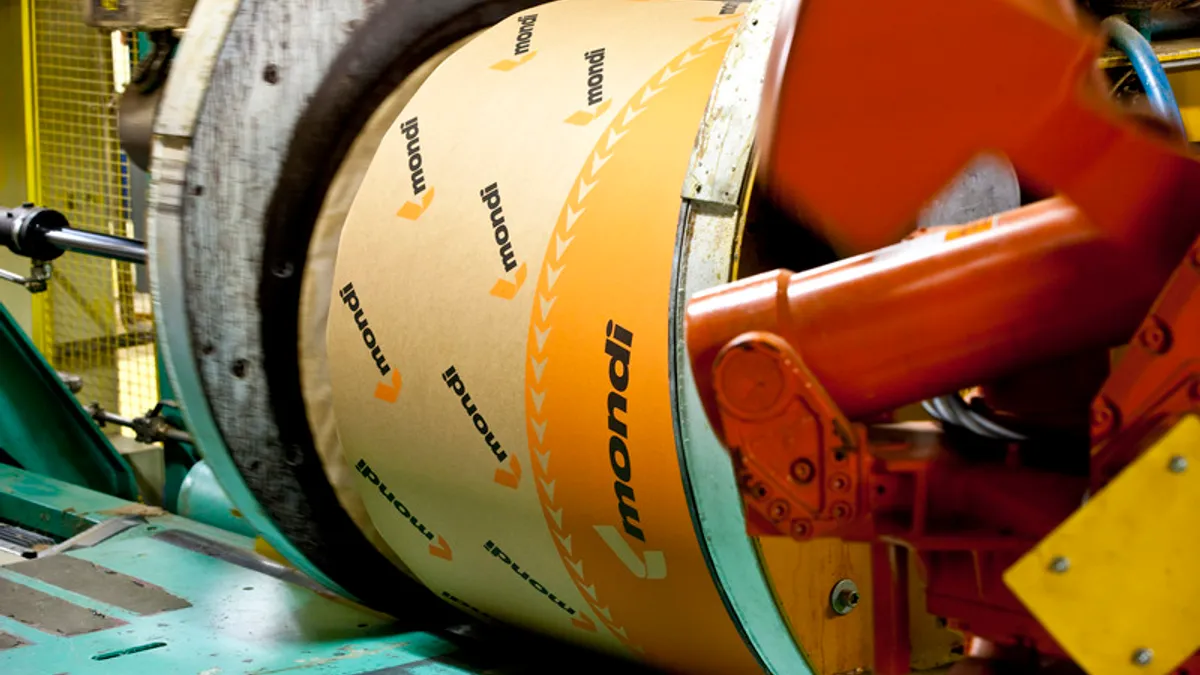
Mondi
U.K.-based Mondi, which has 13 locations across North America, offered a look at its first half of the year, showing a 1.7% increase in revenue compared with the first half of 2025. Revenue for the corrugated packaging segment came in at 1.98 billion euros, a 4.4% year-over-year increase, while the flexible packaging segment charted a 1.1% year-over-year decrease to just over 2 billion euros.
Underlying EBITDA dropped nearly 33% to 379 million euros, mainly due to margin pressure from lower average selling prices and higher input costs, said CEO Andrew King during a July 30 earnings call. Containerboard volumes were up about 12% and box volumes grew 2%.
Executives cited a volatile market environment and higher input costs, including for energy, due to the war. As such, they implemented a series of price increases across all key fiber grades. “Although not sufficient to fully offset the impact of the cost increases in Q2, we do see further benefits from these price increases into the second half,” King said.
In light of the prolonged industry downturn, Mondi is implementing optimization measures. This includes closing six converting sites and cutting 580 employees by year’s end.
Sylvamo
“2026 is a transition year,” said Sylvamo CEO John Sims during an Aug. 7 earnings call. The Memphis, Tennessee-based company launched its “lean transformation” intended to improve operations and results.
Sylvamo’s net loss grew to $11 million during Q2 compared with a net loss of $3 million in Q1. Net sales increased 1.3% year over year. Total adjusted EBITDA was $60 million, down almost 27% year over year.
When Sylvamo spun off from International Paper in 2021, it agreed to purchase certain products from IP’s Riverdale mill in Selma, Alabama. Last year, the companies altered the agreement to end this May as IP started to convert a machine there to produce containerboard instead of uncoated freesheet. IP confirmed in its Q2 earnings release that the mill conversion is complete.
Sylvamo executives discussed impacts from the contract termination, projecting a sales hit in the second half of the year. They estimate that the conversion removed 7% of the North American industry’s annual UCFS supply from the market.
Sylvamo continues to implement UCFS price increases across regions and expects to see realization continue through year’s end. Executives anticipate a price and mix benefit of $75 million to $85 million in the second half of the year compared with the first.
They also expect improvements in operations and other costs in the back half of the year, despite volume offsets from lost Riverdale supply and from a longer-than-expected outage at its Eastover, South Carolina, mill to complete paper machine investments. The upgrades there will add 60,000 tons of annual UCFS capacity — which won’t completely cover the 90,000 tons lost from the IP contract.