Dive Brief:
- Sonoco is making upgrades at two facilities in the Midwest in alignment with its sustainability strategy. The company did not disclose capital investment amounts.
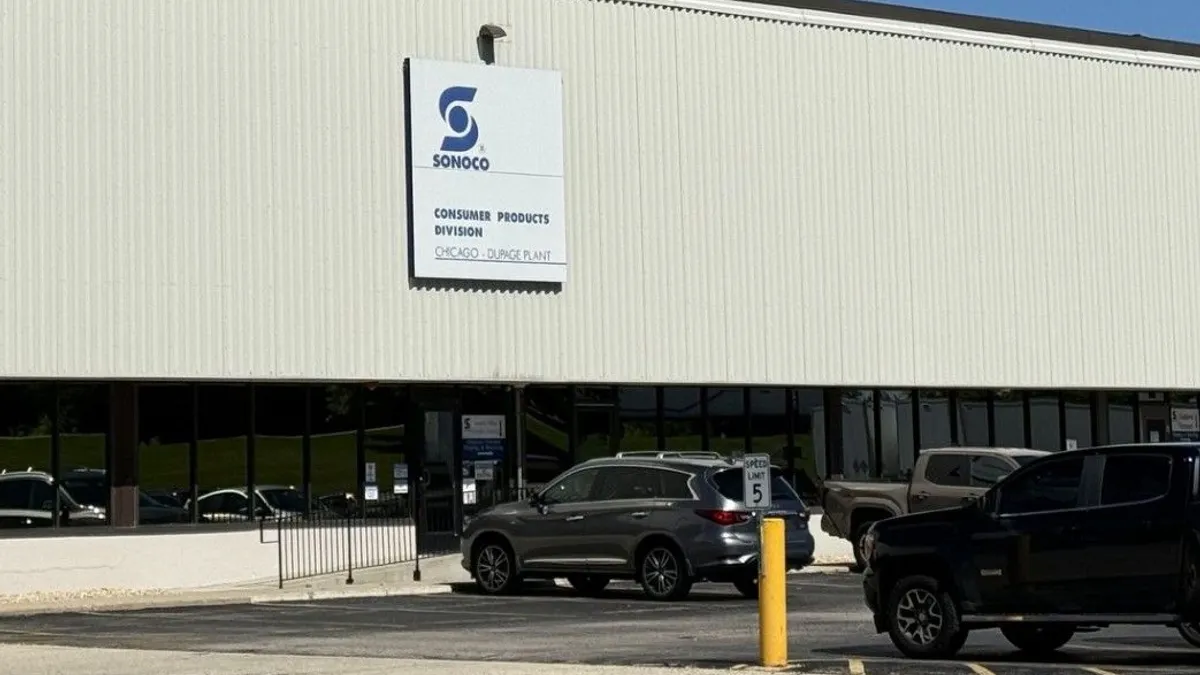
- The company is in the process of adding another rigid paper cans manufacturing line at its West Chicago, Illinois, facility. The paper cans line is operational and “in the ramp-up curve,” according to John Pontrello, vice president of operations for consumer packaging in North America.
- Sonoco is also upgrading its wastewater treatment system at a large metal packaging plant in Milwaukee, which will include biogas capture and combustion. The company expects the system to be operational at the end of Q3.
Dive Insight:
Sonoco has been heavily investing in its capabilities to manufacture rigid paper-bottom cans since its 2023 introduction of the metal-free product. It plans for expansions at other paper cans production sites in the coming months, generally on the East Coast, Pontrello said.
Last year, Sonoco named West Chicago as one of four existing production facilities that would add new paper-bottom presses and can lines during that calendar year. The facility manufactures both the paper cans bodies and bottoms, then seams them.
Sonoco undertook the recent West Chicago expansion to meet demand from a “major CPG that specifically requested this” in the region, Pontrello said. The new paper cans line is the second one at that facility, doubling paper cans production capacity there.
It also will enable “more efficient, lower-emission manufacturing per unit,” according to the company’s most recent sustainability report. Sonoco’s strategy for locating paper cans production regionally benefits customers while reducing transport emissions, Pontrello said.
“All of our investments are paired with customer needs locally to minimize the logistics of transporting that can,” he said. “If you have a paper can that’s manufactured on the East Coast that has to go to the Midwest or the West Coast, you somewhat negate the sustainability of the packaging by adding in the carbon of the logistics.”
In Milwaukee, Sonoco is upgrading the wastewater treatment system at its drawn and ironed metal can plant. The cans produced there have to go through a wash line to remove lubrication oil and any other residues left during can formation, and that creates a lot of wastewater, Pontrello explained. The system processes that water before it goes back into the municipal water system, and the removed materials are disposed.
The new system comes with new capabilities: capturing and combusting biogas generated through the wastewater treatment process. Sonoco expects this will reduce environmental impact while simultaneously improving process efficiency.
“We’re not actually required to do that. It's an upgrade we put into the system,” Pontrello said. “We want to have zero waste on our lines, or at least as close as we can get to that, over and above the state regulation.”
The company has installed this type of wastewater treatment system elsewhere, namely its Chestnut Hill plant in Dandridge, Tennessee. But the Milwaukee location is particularly notable due to its scale, Pontrello said.
“Milwaukee is one of the largest, by output, metal can plants in the entire world. So when you're talking about sustainability impact, this is one that can really turn the needle for our entire network of manufacturing plants,” he said.