Dive Brief:
- A 17-state coalition led by Nebraska’s attorney general filed a federal lawsuit on Monday challenging SB 54, California’s extended producer responsibility and source reduction law, noting its “unprecedented overreach.”
- The National Association of Wholesaler-Distributors says it’s joining as the sole business plaintiff in the case. NAW previously secured a preliminary injunction delaying enforcement of Oregon’s packaging EPR law for its members, a case that’s slated for a five-day trial starting July 13.
- The group wants to block enforcement of SB 54 while the case proceeds. “No state should limit interstate commerce, let alone delegate the power to set and collect taxes to a third party outside of the scope of public scrutiny,” said NAW President and CEO Eric Hoplin in a statement.
Dive Insight:
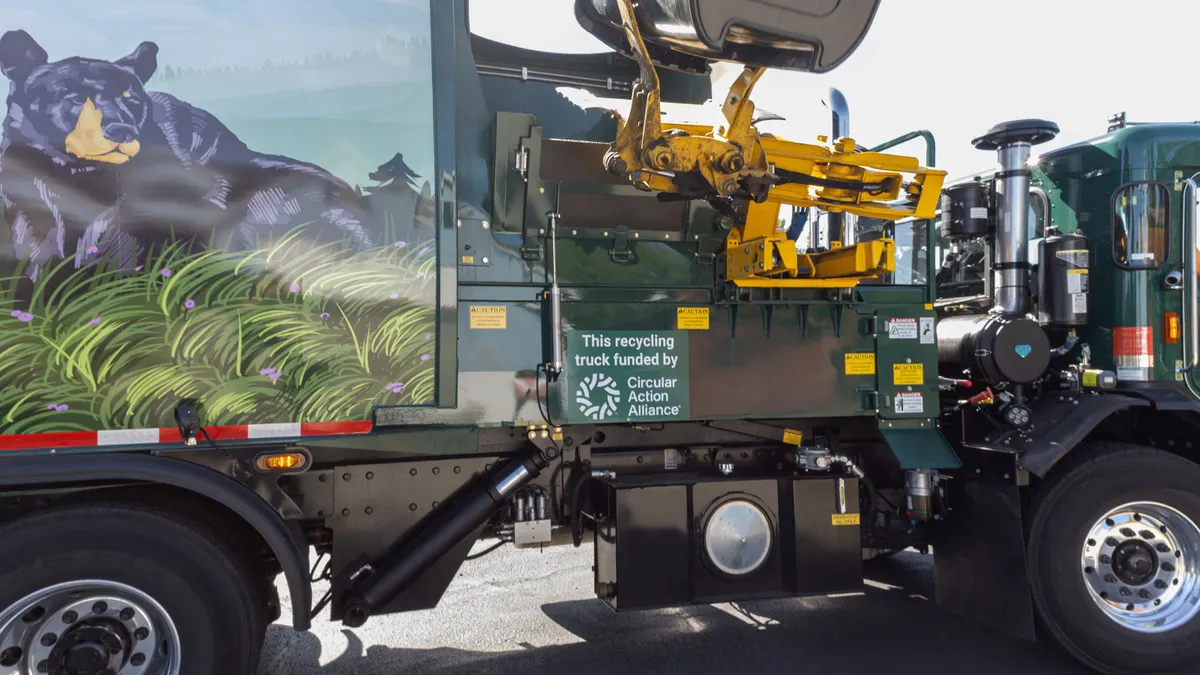
The complaint, filed in the U.S. District Court for the Eastern District of California, lists CalRecycle Director Zoe Heller and Circular Action Alliance as defendants.
CalRecycle does not comment on pending litigation. “The department remains focused on implementing SB 54 and advancing requirements established in statute,” spokesperson Lance Klug said in an email.
The coordinated lawsuit comes one week after CAA — the nonprofit producer responsibility organization that was selected by CalRecycle to help implement California’s law, and is funded and overseen by industry — released its draft program plan for the state. In it, CAA projected the California program budget may be up to $1.87 billion in 2027, and over the next five years it could total as much as $17.2 billion.
It’s also been almost one year since NAW first sued over Oregon’s recently enacted EPR law last July, and just weeks before that case goes to trial. NAW made headlines when it successfully secured a preliminary injunction in February, though an Oregon judge did not allow other groups, such as the American Forest & Paper Association, to join the case.
The complaint says the law harms producers, manufacturers, distributors and consumers, violating both the U.S. and California constitutions. Similar to NAW’s Oregon challenge, plaintiffs in the California case say SB 54 violates the Commerce Clause. The California challenge also invokes the First Amendment, among other issues.
As in Oregon, NAW and the AGs criticized the PRO’s power in the EPR fee-setting process. “California has delegated to CAA the power to create its own fee methodology that is declared confidential,” according to NAW’s press release. “Businesses subject to the Act’s fees cannot challenge the assessments in court. Their only recourse is binding arbitration run by CAA itself.”
In light of the lawsuit, CAA sees its role as unchanged. “We continue to implement SB 54 consistent with state law and regulatory oversight,” spokesperson Larine Urbina said in an email. “We remain committed to working closely with CalRecycle and interest holders to develop a program that is effective, practical to implement and capable of delivering the outcomes envisioned by the law.”
Urbina said that “CAA has been transparent about our approach to fee setting from the start,” pointing to publicly discussed and available information on methodology, principles and fee schedules. Urbina also noted that CAA has launched “a broad consultative effort to continue engaging the producer community in informing the fee-setting process.”
NAW said the state AGs participating with Nebraska include Alabama, Florida, Georgia, Idaho, Indiana, Iowa, Louisiana, Missouri, Montana, North Dakota, Oklahoma, South Carolina, South Dakota, Texas, Utah and West Virginia.
“California does not get to set national policy. Nebraska is leading this coalition because the constitutional problem here belongs to every state,” said Nebraska AG Mike Hilgers in NAW’s announcement.
Packaging has been a recent flashpoint for Republican AGs. A smaller coalition led by Florida’s James Uthmeier has been up in arms since last year over actions of packaging sustainability groups such as the U.S. Plastics Pact and GreenBlue. These groups are “coordinating with some of the largest corporations in the U.S. to impose anticompetitive recycling practices that potentially violate state and federal antitrust laws,” Uthmeier alleged.
SB 54 has already been challenged in court, but by a different type of plaintiff: environmental NGOs. The Californians Against Waste Foundation, Natural Resources Defense Council and Oceana, which are supportive of SB 54’s goals, filed a petition and complaint in San Francisco Superior Court this month arguing that the SB 54 regulations finalized in May “were weakened and create giant loopholes that undermine the law’s recycling and plastic reduction goals.”
There’s another major packaging lawsuit also pending in California. Trade groups including the Flexible Packaging Association filed a federal lawsuit in March challenging SB 343, California’s “truth in labeling” law due to take effect this October, alleging free speech violations. There was a hearing early this month regarding a possible preliminary injunction, but the court has not yet posted a written decision.
CAA’s program plan for the California EPR law will go through revisions in the coming months. Ultimately, the law stipulates that by 2032, producers must cut single-use plastic packaging and foodservice ware by 25%, recycle 65% of single-use plastic packaging and foodservice ware, and ensure that 100% of single-use packaging and plastic foodservice ware are recyclable or compostable.
Editor’s note: This story has been updated with additional lawsuit details shared by Nebraska Attorney General Mike Hilgers, as well as responses from CalRecycle and CAA.