
Dive Brief:
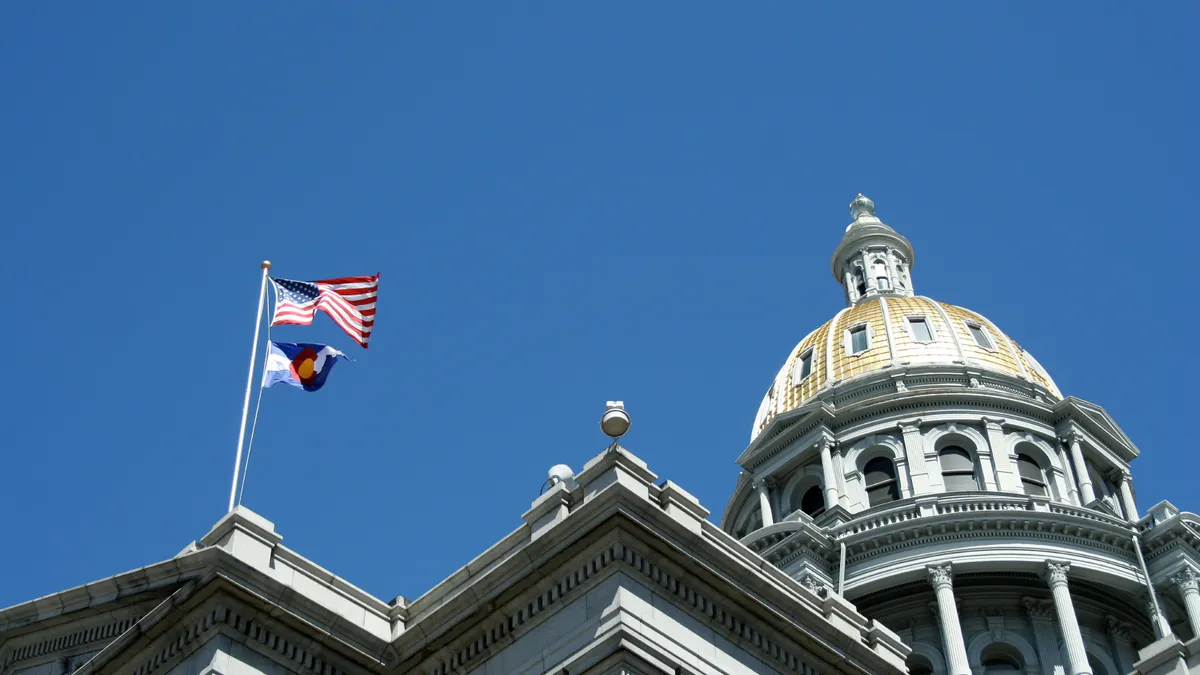
- The National Association of Wholesaler-Distributors has filed a federal lawsuit challenging Colorado's extended producer responsibility for packaging program, saying its rigid fee-setting rules and lack of oversight violate the U.S. Constitution.
- NAW claims Colorado’s EPR law violates businesses’ First Amendment rights by compelling them to join and pay dues to Circular Action Alliance, the producer responsibility organization. It further argues the EPR program violates the due process clause by prohibiting businesses from challenging CAA’s fee assessments in court.
- NAW has also filed a motion for a preliminary injunction, asking the court to block the EPR law’s enforcement while the case proceeds. NAW previously won a preliminary injunction in a separate EPR lawsuit in Oregon earlier this year, blocking the Oregon Department of Environmental Quality from enforcing its EPR law against certain NAW-member companies.
Dive Insight:
NAW is not new to EPR lawsuits: The trade association is currently challenging Oregon’s EPR law in court, a case that went to trial earlier this month and is now undergoing a post-trial briefing. In June, NAW also joined as the sole business plaintiff in a 17-state coalition challenging California's EPR law, SB 54, in federal court.
NAW had previously suggested it would take action elsewhere when it first launched the Oregon lawsuit. The named defendant in the Colorado lawsuit is Jill Hunsaker Ryan, executive director of the Colorado Department of Public Health and Environment. NAW is the sole plaintiff in the Colorado case and is represented by the New Civil Liberties Alliance.
In Colorado, the state Department of Public Health and Environment oversees the state EPR program and approved CAA’s program plan. Most producers are required to participate in the state EPR program, and in January they began paying mandatory fees.
NAW takes issue with the fact that the state did not directly implement the program itself, instead delegating management to CAA, “an unaccountable private party,” according to the lawsuit.
“The Act’s ostensible aim is to increase recycling, but its means are unconstitutional: it grants excessive governmental power to a self-interested private party, it discriminates against and disrupts interstate commerce, and it abridges businesses’ freedom of speech,” the complaint states.
NAW further claims CAA lacks “adequate standards or oversight” to carry out the program and uses its power as a PRO to compel businesses to join the EPR program and “financially support CAA as a condition of doing business in the state,” which it says is a First Amendment violation.
NAW also says CAA prohibits businesses from telling their customers how much they pay in EPR-related fees, which the association sees as First Amendment violation.
NAW takes issue with CAA’s methodology for setting those fees, saying the complex calculations make it so businesses cannot “accurately predict what their fees will be or conform their operations accordingly.” In the lawsuit, NAW calls these fees “a crushing burden on distributors” and says fees can “exceed the producer’s margin on a product or even a product’s price.”
NAW also says the law’s definition of producer includes many wholesale distributors that have to pay fees “even though they have no control over the selection, design, or manufacture of most product packaging.”
“Manufacturers and brands get to choose what materials go into their packaging, but distributors do not,” said Brian Wild, chief government relations officer at NAW, in a statement. “Yet Colorado's law still pulls some distributors into its fee structure as 'producers,' and those costs flow through the supply chain to businesses and consumers beyond Colorado's borders.”
The state’s EPR law does not allow producers to charge Colorado customers a fee “to recover their EPR costs—which bans businesses from informing consumers that EPR fees are the cause of the resulting higher prices,” the lawsuit states.
Businesses that want to challenge fees must go through a CAA-run arbitration process instead of being able to challenge it in court, the lawsuit claims.
“States have a responsibility to ensure regulatory authority remains accountable to the public. Businesses deserve the right to be heard, and they deserve access to a court that will hear them,” wrote Eric Hoplin, NAW’s CEO, in a LinkedIn post.
Meanwhile, Colorado is facing another EPR lawsuit. In March, the Independent Lubricant Manufacturers Association filed a state lawsuit challenging Colorado’s EPR law, saying the associated fees are impacting small businesses.
In an email from CAA’s communications department, the PRO said it “aware of recent lawsuits challenging Colorado's law and are closely monitoring developments” and noted it was “not party to the litigation.”
It added that CAA “has been transparent about our approach to fee setting from the start and our team has communicated extensively with producers, municipalities and other key interest holders. Our methodology, principles and dues schedules are publicly available, discussed in public forums and reflected in our approved program plan. Transparency and engagement are important parts of the program.”
In an email, Lauren Whitney, a communication specialist for CDPHE, said the department does not comment on pending litigation. “We remain committed to reducing waste, conserving natural resources, and supporting a cleaner, healthier Colorado for everyone.”
Editor’s note: This story has been updated with comments from CAA and CDPHE.