Dive Brief:
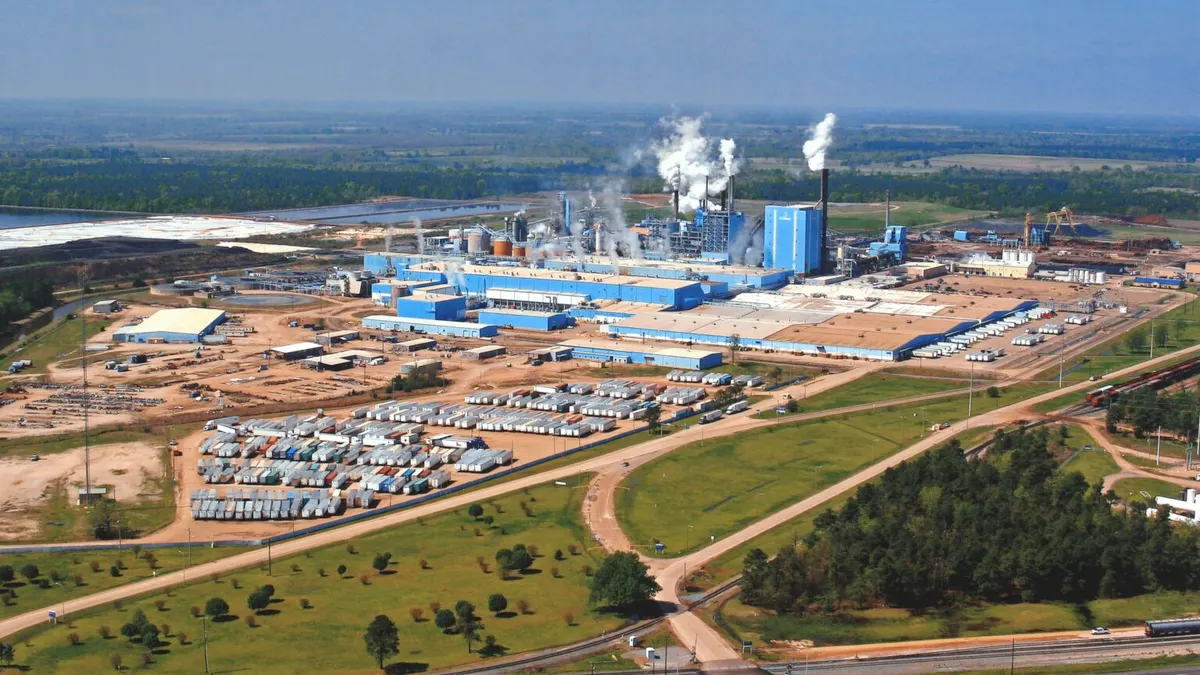
- Domtar agreed to settle with the U.S. Department of Justice over civil allegations of violating the U.S. Clean Air Act and the Arkansas Water and Air Pollution Control Act at the company’s kraft pulp and paper mill in Ashdown, Arkansas.
- The $1.5 million penalty will be split between the state of Arkansas and the United States. Domtar will also undertake an estimated $2.6 million worth of projects to address excess emissions from its operations and to correct “inadequate inspection and monitoring practices.”
- Domtar said in an emailed statement that it has already completed some of the necessary modifications and that this settlement “permanently resolves issues identified during a 2019 inspection.”
Dive Insight:
DOJ filed this lawsuit on behalf of the U.S. EPA and the Arkansas Department of Energy & Environment’s Division of Environmental Quality. They claim Domtar didn’t install the appropriate pollution controls on its brown stock washer, as required by federal and state regulations.
Brown stock washers are used during papermaking to separate black liquor from pulp fibers, and without the required controls they can leak hydrogen sulfide into the air, according to DOJ. Hydrogen sulfide is harmful to human health, DOJ says, and has a strong rotten egg smell.
The complaint also claims Domtar did not abide by required inspection and monitoring rules. The complaint cites 17 instances of violations in which inspections did not occur within the required 30-day period.
In addition, DOJ says Domtar didn’t conduct adequate performance testing for two of its boilers. Therefore, it’s unknown how many excess hazardous air pollutants the equipment emitted, such as volatile organic compounds, methanol, carbon monoxide and chlorinated compounds.
Domtar said via email that it has already completed modifications to the brown stock washer as part of the settlement. It also agreed to work practice changes, ongoing monitoring and recordkeeping.
DOJ acknowledged that Domtar is “taking the necessary steps to ensure that its systems control pollutants from the brown stock washer.” The company agreed to install capping valves to help prevent VOC and HAP emissions leaks and to update its biological wastewater treatment system to capture HAPs and VOCs before they are emitted. Domtar also is required to get a third party to review and revise the leak detection and repair plan to ensure compliance with environmental regulations.
DOJ filed the consent decree with the U.S. District Court for the Western District of Arkansas, and it is subject to a 30-day comment period.
Separately, residents in Kingsport, Tennessee, filed a federal class-action lawsuit against Domtar in March over complaints about ongoing failure to control odor emissions from its recycled containerboard mill and wastewater treatment system there.
When that lawsuit was filed, the company already was in the process of installing an anaerobic digester as a wastewater treatment measure to reduce potential odors; that’s slated to become operational next year. In May, Domtar responded to the complaint, denying it released odor emissions that harmed the community and saying the lawsuit should be dismissed.