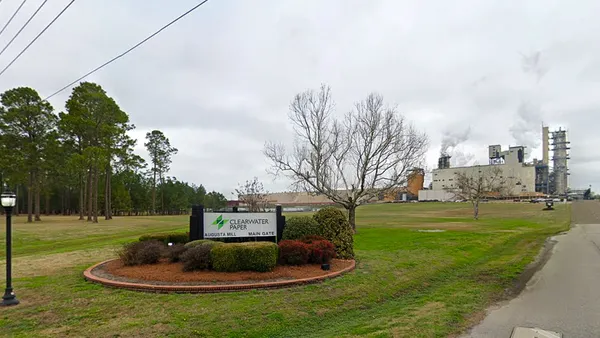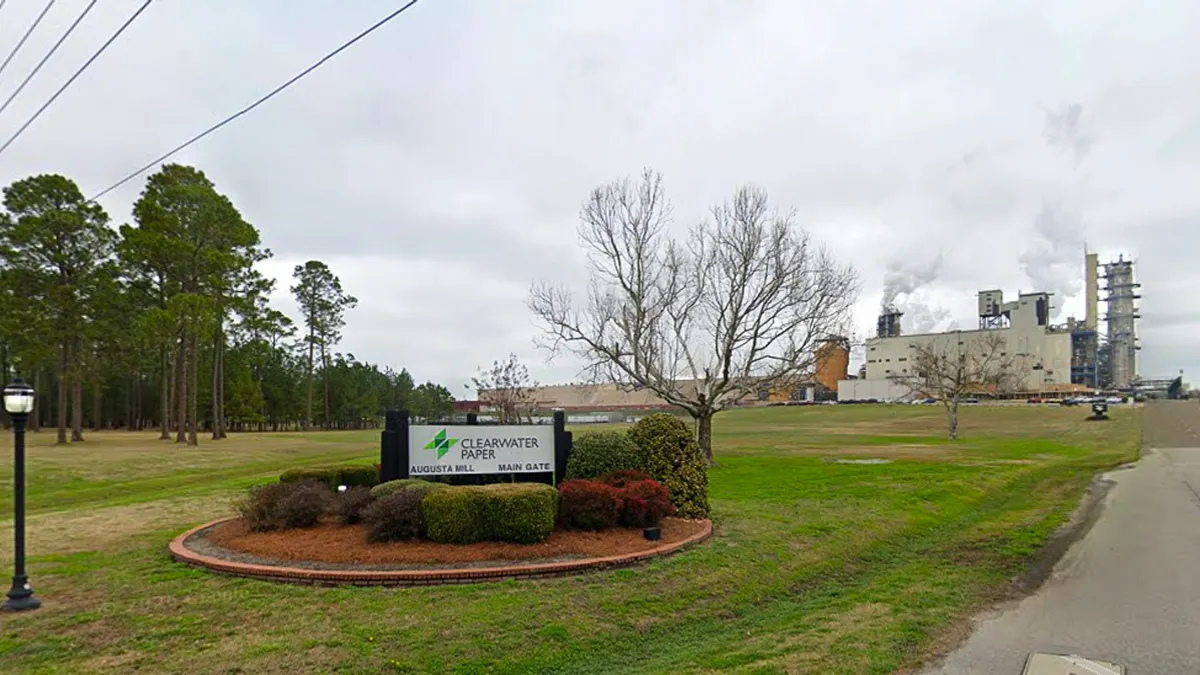
Clearwater Paper is casting doubt on the conditions under which it acquired a mill from Graphic Packaging International in 2024. Operations and financials for Washington-based paperboard manufacturer Clearwater took a hit from recent disruptions at the acquired bleached paperboard mill in Augusta, Georgia, the company discussed in its third quarter earnings report.
In late September and early October, “the mill experienced several electrical and mechanical failures in the pulp, power and recovery areas of the operation,” said CEO Arsen Kitch during Monday’s earnings call. “Due to the interconnected nature of a kraft pulp mill and the continuous flow of our manufacturing process, these failures have significant downstream impacts.”
Prior to these disruptions, for several quarters the Augusta mill had been performing 10% to 15% below desired production levels, Kitch said.
The Q3 disruptions worsened production and shipment volumes. However, much of the financial hit from that was offset by a portion of representation and warranty insurance settlements that Clearwater received related to the earlier acquisition. During Q3, it received the fourth and final RWI payment of $17.5 million, for a total of $73 million since Q4 2025. The policy limit is $105 million.
Kitch explained how during an M&A process, the seller makes representations and warranties on assets, customer agreements and other matters. Clearwater might have been misled during that mill purchase process, he said, and it is examining potential recourse.
“After we acquired Augusta, it became clear to us that some of those representations and warranties were either incomplete or inaccurate,” Kitch said. “We'll review all of our facts and all of our options related to the acquisition.”
The disruptions prevented the company from carrying out some planned maintenance at Augusta this month. Clearwater now plans to conduct a maintenance outage there in January at an estimated cost of $12 million to $15 million. Additional downtime is likely in Q2 or Q3 2027, at an estimated cost of $7 million to $10 million.
“We will need to invest additional capital dollars in the mill to address asset conditions that were not easily identifiable through a typical diligence process and were not accurately represented to us during the sale,” Kitch said.
Clearwater reported net sales of $385 million in Q3, and a 1% decline in shipments. The company had a net loss of $2 million.
In April, Clearwater announced that it would restructure its solid bleached sulfate mill in Cypress Bend, Arkansas, which involved halving production and reducing the salaried and hourly employee count by about 20%. It cited demand pressure for SBS, which has been ongoing for more than a year and has been discussed by other producers as well. The company has laid out a plan to create swing capacity at that mill to also produce coated unbleached kraft.
During Monday’s earnings call, Kitch pointed to “signs of recovery in SBS” with year-to-date shipments up 6% through the second quarter, compared with declines of 2% to 3% in CUK and coated recycled paperboard.
Fastmarkets RISI also recognized a $60 per ton price increase for SBS, and more could come next year, he said. “If all these increases materialize across all our tons, we would expect our adjusted EBITDA run rate to improve by nearly $200 million.”
Clearwater Paper expects paperboard production and shipments to decline in the fourth quarter, both due to typical seasonality and from the Augusta mill disruptions.
“We continue to work through the impact of these failures but we will recover and return the mill back to its normal production capability,” Kitch said. “We do think there will be some additional investments in Augusta next year to take care of some of the liabilities that we've uncovered.”