Geopolitical shocks can take time to work their way through supply chains. That’s currently visible in the paper and packaging industries as companies add fuel surcharges to orders because of skyrocketing diesel costs, largely attributed to fallout from ongoing global conflicts.
Paper and packaging manufacturers have had to balance the risks of absorbing rising costs with turning off customers with pass-through. When examining ways to mitigate or offset lofty diesel prices, many U.S. manufacturers find that changing modes of transportation to make the cost equation more favorable is not an option, said William O’Neil, a principal analyst at S&P Global Energy.
“You don’t really have another choice,” he said. “You have to move those goods from point A to point B ... and in the U.S. there really aren't any sort of scalable alternatives to diesel trucks.”
Paper mills have felt the pinch of high transportation costs in 2026, according to a Sept. 30 Fastmarkets RISI post that cited unnamed sources. Reliance on trucking combined with high fuel costs could prompt mills to reduce the distance from which they source recycled fiber feedstock, according to the post.
Paper and packaging companies have turned to adding fuel and freight surcharges to customers’ bills. Sylvamo issued a news release in late September announcing a $1 per hundredweight fuel surcharge to take effect on shipments as of Oct. 1. The news release said Sylvamo expects “other mills to follow given the run up of diesel costs.”
And they have. Billerud and Sustana have imposed fuel surcharges, and those companies chose to go by tonnage instead of hundredweight. The announced increases are $25 per ton of paper and paperboard as of Nov. 1 for Billerud and $20 per ton on all grades starting Oct. 12 for Sustana.
Earlier this year, prior to U.S. diesel prices reaching a record high in September, numerous packaging companies' executives discussed fuel cost inflation and potential action measures during earnings calls and industry events, including those at Ball, Cascades, Graphic Packaging International and International Paper, among others.
Speaking about Sonoco’s fuel surcharge during a July 23 earnings call, CEO Howard Coker said, “It will come and go as diesel varies. ... This is not new to the world.”
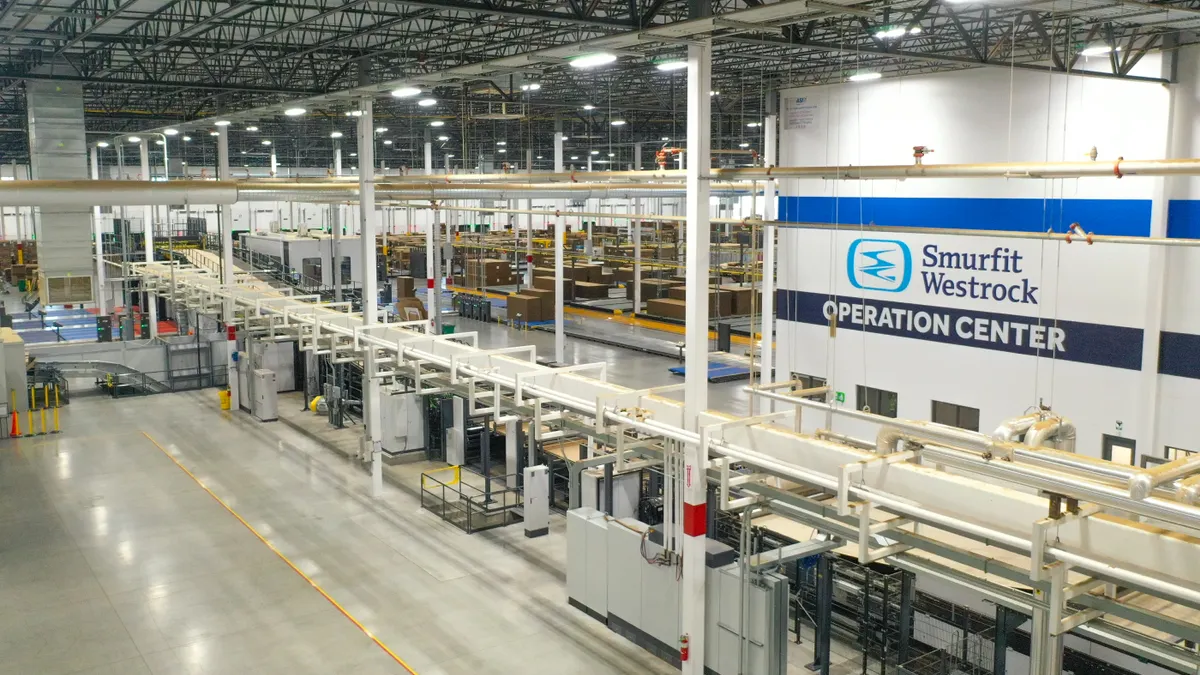
During their July 29 earnings call, Smurfit Westrock executives discussed freight cost absorption and baking inflation costs into the company's third round of announced containerboard price increases this year — while still exploring other options. CFO Ken Bowles said freight cost “remains the most significant headwind we face in 2026.”
The freight surcharges have potential to stick around for a while, given the predictions for diesel supply and pricing in the coming months.
“We expect diesel supply globally to remain pretty constrained throughout the fourth quarter into 2027,” O'Neil said.
Diesel dynamics
How exactly did we get to this point of sky-high diesel prices? It primarily comes down to the war with Iran and Russia’s war with Ukraine affecting global diesel supply this year, O'Neil explained.
The Iran war started Feb. 28 and resulted in a nearly full closure of the Strait of Hormuz. That hampered producer shipments from several major suppliers to the diesel market. Plus, attacks on some refineries in the Middle East curtailed output. Those factors together have constricted supply from the region for more than six months.
Then during the summer, Ukraine ramped up its attacks on Russia and took out some refineries. That curbed supply coming out of Russia, which traditionally has been the second-largest diesel exporter behind the United States. Last year, Russia exported about 800,000 barrels of diesel per day, although that has fallen to around 120,000 barrels per day in recent months due to reduced capacity from Ukrainian drone strikes. The U.S. exports about 1.5 million barrels per day.
With diesel supply in Russia and the Middle East getting crimped, “the role of the United States in supplying the global diesel market has grown significantly this year,” O'Neil said, explaining that the U.S. has accounted for about a quarter of all seaborne global diesel exports in recent months.
Meanwhile, U.S. diesel demand remains steady. The U.S. consumes about 4 million barrels per day, with up to 75% going toward trucking, he said. If considering diesel supply and demand curves, “your supply curve is shifted down, but your demand curve really hasn't budged that much — you end up with significantly higher prices,” O'Neil said.
The retail price per gallon of diesel in the U.S. reached a record high of $6.53 on Sept. 22. It has dropped slightly to $6.32 per gallon as of Wednesday, which is “still exorbitantly high,” said O'Neil. This week’s price is up about 75% compared with a year ago.
Now what?
S&P Global Energy anticipates that diesel prices will peak this quarter. That’s due to the current limitations combined with typical diesel demand peaks at this time of year. Supply isn’t projected to change much into next year.
It’s unclear how long it will take for diesel prices to return to a more normalized level, but analysts generally suggest bracing for high prices for more than a year from now. O’Neil doesn't anticipate U.S. diesel prices will fall below $5 per gallon again until early 2027.
“We don’t really expect much getting back to normal before 2028,” O'Neil said. “Our running assumption is that something changes that allows more oil out by sort of the middle of 2028.”
Even the petroleum and gas industry doesn’t expect quick renormalization. In September, the Federal Reserve Bank of Dallas surveyed oil and gas executives, with many questions garnering responses from leaders at more than 100 companies. Nearly 30% of respondents reported they expect crude oil exports from the Middle East to return to normal during the second quarter of 2027. The second most popular answer, at more than 20%, was 2028 or beyond.
When predicting how many quarters it could take for the spread between diesel prices and crude oil prices to return to 2025 levels, nearly half of respondents anticipate more than four quarters. Nearly 25% said between three and four quarters.
Considering some paper companies’ diesel surcharges were just implemented days ago and others have yet to take effect, data is not yet publicly available that would reveal impacts to orders and volumes or whether customers engaged in frontloading to get ahead of the fees. But Fastmarkets RISI noted Oct. 1 that its sources suggest mills’ attempts to procure materials more efficiently to reduce fuel expenditures could influence recovered paper generation and collection.
While customers initially might gripe at fuel surcharges, some observers think the alternatives are worse. For instance, LinkedIn posts by packaging professionals have highlighted that transparent fuel and freight surcharges are more likely to be pulled back when conditions improve than if companies incorporate the cost into their base price, which tends to stick.
Even so, observers suggest figuring out a long-term diesel cost management strategy. “We’re looking at pretty prolonged pain,” O'Neil said.