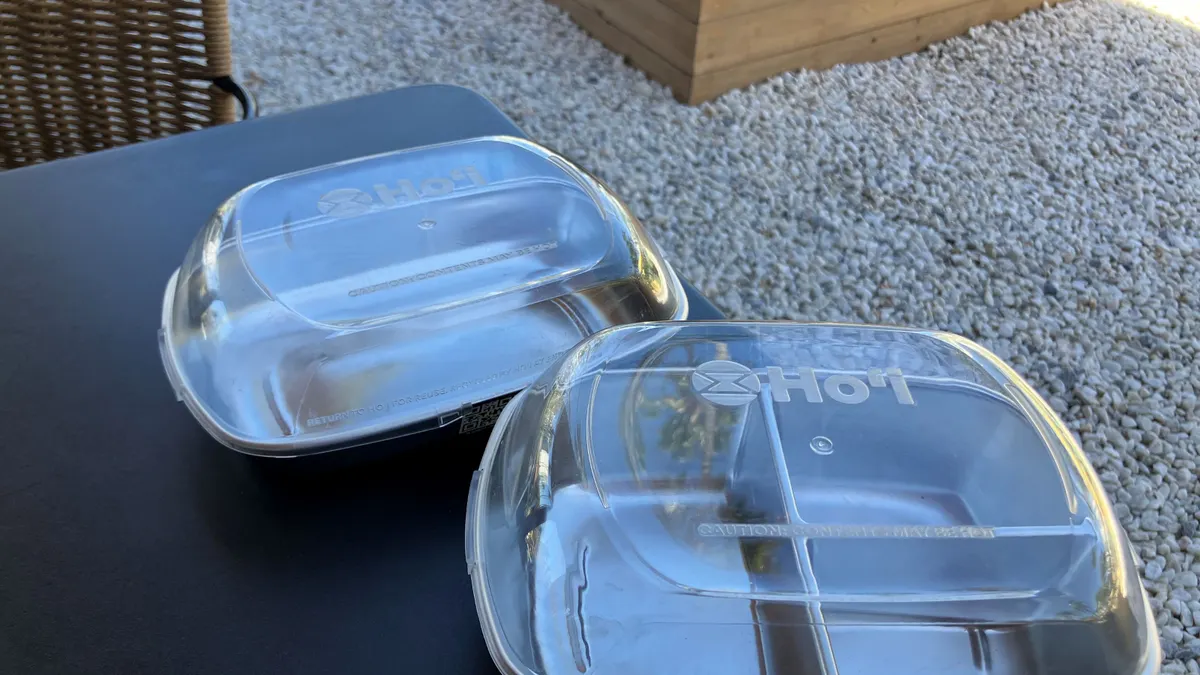
Reuse systems nonprofit Perpetual is preparing to help launch an upcoming open-loop reuse program spanning foodservice establishments in Hilo, Hawai’i, dubbed Ho’i — meaning return. But first, it had to get the containers right, explained Ellie Moss, an executive director at Perpetual.
The county has an ordinance that in part defines reusable foodservice ware as not having a base constructed of plastic, which restricted the container options. What’s more, insights from open-loop reuse pilots elsewhere, such as Closed Loop Partners’ Petaluma Project in California, revealed that some users weren’t a fan of plastic for certain use cases, such as drinking hot beverages out of plastic cups.
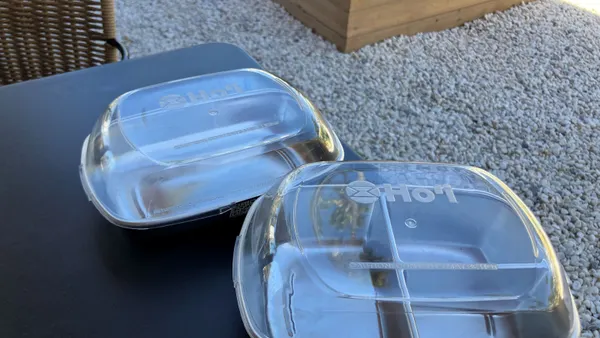
The Hilo project partners — which include nonprofit, government and university entities, as well as German reuse service provider Vytal — are going with a range of stainless steel containers, although plastic lids are allowed so users can see the food inside.
For example, one of the program’s suppliers is Australian company Returnr, which has manufacturing in China, Moss said. Tariffs have been a factor to navigate. “Over time, I would love to see more options being developed,” Moss said, noting there’s currently little to no small-piece stainless steel manufacturing happening in the U.S.
Multiple growing reuse program operators, such as Bold Reuse and Re:Dish, have targeted closed-loop settings such as sports venues, schools or corporate campuses. The logistics of managing consumer behavior and container return is considered simpler in these settings.
But open-loop programs at the restaurant or municipal scale could be poised to become more common. “Perpetual has chosen the hardest piece of this to focus on, and we recognize that,” Moss said. Beyond Hilo, Perpetual is working to develop such programs in three other localities around the U.S., focusing on Savannah, Georgia next. Moss’ organization aims to play a project and market development role in what she hopes will become longstanding programs that can ultimately sustain themselves.
California EPR law SB 54 is expected to catalyze further moves into reuse, and Moss hopes stakeholders will see not just obligation but opportunity. In this vein, producer responsibility organization Circular Action Alliance recently announced the Reuse Cities initiative with Closed Loop Partners to help implement and scale reuse systems for packaging in the state.
CAA’s updated California budget shared this week earmarks between $901 million and $1.975 billion for reuse and refill in the state between 2027 and 2031. CAA projects that anywhere between 3,000 and 10,000 total venues — namely K-12 schools and quick-service restaurants — could convert from single-use to reusable packaging during that period.
And the PRO projects it could spend between $221 million and $603 million on packaging inventory itself, meaning initial reusable packaging supplied at launch plus annual replacements for lost or damaged inventory.