Scott Trenor saw a stack of storage containers in a retail store and did what most consumers would never think to do: “I stuck my head in them and took a whiff.” Trenor, technical director at the Association of Plastics Recyclers, was met with the unmistakable smell of recycled plastic.
Odors are one of the major sensory limitations brands face when incorporating postconsumer recycled plastics into their rigids and films. Optics are another issue, as PCR often has a yellow or gray tint due to heat exposure during processing and residue from the plastic’s previous use, according to Crystal Bayliss, executive director of the U.S. Plastics Pact.
Tackling these challenges is especially important for food and beverage as well as personal care products, in which smells or colors could be off-putting to consumers — potentially swaying them to buy a different brand. The issue is becoming more urgent as states pass sustainable packaging policies incentivizing less virgin plastic use and, in some cases, specific recycled content minimums.
“A lot of folks are coming to us asking for PCR as a direct result of packaging EPR laws, particularly SB 54,” said Caroline DeLoach, director of sustainability at Atlantic Packaging, referencing the California regulation that established extended producer responsibility for packaging and single-use plastic foodservice ware products.
PCR uptake overall, however, is low. The U.S. Plastics Pact’s latest annual report said average use of PCR or responsibly sourced biobased content in plastic packaging is 14%. But year after year, the report shows small increases in PCR uptake, Bayliss said. “There’s steady and incremental progress.”
Food and other CPG brands, in conjunction with their packaging partners, are devising packaging and using technologies that overcome PCR’s sensory hurdles.
Packaging suppliers, consumer brands get PCR in the mix
Odor is an issue especially for polyolefins, Trenor said. Consumer goods with fragrances can leave residue, which imparts a smell onto their plastic packaging. When a reclaimer washes the recycled material at a high temperature, “it smells like you took all of the laundry detergents in the laundry aisle and heated them up,” Trenor said. Devolatilization removes the majority of fragrances, so the smell in the recycled pellets is “mostly mitigated,” Trenor said.
Paper labels on recycled plastic also create olfactory problems, because “paper doesn't melt; it burns,” which DeLoach said results in a smoky odor in PCR pellets. Atlantic Packaging asks its customers to use polypropylene labels instead of paper ones on stretch film for this reason.
Odor has presented challenges in serving the pet food market. DeLoach has talked to CPG customers who tried to integrate PCR into their pet food and treat packaging. But in testing, dogs and cats’ acute senses of smell picked up the PCR scent in primary packaging and the animals shied away from those products. The issue was less prevalent when PCR was in the secondary or tertiary packaging.
Atlantic Packaging began working with a major pet food manufacturer on a PCR solution four years ago, DeLoach said. They initially developed a shrink bundling film for pet food cans with 30% PCR to replace the virgin film used at the time. After six months of successful runs, they trialed a 50% PCR film which is still in use today.
The other major sensory limitation of PCR is an off color, which is problematic for products that are expected to have a particular, consistent aesthetic. When Unilever changed PCR resins for its Hellmann’s mayonnaise bottles, consumers thought something was wrong with the product because it appeared to have a gray tint.
Paper towels are another example, DeLoach said. Consumers want something that looks clean, clear and bright, so brands are hesitant to use a PCR bundling film that comes across as gray.
“There’s concern that consumers may shy away from that, even though it obviously has nothing to do with the performance or cleanliness of the actual product,” DeLoach said.
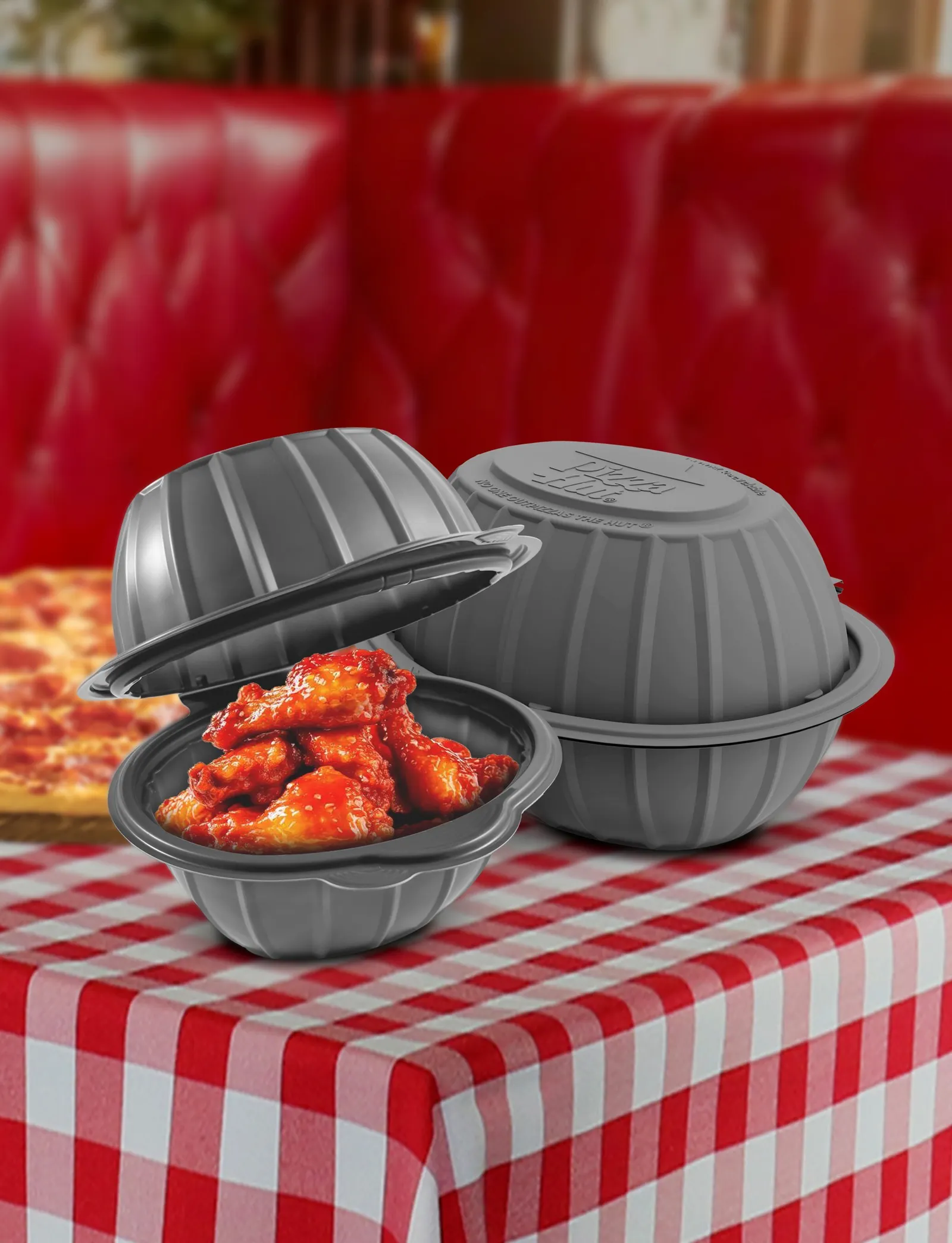
One way to get around color issues is to deliberately design packaging that’s dark in color, Trenor said. He cited Pizza Hut’s work with Anchor Packaging to design a charcoal-colored chicken wing bowl. The companies removed carbon black and mineral fillers from the packaging and incorporated 10% postconsumer recycled polypropylene, while also designing the bowls to be recyclable.
The clamshell wing bowl costs more than the previous packaging, Trenor admitted. However, the bowl was designed in a way that employees could coat the wings with sauce directly in the packaging and shake it, which reduces the amount of dishes used and streamlines the overall system.
“The cost savings on that front-end covered the additional cost of the recycled content,” Trenor said.
Overcoming PCR hurdles with tech, creativity
Churchill Container, which makes reusable plastic drink cups and food buckets for sports venues and movie theaters, ran into color and odor hurdles when designing with PCR, said Erik Johnson, product director at the company.
Churchill was acutely aware that beverage containers go right up to a consumer’s nose and mouth.
“Consumers won’t buy a product if the drink container smells bad,” Johnson said.
The company worked with PureCycle Technologies to create a material derived from dissolution purification technology without a noticeable odor. Churchill manufactured 32-ounce collector cups made entirely of PureCycle resin that were featured at the College Football Playoff National Championship in January.
In addition to PureCycle, other companies are stripping out volatiles and making PCR possible for consumer-facing packaging applications, Trenor said. Last year, Procter & Gamble and Lindner launched Flexloop, an extraction and recycling technology that removes contaminants like surface ink, adhesives, labels and odors, allowing the material to be used in personal care or cosmetics packaging. Also in 2025, Nextloopp received approval from the U.S. Food and Drug Administration for its recycling process producing food-grade recycled polypropylene.
“There is quite a bit of innovation in this space,” Trenor said, noting that such solutions exist but often cost more than using virgin plastic.
Packaging companies and CPGs are also innovating in the specific ways they incorporate PCR. Secondary and tertiary packaging that doesn’t directly touch food offers a PCR opportunity, DeLoach said. B2B applications such as shrink bundling or palette stretch film eliminate brand concerns about consumer perception of a gray tint.
“Stretch film is something the consumer would never see,” DeLoach said. “If we have slight changes in color, it doesn't matter as much.”
Other options include using PCR in the middle layers of a multi-layer package, a PCR closure on a virgin container, or full label coverage that hides color variations, Bayliss said. “With a little creativity, the sky’s the limit.”