CHICAGO — TemperPack is a company that prides itself on offering plant-based alternatives to plastic cold-chain packaging. The company is advancing that mission by acquiring the intellectual property of Cruz Foam, a company that made biodegradable foam partly derived from chitin, a biopolymer found in the shells of shrimp and other sea creatures.

The companies shared a goal to use science to produce sustainable packaging, according to TemperPack CEO Peter Wells. Now that Cruz has ceased operations, TemperPack intends to carry on the mission via the acquired IP portfolio which includes 23 patents and patent applications.
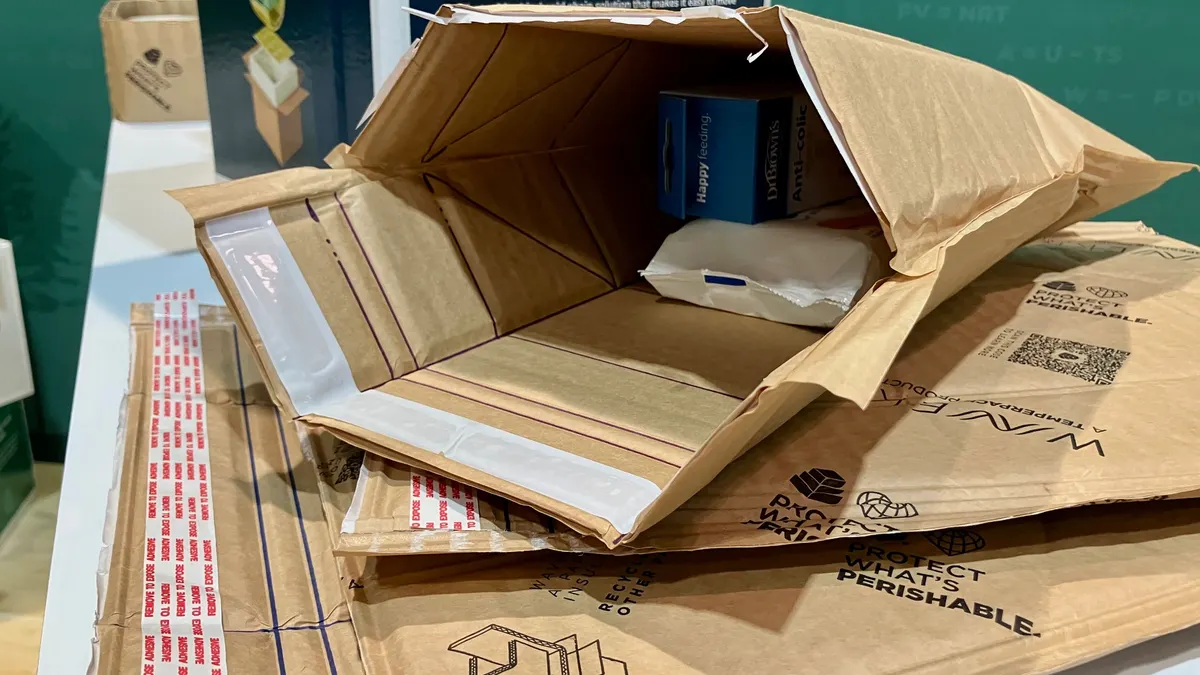
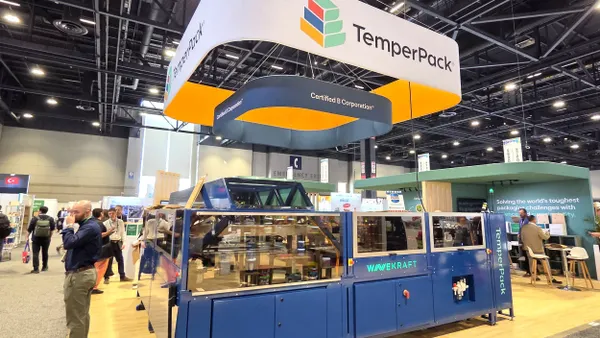
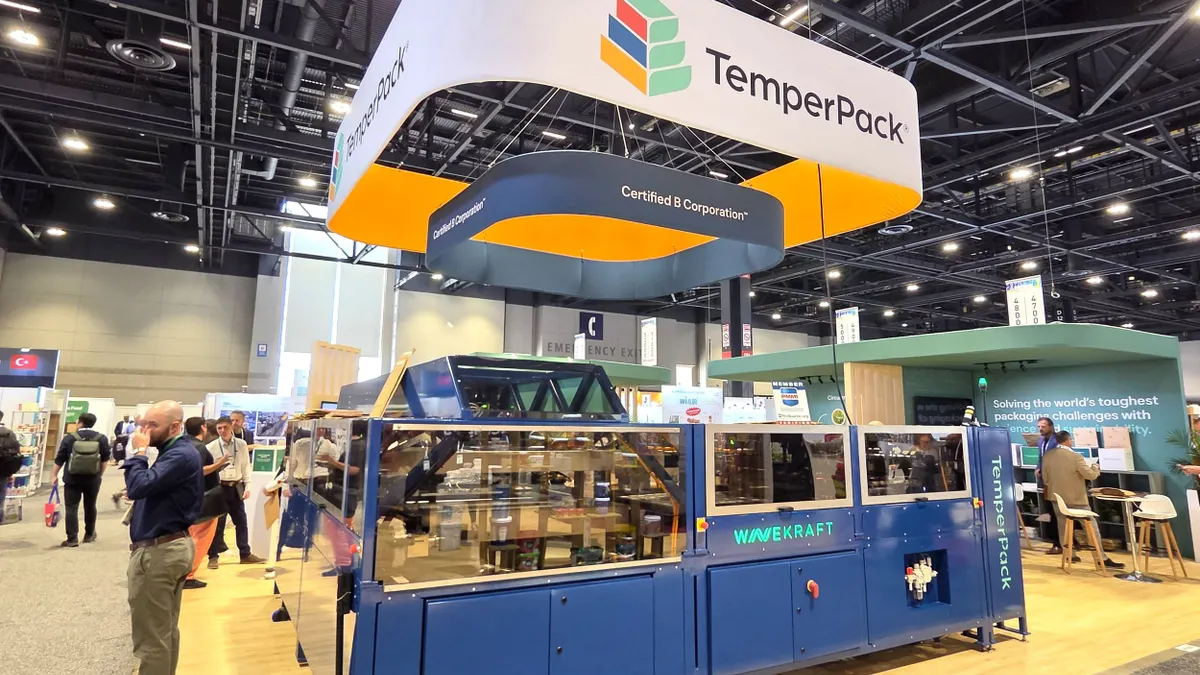
Last year, Closed Loop Partners loaned TemperPack $10 million to advance the circularity mission. This year, TemperPack further expanded the reach of its proprietary engineered material, dubbed WaveKraft, with the introduction of a fiber padded mailer. It also sells WaveKraft production machinery.
Wells spoke with Packaging Dive at Pack Expo 2026, including about M&A, AI integration, a notable sustainability accomplishment this year, and “warm-chain” product experimentation.
This interview has been edited for length and clarity.
PACKAGING DIVE: What prompted TemperPack to acquire Cruz Foam’s intellectual property?
PETER WELLS: It was opportunistic. They were going through a process where they were selling off the assets of the company, principally the IP. There was nothing to take over, operations or customers, because it was already sort of wound down.
We knew Cruz Foam. They were a competitor, they were a lot smaller than us, but we always were looking at them and admired them and liked what they were doing. We felt we shared a passion around what we were doing.
When they reached out, we wanted to take a look. We felt that we'd be a good home for the IP. They felt we'd be a good home for the IP. There's some interesting capabilities here. We should take the opportunity, bolster our own IP footprint, and then see what we can learn from it and see if there's ways to adapt it and apply it to what we do.
I’m familiar with Cruz due to its use of chitin. Do you plan to continue that work?
No. And I'm pretty confident they were also evolving their formula. They were moving away from it and using more starch-based formulas, which is what we do.
Are you hoping this IP will help TemperPack explore other biomaterials?
Yes, we're always looking at that. We have an R&D lab in our facility in Richmond, Virginia. We're always playing with different materials — different types of starch, we're also looking at cellulose. There is always going to be that desire to play around with different plant-based materials to see if we can get better performance, lower cost, different options for end of life, whether it's composting or recyclability. I don't think that's a journey that ever stops for us.
Beyond Cruz, what’s your M&A strategy?
I would call it more of a framework. We tend to divide the market into sort of a packaging lane, a coolant lane, and a fulfillment lane. We're obviously in the packaging lane.
We've broken it down into what is out there that might be material science, it might be a particular product performance or a particular market segment they're in, or a digital capability that we think ties into the digital platform we're developing. We keep an eye on it if we think it would be additive to what we're doing.
At any given moment, I think we probably have 40 or 50 companies that we keep an eye on. And every now and then, one of those might pop up as an opportunity, and we explore. Sometimes we might proactively reach out.
It's hard to get a deal to happen because you've got to get the right moment. They've got to be interested in the first place. It could be a very quick conversation if they say no, they're not for sale. Then you're done. Or, if they're interested, is there enough synergy and potential? Are you in the same place from valuation? There's a lot of things that have to line up in the right way.
We acquired KTM Industries in 2022, which was the company that was making Green Cell Foam. So we've done it, and we know it can be successful for us.
But in my view, you can't say “Hey, I have the strategy, and this is how we're going to going to drive all this inorganic growth.” Because you just don't know what's going to land at the end of the day.
That’s so true, especially with the current state of the economy and geopolitics. We’ve noticed a lot of packaging M&A has dried up in 2026.
Yes. Somebody described it to me today as a choppy market, and I said that's a perfect description.
It's really choppy. There's some stuff that pops up and then goes away, and then you're never really sure what's going on.
TemperPack has released several WaveKraft innovations recently. Do you anticipate that you'll continue to innovate, and potentially put out new products, in 2027?
I think so. I think we've noticed this year that we've been evolving the WaveKraft platform to find its sweet spot. The interest level has been increasing. I think we'll probably go beyond the deployment number that we were thinking we would do next year. It seems like even in the first quarter we'll probably deploy the number of machines we thought we would do the whole year.
I think we’re on the edge of really big growth in WaveKraft, and part of that also is some experimenting, including in “warm chain.” That's really interesting because it's thermal properties, but you're just using it differently to keep things warm as opposed to cold.
When we launched WaveKraft it was more around cold chain, which is where we’re focused. But then we got approached by a major brand who wanted to pay us to develop a product for them, so it seemed like a great opportunity. It's really leveraging the substrate that we have and making it something that fits for them.
A topic that is hot here at Pack Expo, and in general, is AI. I’ve been hearing recently that some people view 2026 as a pivotal year, or an acceleration year, for AI in packaging, whether for design or within operations. Is that the case at TemperPack?
I think our approach to AI has been a little different. We started with a data architecture.
When I joined the company three and a half years ago, I was talking to the board and the team about digital, mainly because of my experience with energy. Back when I was at GE, we rolled out a big digital strategy, Internet of Things. All of that ability to understand what information you could pull from where, TemperPack knew that was going to be important.
So we hired a digital leader over two years ago, and mainly the focus was to help us professionalize our IT capability. But also to help us think about how digital tools could help us run the business, how digital tools could help us interface with customers. Then, of course, AI starts to emerge.
His view, which I would say is absolutely correct, was that you can't go down the path of AI and doing digital unless your data architecture is correct. So that team spent the first year just completely revamping our entire data architecture. We now have an enterprise data warehouse, and that was step one.
Then, as we came into this year, we said OK what can we do? So we've been focused a little bit more on business process automation and how you can use AI to help with how the orders get processed. And how you get more efficiency out of leveraging those kinds of tools.
We’ve launched our own digital platform, and that’s ultimately going to have three modules. The first two are the customer interface environment, and then what we might call the digital twin of our lab. We have an ISTA-certified lab where we do loads of pack-out design and optimization, loads of testing. We’re trying to leverage our digital platform to see how we can iterate in a digital format really fast before doing a physical test. We’ve played with agentic AI, but we actually have found that sometimes it’s not the best solution.
I do think AI is transformative and is going to help us in the way that we run the business. I don't know that you'll see us promoting any kind of tool, such as “TemperPack has AI.” I just don't know that it's necessary. For us, it's more digital capabilities that are real and that are really helping the customer — using algorithms, using machine learning, and things like that. There’s loads of opportunities there.
Another thing a lot of folks are talking about right now is how economic and geopolitical factors — primarily tariffs, the war with Iran, diesel prices — are affecting their bottom lines. What are you seeing at TemperPack?
Slow changes on cost. For a long time we really didn’t see any impact.
Initially, of course, was tariffs. We have some imports, but a lot of stuff we source domestically or from Canada — which to us at the time was kind of domestic. Our strategy has been to make sure we don't sole source on anything; the team’s done a good job, I think, of trying to be diverse such that if we need to pivot, move more volume from one place to another, we can do that.
So tariffs have really had no impact on the business cost. Though the diesel cost and the impact of that cost feeding into the supply chain, we see it obviously in surcharges like everybody does. We have to look at our customer contracts and our pricing mechanisms, and to obviously try to pass through what we can when we get impacted. We’re expecting to see some cost inflation next year.
It’s unfortunate, it’s across the board, everybody’s seeing it everywhere. I think it will normalize, but it’s anybody’s guess how long that will be.
Is there a fun fact about TemperPack you would like readers to know?
We’ve never been so happy to get a “B.” We got B Corp certification in April of this year. It’s a really big deal, and we’re super excited about it.
A lot of our employees are here because they like the mission, so it was a really good way to emphasize that it matters and get a third-party validation. It’s not that easy to get. I would say it’s wonderful.
Editor’s note: This story has been updated to clarify the nature of TemperPack’s “warm-chain” experimentation.