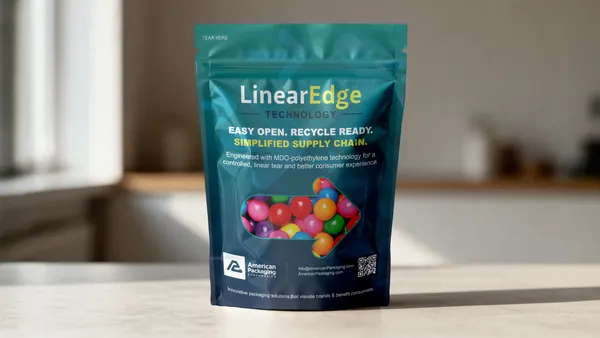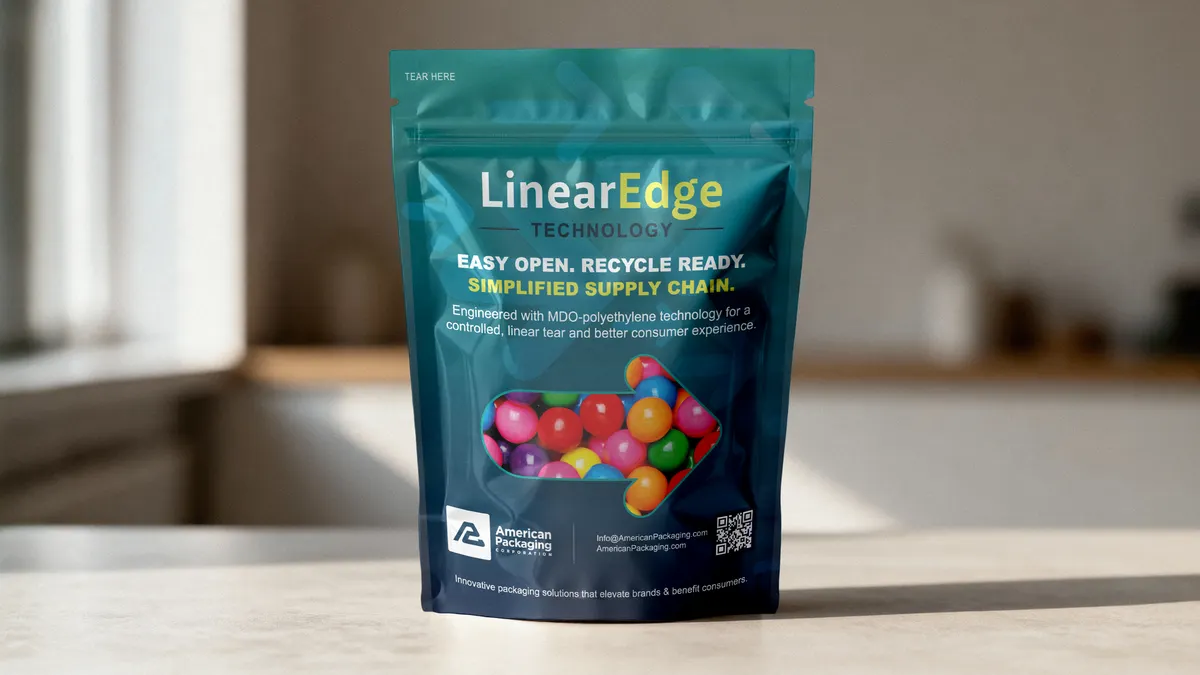
Have you tried to open flexible plastic packaging along a perforation only to have the material improperly rip all the way down to the zipper closure — or into the pouch section — and become difficult or impossible to reseal? That’s the consumer frustration American Packaging Corp. sought to prevent by enlisting Dow to help create a new recycle-ready monomaterial that provides a cleaner tear.
“This is something very important to our customers, and this has been brought to us many times,” said Jeff Travis, senior manager of innovation and sustainability at American Packaging Corp. “Our goal here was to develop something that was real simple and easy to implement” without adding additional steps to the manufacturing process.
The partners worked for nine months to develop LinearEdge, a machine direction-oriented polyethylene film. Dow explored how it could balance a new feature — cleaner, easier tearing — with existing film packaging requirements.
“How do we optimize the easy-open feature, but not compromise on the food protection and the toughness and all of the other things that a package has to be designed to do?” said Michelle Sauder, marketing director for food and specialty packaging at Dow. “It's a combination of choosing the right resins with the right process.”
The team focused on innovating while maintaining design for recyclability, keeping in mind emerging extended producer responsibility standards like California’s. This centered on developing a monomaterial instead of a multimaterial film.
“The problem with many of these [innovations] is when you're adding additional materials,” Travis said. So the partners focused on simplicity. “This is essentially just modifying the current film and still maintaining that recyclability,” he said.
Process-oriented project
A challenge with using polyethylene materials is that no two are the same, Travis said. “Everyone comes up with different blends and ways to manufacture them.”
The project team notes that orientation processes are important when improving the performance of polyethylene-based films. Stretching the material in this way changes the properties of PE and is gaining popularity as a way to advance monomaterials and film recyclability.
MDO-PE also requires additional processes to ensure high packaging performance. To that end, converter APC laminates Dow’s material to create the final product.
“You can't look at the MDO film alone. You also have to look at what you're pairing it with, which is typically a sealant film,” Travis said. “There's a number of things that optimize that solution.”
Machine-direction orientation also is shown to provide high clarity and reduce the haze that PE films often exhibit, Travis said. Plus, he noted that LinearEdge offers improved stiffness while working well in printing presses.
Most similar existing material solutions are produced outside the U.S., the partners explained. Dow Pack Studios in Freeport, Texas, is a flagship packaging innovation and testing facility for the film producer, and it’s the location behind the new product design. Dow also has an MDO line there.
Developing and producing the new material domestically provides customer advantages including reduced costs and lower potential for supply chain hiccups, partners said.
“That robust supply chain is really meaningful to customers in North America, having easy access to this technology,” said Teri Meadow, APC’s director of corporate marketing.
But consumers are the project’s foremost focus. Consumers typically don’t choose a product because the packaging is monomaterial or recyclable, Sauder said. Rather, consumers desire products with packaging that meets their needs, such as for freshness, convenience and ease of use.
“In the conversations between Dow and APC as part of this collaboration, over and over again I heard the term, ‘improving the consumer experience,’” Meadow said. “Having that really consistent linear tear across is really meaningful to the consumer experience. ... I think the market's going to really respond to this one well.”
Speeding toward commercialization
Dow eventually intends to distribute the easy-tear solution globally after starting domestically with APC. Collaboration is key to de-risking and speeding commercialization, partners said.
Working with APC helped Dow understand the importance of certain features and steps during converting, such as “in the lamination step, in the packaging production step, how is it performing, and making sure that it's meeting all of those check boxes,” according to Sauder.
The partners are currently in the validation and ramp-up phase, and they hope to bring the final product to market soon. Getting this material into APC’s product line to meet customer needs is “urgent,” Travis said. But even accelerated R&D timelines requires patience, and nine months is pretty quick in the grand scheme of things, Sauder said.
“The multimaterial films that are out there have been optimized over 50 years,” she said. “We're sort of still on the beginning evolution of this transformation of packaging into recyclability.”
APC approached Dow with the problem in a large part for confectionary customers, Travis said. But LinearEdge will be suitable for a variety of stand-up pouch applications, including for snacks.
“PE films have come a long way. ... The challenge has been when it gets to the consumer side,” Travis said. “This is where that innovation really developed, and it's been a fantastic solution. We look forward to getting this implemented in the market.”
Correction: A prior version of this article misttated the location of Dow Pack Studios. It is located in Freeport, Texas.