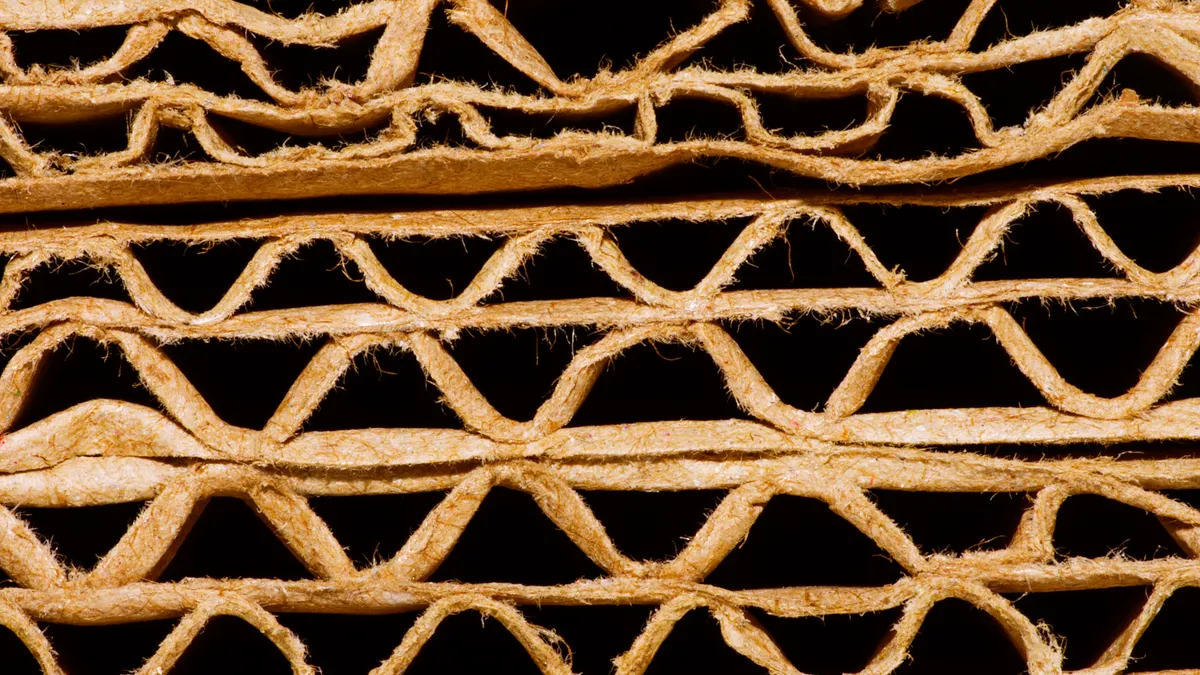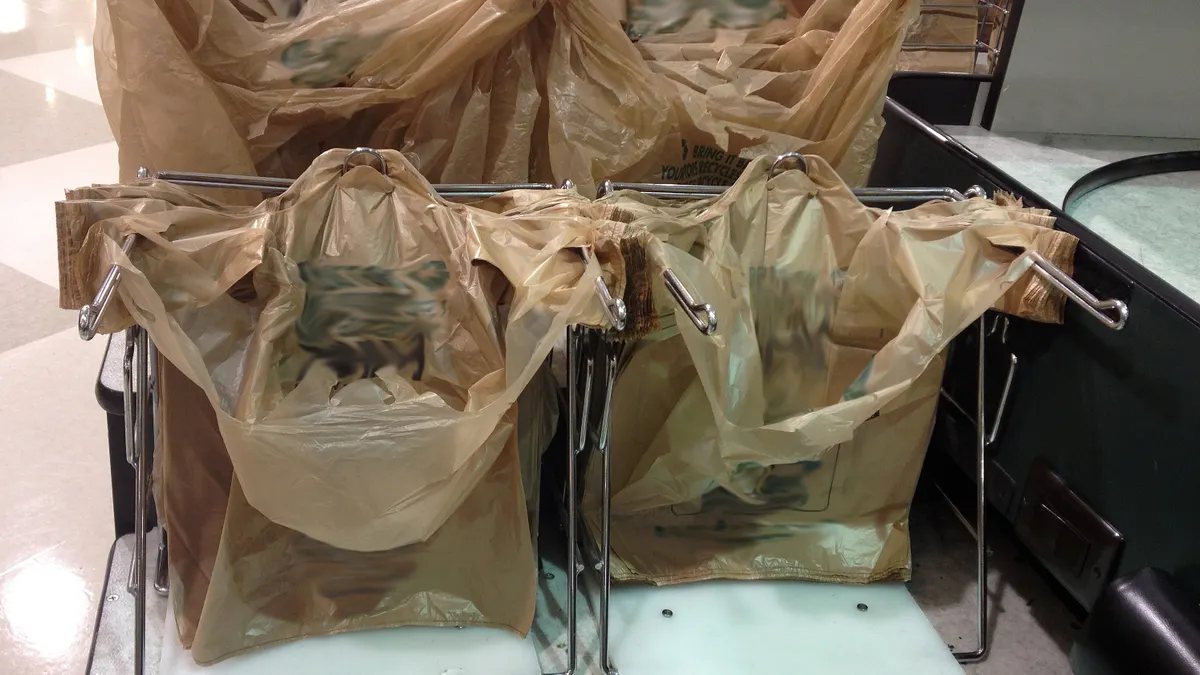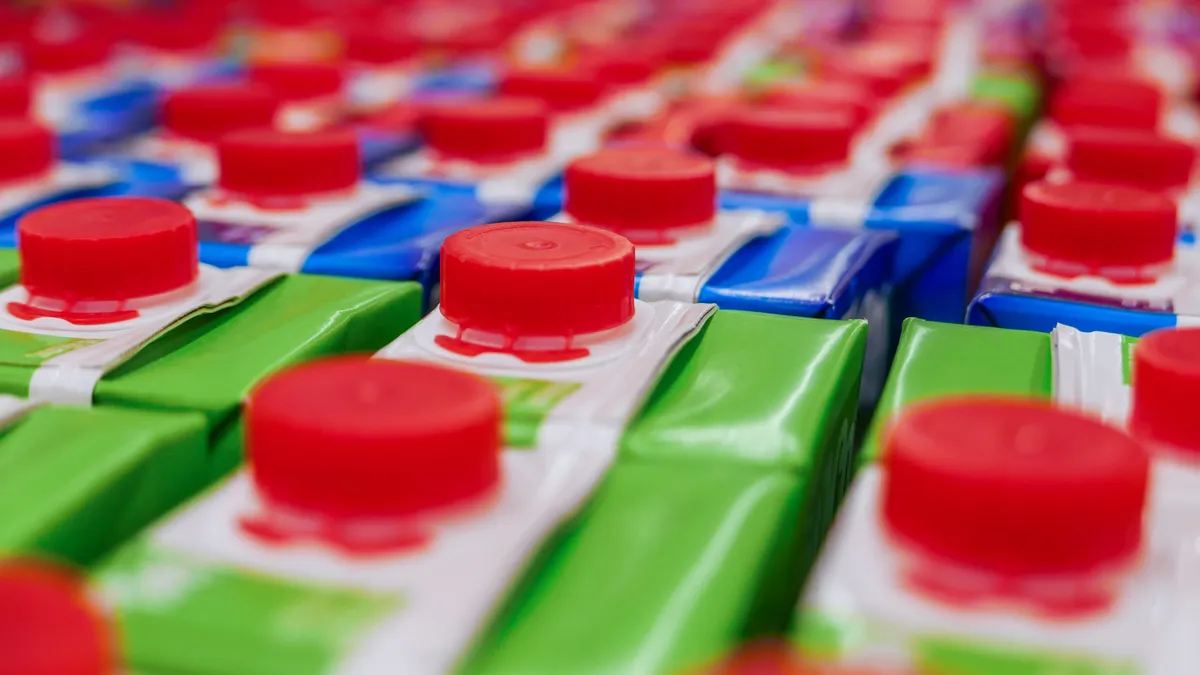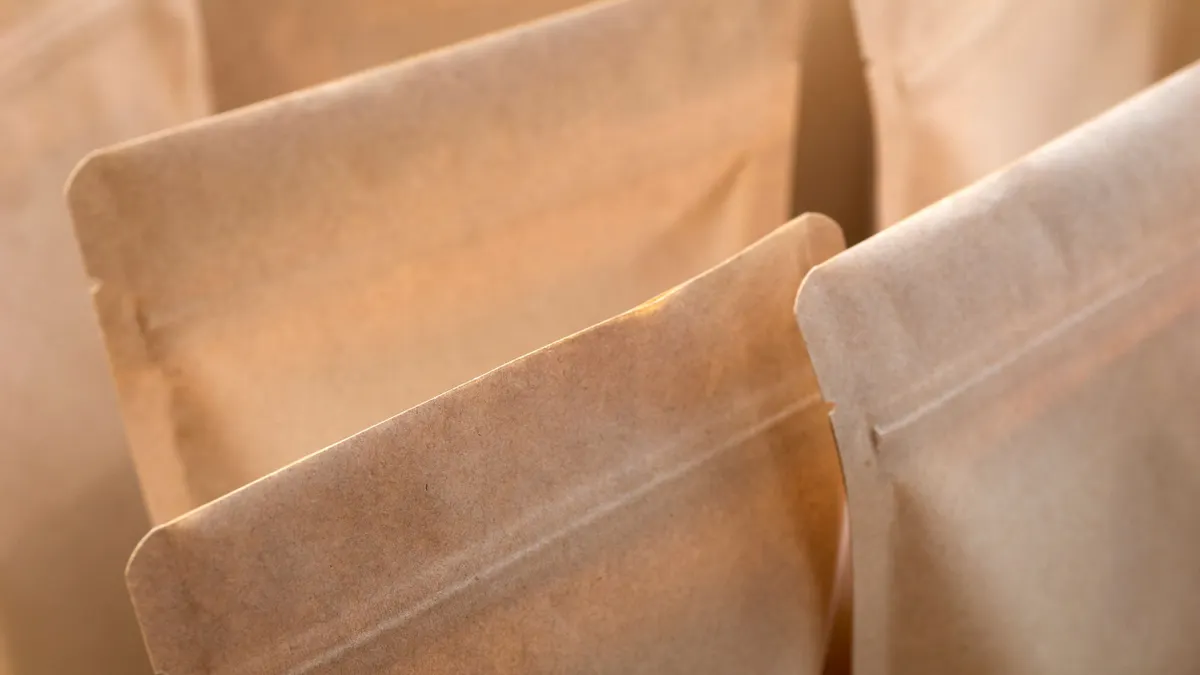
Although demand for recycled fiber packaging has been rising steadily in recent years, the market for virgin fiber is very much alive and well, according to industry experts. While recycled content levels vary by packaging type and application, some forms simply require virgin fiber for functionality.
“Recycled fiber is inherently less strong than virgin fibers,” said Bill Moore, president of consulting firm Moore & Associates, which tracks fiber packaging industry trends. “So at the high-strength end, it’s mostly virgin. But the rest of the market is highly recycled.”
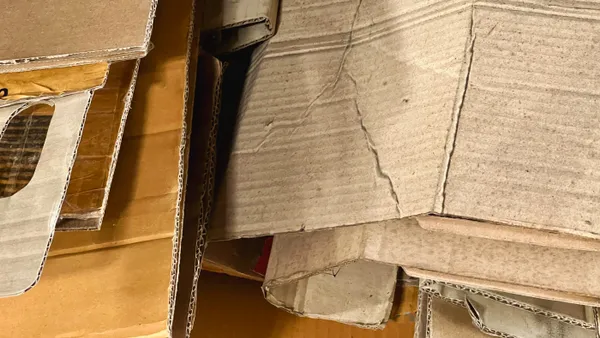
Recycled content use varies by product. In 2025, the average corrugated box was made with 52% recycled content, according to the Fibre Box Association. Solid board is up to 88% recycled content, while food-contact packaging has less than half recycled content, according to Moore. Recycled fiber use in U.S. containerboard has been on the rise since 2012, increasing from 46% that year to 56% in 2025, Moore’s data shows.
There will always be demand for virgin fiber, though, because recycled fibers break down over time, industry experts said. While starches and other strengthening agents allow for improved durability, fibers typically can’t be recycled again after about five to seven cycles. For most products, a certain amount of virgin fiber needs to be in the mix, said Mackenzie Crigger, sustainability manager at International Paper.
“We want that OCC and [double-lined kraft fiber] coming back into the stream, but you also need fresh fiber coming in because it’s going to add strength properties,” she said. “If we only had recycled content to rely on, we'd be out of fiber in about eight months. So there is a balance. You really do have to evaluate what you want that product to do.”
International Paper continues to produce a mix of recycled and virgin fiber products, both to meet customer demand and IP’s sustainability goals, Crigger said.
What’s behind the shift?
There are several factors supporting adoption of recycled fiber, market analysts said. First and foremost, the cost of manufacturing recycled corrugated boxes has decreased, Moore said. “The economics of making a corrugated box favor recycled fiber, and have for some time,” he said.
Virgin board can cost up to $100 more per ton than recycled, said Doug Larsen, a market analyst with Bloomberg’s Green Markets, who spent 44 years in the corrugated industry.
Building a virgin mill or expanding virgin containerboard capacity is cost prohibitive, and permitting can be a challenge, Larsen added: “It’s much easier and more economical to put a recycled system in.” The last greenfield virgin mill was built in the early 1980s, Larsen said. “Basically what you're seeing is older virgin machines coming out and newer recycling machines coming in.”
Another factor is the recent “cardboard box recession”. During the post-pandemic period, e-commerce companies such as Amazon and Walmart sought to reduce corrugated box use as a sustainability play amid consumer complaints of small items arriving in overly large boxes. Many of them were replaced by smaller or rightsized boxes and mailers.
Simultaneously, several containerboard mills shut down, primarily those used to manufacture virgin material, Moore said. That reduced the industry’s North American production capacity by approximately 10% in a little over a year. In contrast, five new recycled machines had come online in 2023, Larsen said.
Incrementally adding recycled capacity is more cost effective than switching a mill from 100% virgin to 100% recycled in one fell swoop, which would be “a massive investment,” said Kenny Knipschild, president of mills for the U.S. and Canada at Smurfit Westrock.
“There’s a number of places where we and others have added recycled capacity because we've got, say, a bottleneck in pulping and we've got extra room on a paper machine,” he said. “That’s a much lower investment than what it would be to add kraft pulping capability.”
One unresolved question is whether extended producer responsibility laws, many of which are just beginning to go into effect, will significantly influence the recycled fiber market, Larsen added.
“EPR attempts to shift the financial responsibility from the municipalities to the producers,” but doesn’t inherently lower the cost of collection, he said, noting that some municipalities report a cost of up to $500 a ton to collect curbside corrugated that has a market value of $100 a ton.
Virgin fiber demand persists
Even with the recent growth in recycled fiber markets, demand for virgin remains strong, sources say.
Of Smurfit Westrock’s 21 mills, 13 use mostly virgin fiber and eight primarily use recycled. Certain customers prefer recycled, but “there’s still plentiful demand for both virgin and recycled,” Knipschild said. Across SW’s North American and European operations, about 55% of fiber is virgin and 45% is recycled, according to the company’s website. The need for virgin is unlikely to change, Knipschild said.
“Without sourced virgin fiber coming into the system, at some point all of the fiber is too short to make boxes,” Knipschild said. “So there’s still the right amount of demand for virgin fiber.”
Virgin fiber is essential for boxes that need to withstand heavy loads or high humidity environments, he said. Virgin fiber also resists moisture better than recycled, he added. All things considered, the recycled fiber ecosystem needs virgin inputs, Knipschild said.
Knipschild emphasized that virgin fiber can be just as sustainable as recycled fiber — or even more so — since the kraft cooking process generates its own electricity, reducing reliance on carbon-based fuels.
How the recycled versus virgin mix plays out in the coming years is hard to say, sources said. But the industry is likely to see more virgin mills close as equipment continues to age and becomes more expensive to operate and upgrade, while new recycled machines will continue to come online, Larsen said.
The segments of the industry that rely on virgin “aren't going away,” he said. “So it certainly is a possibility that virgin paper could become more valuable. At the same time, the recycled guys are making better and better paper all the time.”