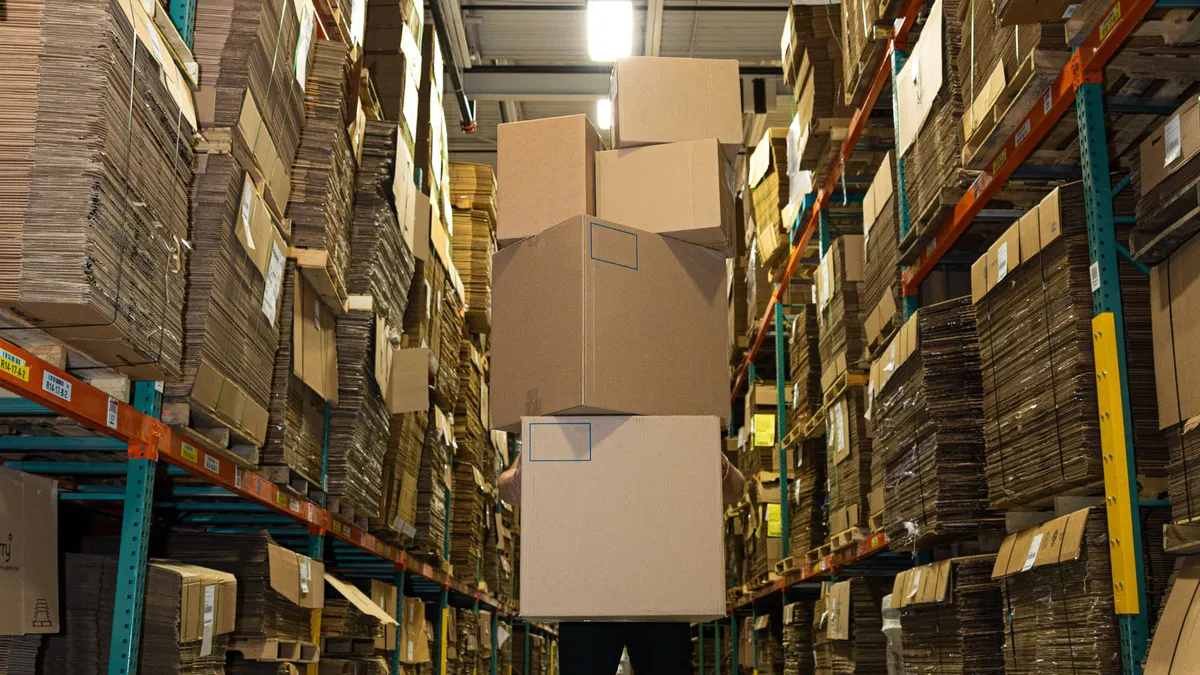
As the cost of new boxes jumps, leaders of a small, little-known corner of the corrugated packaging market — used box resellers — are eyeing opportunities for growth.
In recent months, prices for containerboard have seen unprecedented increases, with producers largely citing input cost inflation. In late July, Packaging Corporation of America initiated the industry's third round of 2026 price changes when it announced a $140 per ton spike — double the size of typical containerboard price raises. Other producers, including International Paper and Smurfit Westrock, followed suit with slightly lower announced hikes. AICC, The Independent Packaging Association, opposed the wave on behalf of its box maker members.
But these rising prices could present an advantage for the used corrugated box market, said Marty Metro, CEO of Used Cardboard Boxes. As companies look for ways to cut costs, buying used boxes — which are typically cheaper than new ones — is becoming more attractive, he said.
“To me it’s a huge, huge opportunity for the used box market because all these companies are realizing, ‘I'm just shipping something to my own store or to my own [distribution center] or to my own partner,’” he said.“‘I don't need a fancy branded box with my name on the outside.’”
The used box market is not yet formally tracked – although one independent analysis is now underway – so there is little objective data on industry trends. But there are indications that used box brokers may be well-positioned to take advantage of recent industry shifts, sources say.
For certain retailers, such as discount stores, used boxes are increasingly appealing amid rising prices, said Rebox CEO Kyle Otting.
“They’re always looking for cost savings because their margins are pretty thin,” he said. “We can provide for them savings of up to 40% off of what a new box would cost them. That’s real dollars.”
Following a slew of facility closures that resulted in a 10% loss of North American containerboard production capacity last year, some analysts predicted the market for new cardboard boxes would rebound somewhat in 2026. But those hopes dimmed when war in Iran began in February, leading to a spike in fuel and shipping prices.
While several producers said demand did rise a bit in the first half of the year, International Paper executives reported during their Q2 earnings call that demand was softer than anticipated. Plus, ongoing geopolitical tensions along with a shift toward lighter packaging materials, such as the mailers increasingly used by e-commerce leaders including Amazon, have left some analysts wondering whether that demand uptick will continue.
Looking at the big picture, “box demand has been weak for many years,” said Adam Josephson, a packaging industry analyst and founder of Sakonnet Research. “Bearing in mind that box demand is tied to goods demand, if the population is not growing and people’s income adjusted for inflation isn't growing, people are probably not going to buy that much more stuff year on year.”
Used box reselling is a fairly new industry and it will take time to determine its influence on overall box demand, he added.
Opportunities for growth
Despite the recent headwinds affecting the demand for new boxes, many companies still need a steady supply of boxes and also have corporate sustainability targets to meet, particularly as more states implement extended producer responsibility for packaging laws. While cost savings were the primary driver of demand for used boxes 15 years ago, “now there’s a much greater focus on the sustainability aspect of it,” Otting said. “And we, pardon the pun, check that box.”
Rebox, which has 35 distribution centers in the U.S. and Canada, began in 1990 when founder Mark Young, who was selling new boxes out of his basement at the time, received a call from a customer asking if he would take a truckload of misprinted boxes. He found a taker for the boxes within 48 hours.
“I’d say the industry overall, the broader supply chain, isn’t fully aware of the capability of a used box and the uses it provides and the cost savings it can provide,” Otting said. Even Otting had not heard of the used box market before being approached for the job.
“Part of my focus is educating the market and the broader supply chain that we exist, that we’re a thing, that it’s a viable platform for certain industries,” he said.
“We need to educate people. We need to build the trust,” Metro added. UCB provides food-grade, closed-loop systems for several major food companies, “but it took a lot of work,” he said, including addressing concerns about quality control and contamination from items previously packaged in the boxes.
Like UCB, Rebox has found success with a closed-loop system consisting of connected, repeat customers on both the supply and demand sides. “It’s kind of a win-win-win situation,” Otting said. “Everyone is getting benefit, and we're the piece in the middle that makes it all happen.”
UCB, which expanded into a B2B in 2010, found success by focusing on three used box categories: closed-loop, retail and Gaylord totes.
While the increased prices for freight and gas have largely “killed” the company’s retail business, closed-loop and Gaylords are doing well, Metro said. In the closed-loop operation, UCB buys a company’s used boxes, inspects and processes them and then sells them to one of the company’s own vendors. This system works well because the demand is almost guaranteed to match the supply, he said.
“They’re buying on a recurring basis over and over again, and we have one company to manage logistics and quality control,” Metro said. Any boxes that are damaged or are otherwise unusable are replaced with new ones.
On the Gaylord side of the business, the company processes “hundreds of thousands” of Gaylords. The large, four-by-four-foot boxes fit squarely on pallets and are used to ship items such as scrap metal and plastic, he said. In addition to these items, demand is particularly strong from liquidators, demand is particularly strong from liquidators that buy returns from large companies like Amazon that need big boxes able to accommodate a wide range of items. “That industry is exploding,” Metro said.
But the used box market’s potential for growth will likely always be limited, largely due to logistical challenges and established systems that make it impractical for large companies to switch, said Myles Cohen, founder of Circular Ventures, a recycling and sustainable packaging consulting firm.
For example, big box stores receive high volumes of various products in each tractor trailer delivery, and it would be too complicated to sort the boxes by size and brand for reuse, he said. Instead, those boxes are sold to recyclers, he said. Where reuse makes the most sense is for smaller-volume products that are delivered by small trucks or vans, such as first aid ointments or certain potato chips.
“The reusable box market is this tiny, tiny fragment of the box business,” he said. “I don’t see it changing a lot from where it’s been, and it’s been around forever.”
Growing pains
The used box market still faces some considerable barriers to growth, sources say. While UCB and Rebox are among the major brokers that have been around for decades, the niche has remained small. One reason is the challenge of matching the supply of available used boxes with the demand.
Metro started UCB 20 years ago with moving kits after balking at the price of boxes while preparing to relocate. He said it took some time to figure out how to perfect the supply and demand matchmaking, in part because boxes come in so many sizes.
“You can’t buy boxes unless you have an outlet, and you're not going to have an outlet unless you have enough boxes to make an impact,” he said. “So you have to find companies where a used box supply can make a big impact” on cost reduction.
Those savings largely depend on the proximity between the supplier and the buyer. Unlike new boxes, used boxes need to be transported, sorted and inspected before being transported again to the buyer. Those additional costs have to be weighed — particularly given the recent sharp increases in freight rates. When a match can be found in the same area, the savings can exceed 50% compared with new boxes, Metro said. But if the boxes need to be shipped across several states, that figure can drop into the single digits, he said.
With the exception of the Gaylord business, where all the boxes are the same size, matching the right size boxes to those that are in demand at any given moment remains a barrier to expansion, Metro added.
“If I've got a 24 by 20 by 15 box and your conveyor belt is 12 inches tall, I could give you the box for free and you can't use it, because it's higher than your conveyor belt,” he said. “That's the danger of getting in the used box business. If you don't have an outlet, you better not buy boxes. And that's why we've been so successful: We don't buy boxes unless we have an outlet.”
So far, major e-commerce companies that ship large volumes, such as Amazon, have remained out of reach for used box companies. That's partly due to the size-matching issue as well as a move toward mailers.
Both Otting and Metro say the biggest challenge in growing their businesses is educating potential customers about the advantages of used boxes.
“I would say the used corrugated box industry is what the recycled pallet industry was 35 years ago,” said Otting, who joined Rebox as CEO last month after spending years in the pallet industry. Companies previously would grind up used pallets, and there was little awareness that they could be recycled.
Another challenge: People tend to think in terms of the price per box, when it makes more sense to consider the price per use, Metro said.
Otting said site visits to see first-hand how products flow through a customer’s supply chain can go a long way to help build trust and identify unrealized opportunities to reduce costs.
During a recent tour of an existing customer’s warehouse in Georgia, for example, the team saw that the company’s new supplier used a different type of box that Rebox had a demand for.
“I've seen so many people come into this industry and fail because they're like, 'Oh, I’m going to buy some boxes and then sell them to somebody else.' It's not that easy,” Metro said. “You have to buy on a recurring basis, and you have to sell consistently. And you have to have a system to manage that.”
Despite these ongoing challenges, Metro and Otting remain optimistic about the industry’s prospects.
“We’re not a fit for everybody, because it is a used product,” but used boxes do make sense for plenty of customers, Otting said.
While the need for careful matchmaking can make this niche tricky, awareness among businesses that need boxes is increasing, and there’s a lot of untapped potential in the used box market, Metro added.
“This is not a kind of business where you're going to jump in and get rich real quick,” he said. “But there are enough people out there buying boxes that if you know what you're doing, you can be wildly successful.”