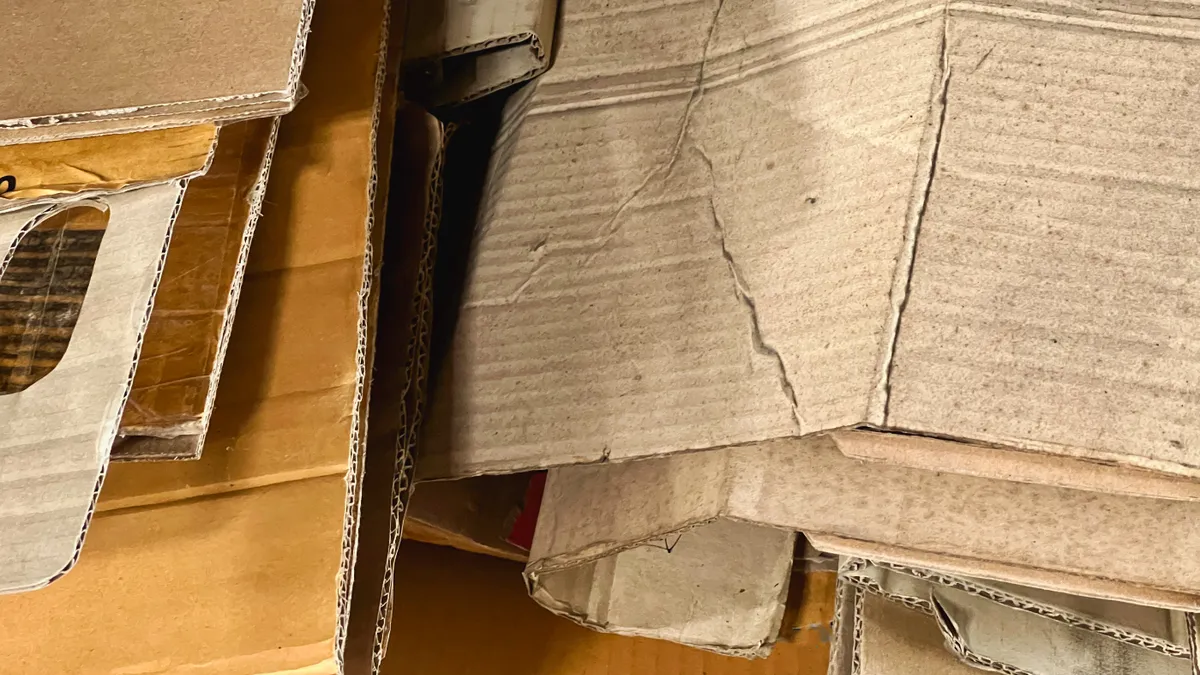
The old corrugated containers market in 2026 is one of paradoxes: Rising OCC prices spell better margins for recyclers, but they put pressure on packaging companies that consume the material. While OCC prices are up, they're still below historical norms. And OCC is poised for medium-term growth, but the market has to get over some short-term hurdles first.
OCC prices have increased incrementally every month in 2026, driven by the spot market, said Ceri Krening, director of recovered paper at pulp market intelligence and price index firm TTOBMA. This movement has outpaced the firm’s expectations.
That said, the $80 per ton price that TTOBMA charted early this year, and approximately $100 per ton now, are well below the five-year OCC average of $140 per ton, said John Litvay, the firm’s vice president of market intelligence, noting that TTOBMA's index often is $30 to $40 higher than other leading indexes due to calculation differences. “Net OCC is still affordable,” Litvay said.
Last year, prices started low and declined, he said, so the upward movement so far in 2026 is “just going back to where we were at this time last year.” The sluggishness followed a spike that peaked in mid-2024: Analysts calculated an 18-month leap of more than 200% from early 2023 through summer 2024.
OCC prices have risen every month in 2026 to date following declines in 2025
OCC is a key containerboard feedstock, so when containerboard demand is down, OCC consumption falls too. “Box demand’s not great,” Krening said.
In 2025, containerboard companies announced production capacity closures totaling a historic 10% loss across the North American industry, the majority of which consume virgin material. TTOBMA initially had predicted 2026 North American containerboard market growth of 2% to 3%. But it revised that to 1% growth after the war with Iran began on Feb. 28. It has further revised the forecast to be down 2% for the year.
The war has pushed fuel and freight prices significantly higher, dragging the economy and consumer confidence, Litvay said. “It’s just such a big event. It's hard to divorce yourself from that mattering in our markets.”
Containerboard connection
The containerboard market entered 2026 in flux as the last of the closures from the capacity shutdowns announced last year occurred.
Containerboard producers this year have reported strengthening conditions for a market dogged by sluggish demand since the COVID-era boom. During an April earnings call, International Paper executives touted market tightness. Likewise, Packaging Corporation of America executives reported during two earnings calls this year that they’re seeingimprovements in corrugated demand and customer orders. PCA CEO Mark Kowlzan reiterated during a June conference that the containerboard market is tight.
However, some analysts have cautioned that containerboard demand in 2026 is not turning out to be as robust as anticipated.
“It's hardly a time to celebrate the sector. While the stocks have risen 5-10% since May, demand remains lackluster and volumes weak,” George Staphos, Bank of America Securities analyst, said in a July 14 memo about the overall paper and packaging sector. “Containerboard is okay, but that’s because of pricing strength rather than demand.”
Higher OCC prices represent one of the main reasons major containerboard producers have cited for raising their own prices twice this year. They first tried in March, but “no one got the increases they were looking for” at that time, Krening said, pointing to the surprising $20 per ton month-over-month decrease that Fastmarkets RISI's Pulp & Paper Week reported Feb. 20. P&PW then reported increases in both March and April.
Producers announced a second round of price hikes in June, and P&PW fully recognized it in its $50 per ton sequential increase that month. There was no movement in July, according to Friday’s data release. To date in 2026, Fastmarkets RISI has recognized a total of $100 per ton worth of increases.
Price movement in 2026, both for containerboard and OCC, underscores this year’s non-traditional dynamics — without providing many solid answers for why it's happening. For instance, an analyst on IP's April earnings call suggested the containerboard market so far had not shown the anticipated tightness from the industry’s 10% cuts that would support producers hiking prices. And the current corrugated dynamics typically would result in a tight OCC market, but that has not materialized so far, Litvay said.
Shift toward recycled
Nearly all the recent containerboard shutdowns have been sites with aging equipment that’s costly to operate and that consumes virgin material, experts say. The industry overall is shifting toward recycled fiber, which will increase demand for OCC, according to Bill Moore, president of consulting firm Moore & Associates.
“Nobody’s going to build a virgin containerboard mill in the United States, if anywhere in the world,” Moore said.
Recycled fiber use in US containerboard production has grown for more than a decade
When looking at the aggregate of three fiber grades — OCC, kraft linerboard and semi-chemical medium — recycled fiber utilization for containerboard production in the U.S. generally has shown an upward trend since 2013, according to data from Moore & Associates. The firm projects 0.7% growth in OCC demand per year for the next five years.
But to get there, the market still has to recover from some recent shocks, such as China’s crackdown on dry pulp imports in October 2025.
“Two-million tons of our OCC were going into dry pulp that just stopped overnight and had to get redistributed,” Moore said. “It came back slowly, but I think that situation is still not totally straightened out yet.”
The war with Iran, which has intensified over the last two weeks, will continue to influence the dynamics. “As long as that's still ongoing, it just seems like the economy won't be awesome,” Litvay said.
In addition, consumer spending will play into containerboard demand and OCC generation.
“We’re at this bit of a tipping point. If all of a sudden the economy does great, there may or may not be enough corrugated to go around,” Krening said. “There are just not loads sitting anywhere.”
Meanwhile, recyclers are riding the wave of higher OCC prices, with increases in several regions of the country. Overall, OCC prices averaged about $64 a ton in the second quarter, said Sabahat Khan, a managing director for RBC Capital Investments, in a newsletter to investors July 20. That’s up about 3% year over year and about 30% quarter over quarter.
Regional price changes in July varied, with RBC reporting increases of $5 to $10 per ton in the Southeast, Southwest and Midwest.
Eureka Recycling, a nonprofit MRF in Minneapolis, said Midwest regional OCC prices have jumped significantly in the last six months, going from about $55 to $85 per ton. It was a welcome period of price recovery after OCC hit a low for the year in December 2025, said Eureka COO Miriam Holsinger.
“We weren't surprised when it was raised again this month,” she said. “Right now, the spot has been even higher than our contracts. ... Whenever the spot markets are asking, ‘How much can I get? How much can I get?’ before the pricing is even out, that's always a good sign.”
In July, Khan noted a $10 per ton decrease in OCC prices on the West Coast, which he attributed to an easing off of export demand and “buyer pushback on further price increases.”
In the Northeast, prices at the beginning of July were flat, said Chaz Miller, principal at Chaz Miller and Associates, who monitors recycled commodity markets. That surprised him a bit.
“The Northeast normally has very good paper markets because of the opportunities,” he said. “You have pretty easy access to a lot of recycled paper mills, and you also have good export access. So it was kind of intriguing that [prices] were flat.”
National price trends are part of the overall picture, but MRFs are also subject to more nuanced regional price differences, he said. That could be in part because of differences in weather, access to nearby end markets, nearness to mills, mill closures, and other local influences such as state-specific recycling laws.
MRFs may also fetch premiums based on a specific quality or volume they can process, further impacting the end price they’ll get for a bale, he said.
Though the national price increase trend has been good for many MRFs overall, Miller noted that he doesn’t expect the upward pricing trends to continue forever. “I think these are good prices,” he said, but added, “I'm not sure what a ‘normal’ price is because it does rotate throughout the year. It's almost always lower in the winter.”
Eureka often sees demand ease off in the summer into June, Holsinger said, adding that the trend of OCC price decreases in winter is especially true for Eureka as it gets ready for cold Midwest weather.
That makes these continued price increases in the first part of July somewhat unusual, Holsinger said. “What worries me a little is that I’m not exactly sure what’s driving the demand,” she said. “This winter, it felt like the increase in price was more just because there wasn't much material out there.” Now, she suspects customers may be building up inventories, which could also signal lower prices ahead.
Other experts agree the rising prices observed so far in 2026 likely won't continue at this pace.
“You've got another month, maybe two, of increases, and then a pretty big slowdown,” said Litvay. “We're already seeing some cracks.”
TTOBMA projects that prices are likely to dip seasonally later this year and end up close to the $80 mark where the year began, he said. But once economic and geopolitical factors even out, and the recent virgin containerboard capacity losses further play out, the tide could begin to turn again.
“Going forward, that should mean a tighter OCC market,” Litvay said. “Especially three to five years out, we think that $140 to $150 type number is much more on trend than this $80 to $100 that we've seen for basically two years.”
Waste companies could see tailwinds from higher prices
After major waste companies faced lower blended commodity prices for parts of 2025 and early 2026, higher OCC prices have been a welcome change. It’s especially appreciated as these companies are still weathering low values for other commodities like PET, which can bring down blended commodity values for the range of recyclables in the basket.
OCC changes can be particularly meaningful for the major waste companies because the material is “the largest component of each company’s commodity mix,” said Trevor Romeo, an analyst for William Blair, in a July investor newsletter.
OCC accounts for an average two-thirds of the commodities basket for major public companies like Republic Services, Waste Connections and GFL Environmental, according to analysts at Jefferies. During Waste Connections’ Q1 earnings call in April, executives highlighted how recovering OCC prices helped drive a blended commodities turnaround: OCC averaged $89 per ton in Q1 and ended the quarter at about $94, executives said.
As waste companies prepare to host their Q2 earnings calls in the coming weeks, OCC’s six-month price increase run is expected to continue its positive impact on these companies’ margins, wrote Khan. WM, for example, estimates about a $27 million EBITDA impact for every $10 per ton move in single-stream commodity prices, he wrote.
Romeo of William Blair added that the six-month sequential price increases “could flip recycled commodities to a year-over-year tailwind in the third quarter, sooner than we had previously expected.”
These companies could ride a “modest tailwind” for a few months even with a possible price slowdowns in coming months, RBC noted.