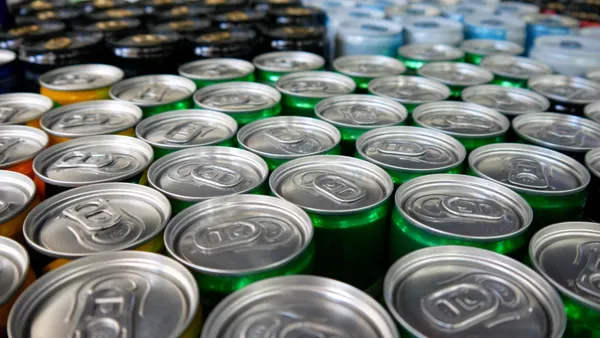
Global beverage can volumes were up 6% in North America and globally in the third quarter, Crown Holdings reported in its earnings release this week.
“It is a global growth spurt right now we’re experiencing across beverage cans. It feels a little bit like pre-COVID although this feels a bit more organic,” Crown CEO Tim Donahue said on an earnings call Tuesday, pointing to growth in beverages as well as substrate changes.
Crown in part attributed the revenue bump in the Americas Beverage business to $240 million in pass-through of higher metal costs. “The majority of the volume contribution was offset by rising input costs,” he said.
Outside of beverage cans, Crown reported high-single-digit volume gains in food cans in North America amid strong demand for canned vegetables and pet food. This reportedly helped offset softer aerosol can sales. Meanwhile, Crown’s transit packaging business “disappointed” in Q3, Donahue said.
Rising costs and prices
Crown reported that inflationary headwinds stemming from conflict in the Middle East were more significant than expected in Q3. This also put pressure on volumes in the Middle East.
The company estimates a similar headwind in Q4 from heightened energy, freight and other costs, as it works to offset. “The contractual recovery of these and other nonmetal costs will occur in 2027 via a look-back formula,” Donahue said, anticipating “a fairly large repricing” around April 1.
Growth ahead
Crown anticipates full-year beverage can shipments will be up 4% to 5% globally and up 3% to 4% in North America.
Crown adjusted its 2026 guidance slightly. It now expects adjusted diluted earnings per share between $8.35 and $8.45 (previously $8.30 to $8.50), and adjusted free cash flow of at least $950 million (previously $900 million).
The company is progressing on capacity expansions internationally, including projects in India and Brazil and three in Europe. Crown is accounting for startup costs at the end of this year and in Q1 2027.
Donahue said acquisitions in cans could also contribute to growth, though large M&A is unlikely. “It’s hard to see how we could do a large-scale can acquisition just given the concentration across so many of the markets,” Donahue said.
“Would we or do we have opportunity to pick up a plant here or there? Yes, and we’ll see what happens. It’s too early to say what might become available from any of the two or three situations that are out there or recently announced,” he said. “But as we sit here today, no large-scale M&A, because we just don't think it's available in cans, and certainly no large-scale M&A outside of cans.”