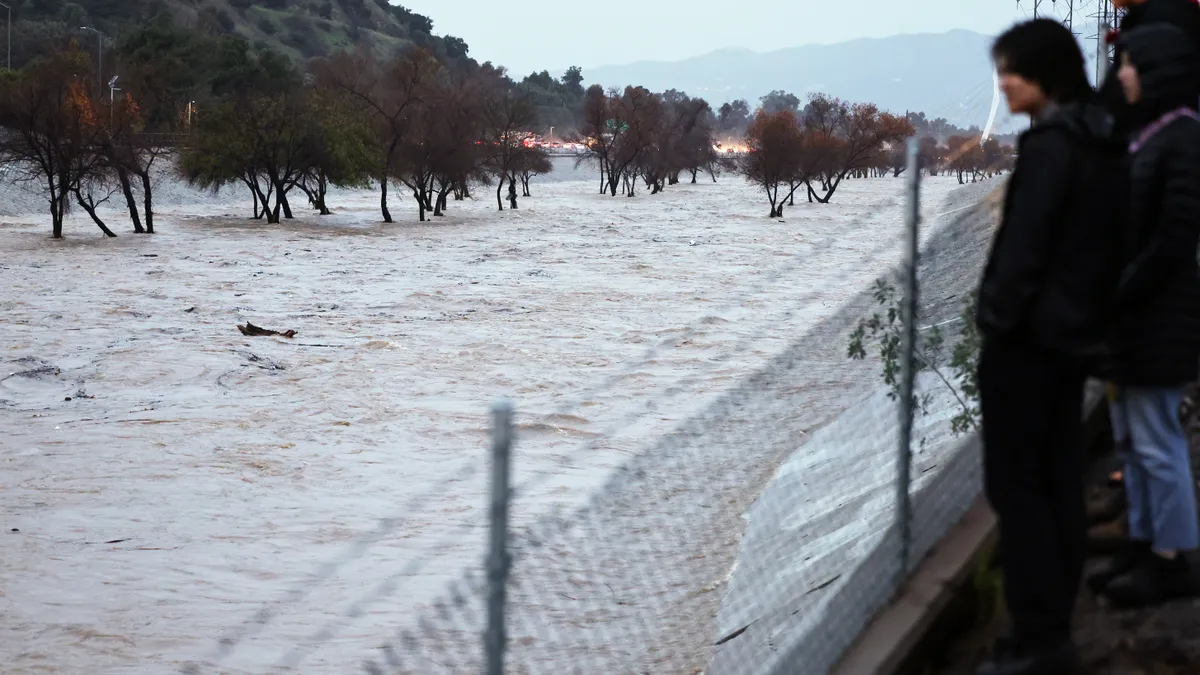

The most significant El Niño ever recorded has begun its descent on the U.S., with global impacts expected to peak around December.
Caused by the warming of ocean water in the central and eastern tropical Pacific Ocean, this year’s El Niño will yield drastically different weather patterns across manufacturing hubs in the U.S. Effects could range from above-average precipitation along the Gulf Coast to drier-than-average conditions in the Pacific Northwest.
Manufacturers need to prepare for unprecedented impacts wherever they are, according to experts.
“As somebody who’s worked in sustainability and this space for the entirety of my career, we’ve never seen temperatures around four degrees at the surface,” said JLL Americas Head of Energy Advisory and Sustainability Josephine Tucker, referring to the ocean-surface temperature anomalies which govern the strength of El Niño events.
The fact that no two El Niños are alike highlights the need for risk evaluation that doesn’t exclusively depend on historical data.
“What we’re seeing is things that never happened are [now] happening all the time,” said Firas Saleh, director of North American flood models at Moody’s. He cited the 2011 flooding in Thailand and 2017’s Hurricane Harvey as two out of many stark reminders that one can no longer define what an “ordinary” weather event might entail.
Local knowledge, assessed via free GIS software or enterprise tools, can help determine a baseline risk level. However, both Tucker and Saleh said that businesses should assess vulnerabilities specific to their sites rather than rely on flood-zone maps.
“Exposure is constantly evolving,” Saleh said. “There are many regions that had impacts of storms, hail, wildfire, but there were no claims reported because it was just empty land.”
Risk factors can include the obvious culprits like equipment on site, exposure to salt water versus fresh water, the potential speed of water and the risk of mudslides and debris. But some risks are more hidden, such as when heavy rain interacts with wildfire damage and makes the area more vulnerable to runoff and mudslides.
There are larger, capital-intensive upgrades that manufacturers could have made months ago to prepare, Tucker said, such as implementing onsite power solutions and changes to site infrastructure. While it’s now too late for many of these, companies can still take other steps to blunt the worst effects of extreme weather.
Start with a risk audit
“Do a water and power audit [and] understand where your risks of failures are,” Tucker said. “If you have many sites, rank them by risk of exposure. Then on a site level, test your backup systems, understand what your fuel supply is like — and actually do that under load constraint.”
She added that running tests under a realistic production scenario can quickly reveal critical points of failure.
Some of the most common ways businesses underestimate their vulnerability are “typically related to stormwater drainage,” Tucker said.
For facilities close to a coastline, the importance of preparing for hurricanes and other emergency water-related events is more obvious. However, businesses slightly inland are also at risk, as these facilities may lack robust stormwater systems or have other vulnerabilities, she said.
Don’t assume you facility is safe from extreme weather
Residing outside of an official high-risk flood zone shouldn’t preclude a business from safeguarding against damage, Saleh said.
In 2011, flooding in Thailand caused tens of billions of dollars in damage and crippled hard drive and car manufacturers around the world. In 2017, Hurricane Harvey caused some $125 billion in damage across Texas and Louisiana and broke records as the costliest tropical cyclone. Both events affected regions that were considered low risk.
If such weather events from the past decade are an indication, business leaders should increasingly see investments in costlier but sturdier resiliency measures as essential and not “nice-to-haves,” Tucker said.
“Think about the opportunity cost of being without power or water, or having catastrophic flooding,” she said. “If you were to lose power for two hours or two days, what would that do to your business?”
Bolster supply chains
Brian Harold, managing director at APM Terminals, said resilience in today’s supply chains is “increasingly tied to connectivity and network optionality.”
“Companies benefit when they have access to reliable port infrastructure, efficient connections to inland manufacturing and distribution markets, and multiple pathways to move cargo through the supply chain,” he said.
To that end, manufacturers should have a “standing forecast and demand-planning conversation with key suppliers,” as well as “safety stock positioned to absorb a four- to six-week transportation delay,” according to an industry report by packaging manufacturer Sonoco.
However, Vice President of Consumer Packaging North America John Pontrello said it’s not enough to simply carry more inventory. In addition, companies should “understand where inventory provides the greatest protection, where the supply chain is concentrated and where an alternate domestic production or logistics path exists before it is needed,” he said.
For instance, Sonoco's domestic metal-can manufacturing base reduces dependence on ocean freight and on individual shipping corridors such as the Panama Canal. “That doesn't eliminate weather risk, but it can reduce the number of variables between the source of supply and the customer's operation,” Pontrello said via email.
Business leaders can also reduce the uncertainties borne by their suppliers with “contingent business interruption insurance,” Saleh said. This applies when the supplier, rather than the manufacturer, fails to provide the equipment or other items they are responsible for.
Additional steps
Other resiliency measures to consider include establishing sources of onsite power, tapping into microgrids and shedding critical loads to keep vital operations running during grid disruptions.
Microgrids, or small-scale electrical grids powered by a local source, allow a business to take 100% of their power from the microgrid in case of an energy interruption.
According to Tucker, some newer microgrids allow companies to go into “island mode” in as few as 20 milliseconds, as opposed to an average of 30 seconds.
“The difference between 20 milliseconds and 20 actual seconds is not resetting a clean room, or not resetting a robotics line. That has meaningful financial implications when it comes to more advanced manufacturing,” she said.
Given their price, such investments should be scaled to the opportunity cost of potential business losses.
Fortunately, there are plenty of financing options. For businesses that don’t have the necessary capital or that have competing investment priorities, the so-called “-as-a-service” model, where companies offer microgrids or energy as services, can be a practical way to finance resiliency safeguards.
Such investments “allow you basically have no upfront costs. You pay a set price every month, and that allows you to turn cap-ex into op-ex, basically,” Tucker said.
Ultimately, the best continuity plan can simply be one that offers the most flexibility.
"The strongest supply chain isn't the one that predicts every disruption,” said Ernest Haynes, Sonoco’s president of global consumer packaging and incoming CEO. “It's the one with options when disruption arrives.”