Dive Brief:
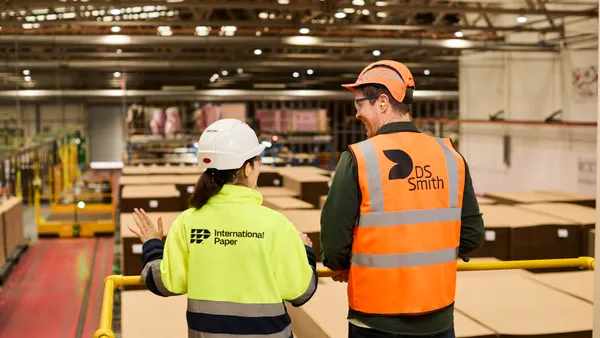
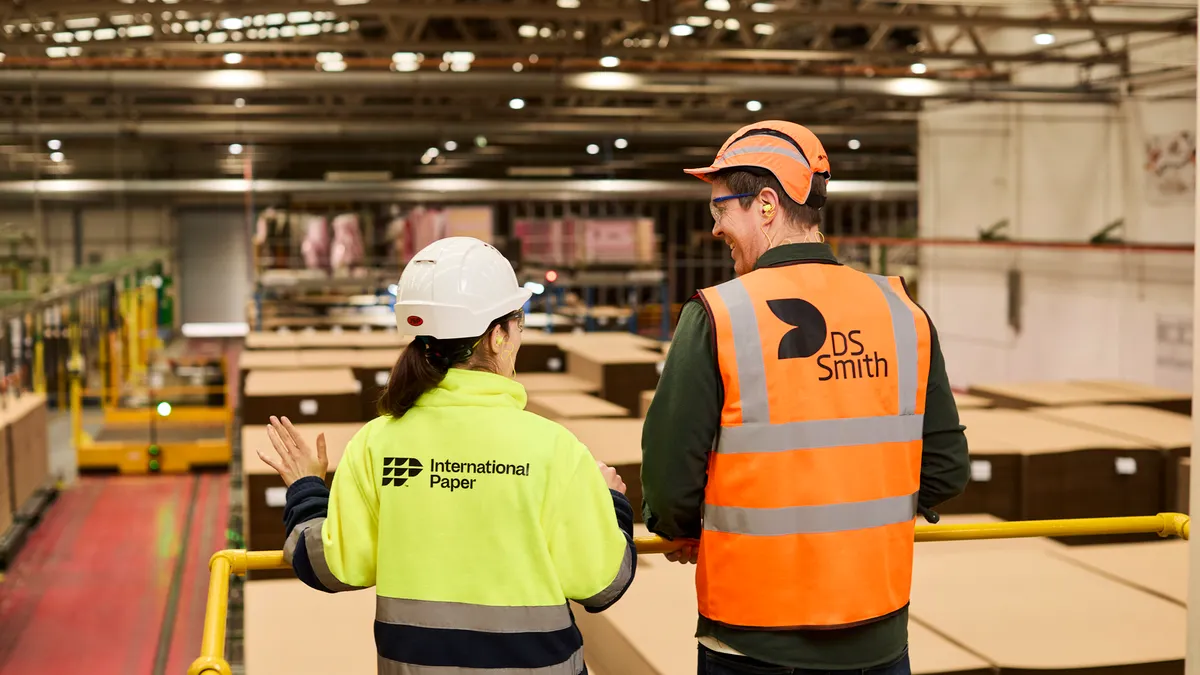
- International Paper’s board on Monday approved a proposal to spin off DS Smith into an independent, publicly traded company focused on Europe, the Middle East and Africa. IP will retain a 19.9% stake in the spinoff company.
- The company is no longer pursuing a sale of the EMEA business, which IP had said in October was an option. “After carefully evaluating sale alternatives, the spin was the clear choice,” said IP CEO Andy Silvernail during an investor webcast Monday morning.
- The split is set to be finalized Dec. 7, which is ahead of the originally stated timeline of Q1 2027.
Dive Insight:
The is an “exciting and important moment for International Paper,” and the split will allow each company to “focus on its unique aspect of its own market,” Silvernail said during Monday’s call. He said this structure will allow each to employ a “laser regional focus and tailored capital allocation strategy that will accelerate value for customers and shareholders.”
IP reviewed multiple options for what to do with the EMEA business, Silvernail said, referencing discussions about selling it instead of spinning it off. “The spin maximizes value while providing a clean, certain and timely path for International Paper, DS Smith and our shareholders,” he said. Last month, the company confirmed it had received unsolicited bids.
The decision not to sell could suggest that IP executives didn’t receive offers that were to their liking, said analyst Adam Josephson, founder of Sakonnet Research.
“Consider the circumstances: DS Smith is losing money and burning cash, and the European market has been quite poor for many years,” he said. “So what would the appetite be among potential buyers of that business for a money-losing, cash-burning business in a European market with persistent overcapacity? DS Smith acknowledged in its recent filing that there is chronic overcapacity.”
Prior to the close of International Paper’s acquisition of DS Smith in January 2025, IP had been in a bidding war with Mondi for DS Smith. Mondi formally dropped out a few days after IP and DS Smith announced they agreed to a deal.
IP executives on Monday reported expectations of paying a $550 million cash dividend in 2027, which Josephson said is a 44% decrease from earlier projections of $980 million.
“They’ve been burning cash for the past two years, and they said demand trends are likely to be no better next year. Then what is a reasonable expectation for the company's free cash flow next year? With that in mind, the dividend cut was no surprise whatsoever,” he said.
Silvernail referenced a variety of challenges during the last two-and-a-half years since he became CEO, notably surging inflation and weak consumer confidence. As part of IP’s cost-cutting and turnaround strategy, the company has closed more than 20 mills and box plants in the United States and taken out roughly 20% of mill capacity, he said. But the strategy also involves significant reinvestment in both existing and new assets.
“We underinvested in our core business for a decade, and we won't make that mistake again,” Silvernail said. “A strong balance sheet enables us to invest through the cycle, not just when times are good.”
As evidence of the investments, Silvernail referred to the new greenfield box plant in Waterloo, Iowa, that just began production this quarter and another slated to come online next year in Brandon, Mississippi. He also noted the plan to invest more in North Pacific Paper Co., which IP acquired in June.
IP projects capital spending will be approximately $1.25 billion to $1.4 billion in 2027, and it will stay at an elevated level for a couple years.
“We are absolutely changing. We have changed our investment philosophy,” Silvernail said.
IP expects to exit the transaction with about $7.5 billion in debt.
After the companies split, IP plans to delist from the London Stock Exchange and solely remain on the New York Stock Exchange. The delisting is expected to take effect Dec. 22.