Sustainability has been a particularly buzzy topic, especially for packaging, for the last eight years. But the practice is going through a period of transition, according to Scott Byrne, vice president of global sustainability at Sonoco. Sustainability is moving from its first generation where companies made voluntary claims to the next generation where compliance will be mandatory, he said.
This is driven by legislation such as extended producer responsibility for packaging laws that are emerging in the United States, Byrne said.
“Instead of saying, ‘Does this help us meet our voluntary goals or our commitments to certain volunteer organizations?’ it's now, ‘Does this fit with California's SB 54? What does this mean for California's SB 343?’” he said. “I think it just took some time for those questions to evolve and for people to find their footing.”
Sonoco’s sustainability targets include reducing absolute scope 1 and 2 emissions by 25% by 2030 from a 2020 baseline, showing an 11% decline as of 2024. It also aims to reduce absolute scope 3 emissions by 13.5% by 2030, versus a 2019 baseline, toward which it showed a 32% decline as of 2024. These goals were approved by the Science Based Targets initiative in 2021, and Sonoco intends to recertify its SBTi targets this year.
Prior to joining Sonoco, Byrne worked on sustainability programs at Tetra Pak, and he had served as director of government affairs at the Carton Council of North America. He’s also on the board of directors for the American Institute for Packaging and the Environment (Ameripen) and previously served as the organization’s president.
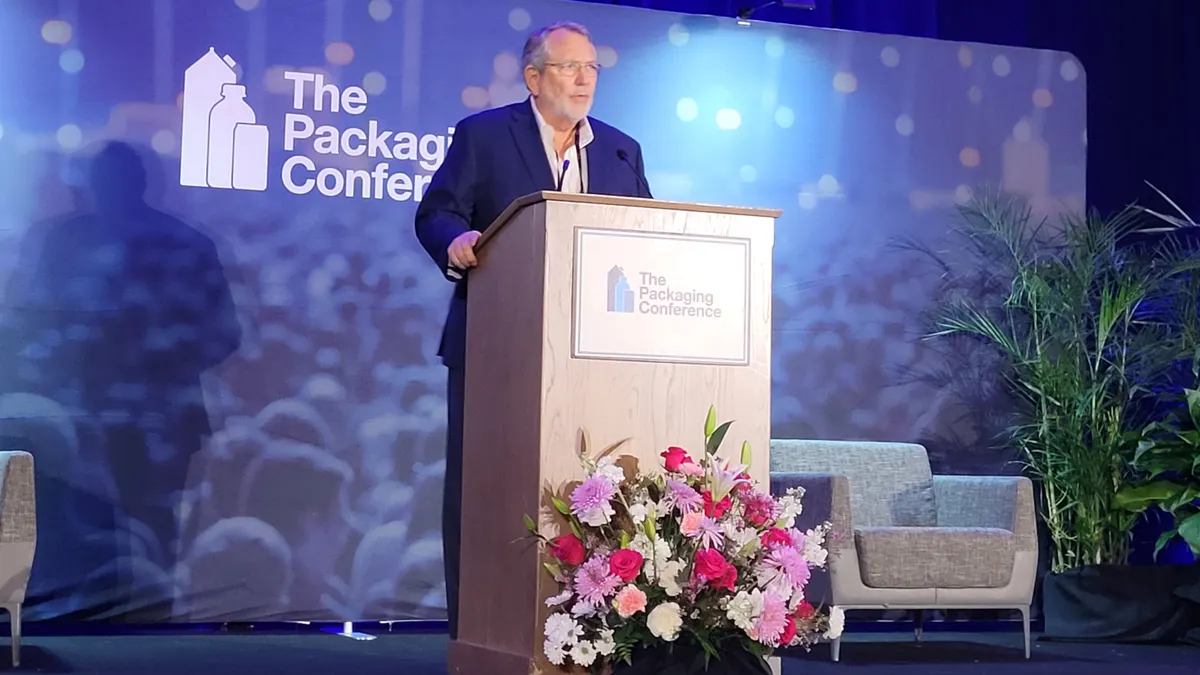
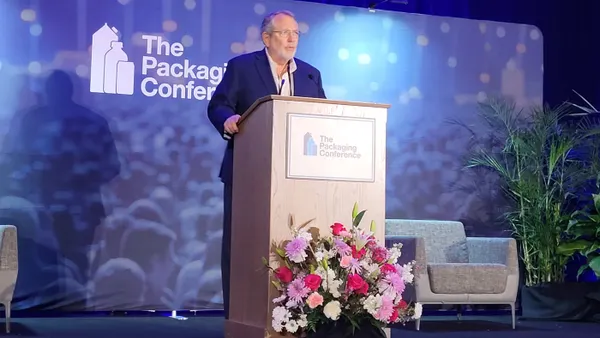
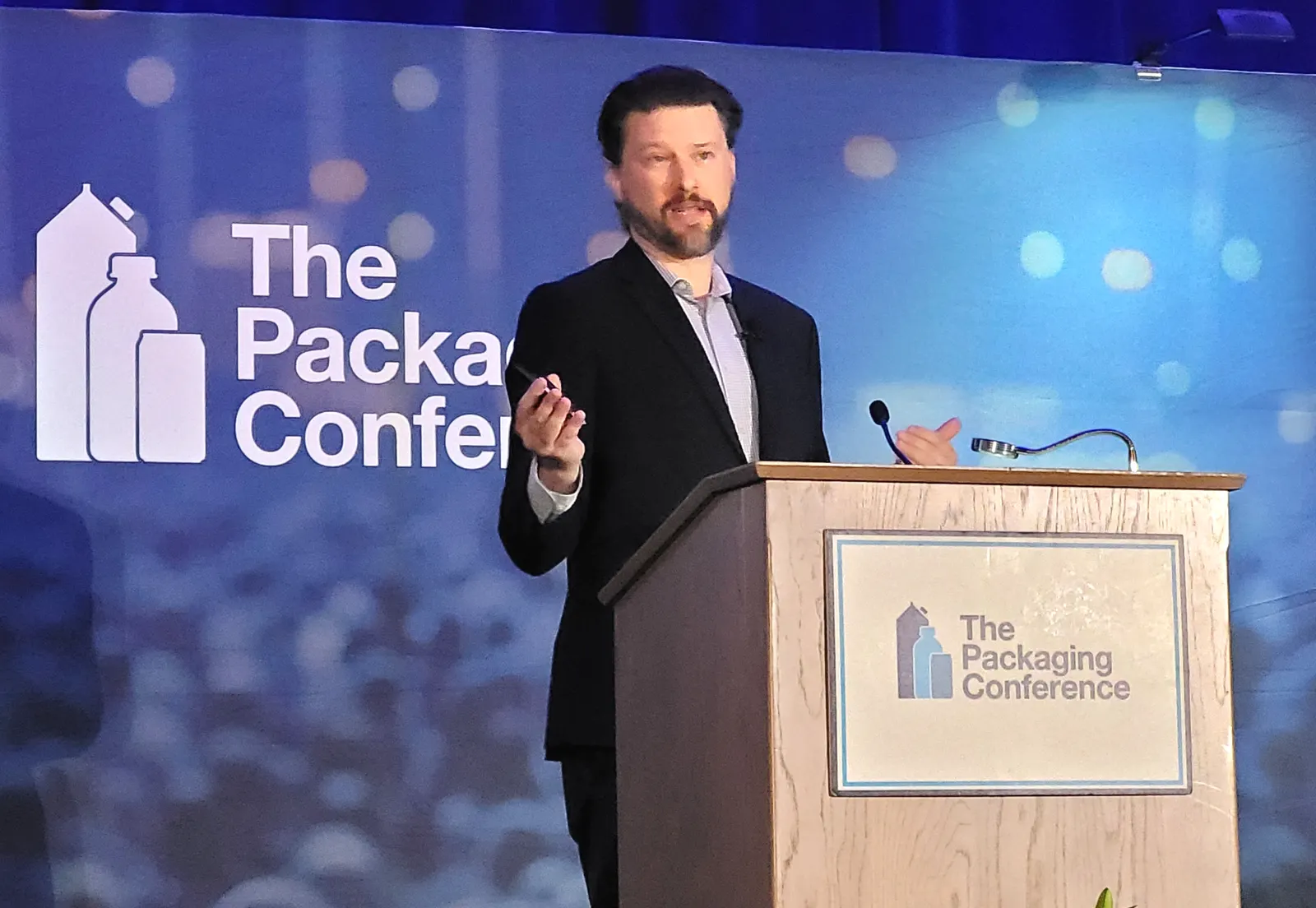
Packaging Dive sat down with Byrne at The Packaging Conference in Austin, Texas, on Feb. 10 to discuss the role of policy in packaging sustainability in 2026 and beyond, as well as Sonoco’s sustainability priorities as the company closes out a multiyear period of change.
This interview has been edited for clarity and length.
PACKAGING DIVE: Simultaneously with the broader shift in sustainability you discussed, Sonoco itself has been undergoing a lot of change over the past couple years, including divestitures, business segment shuffles, leadership shifts, and focusing on different substrates. Where does sustainability fit in? Are you still focusing on it?
SCOTT BYRNE: Absolutely. We just had our virtual power purchasing agreement go live Jan. 1. That's part of the corporate sustainability goals. And I think at the global level, those big corporate goals will continue.
We're going to revalidate our Science Based Targets initiative goals later this year. We're going to move from the well below 2 degrees Celsius standard to the new 1.5 degrees.
Sonoco has focused really on three big businesses and two big geographies. Now it gives us an opportunity to say, are there places where we might want to have a region-specific goal, or a material-specific goal? Before the complexity was such where it just was impossible to kind of break it down into those smaller component parts.
One of the things we're looking at is, does Europe require a different strategy than the Americas for circular economy, for decarbonization, for regulatory compliance? I don't know what the answer is yet, but it could be that those markets have shifted just enough where we're ready to have both a global strategy and a regional strategy.
What are you focusing on for sustainability in North America?
For North America, one of the first places I look is EMEA. I think Europe shows us the different pathways that are available to us. It is not necessarily our North Star, but it gives you context into where you could go.
Certainly on the fiber-based packaging side, I've been making a push with everyone to say, the Europeans are dealing with some of these issues but they're getting towards the end of it. If you like what's happening in Europe, let's do that here today. Let's skip the next decade of unknowns and just kind of get the standards, get the rules of the road and agree with them, because we're going to have to do so anyway.
If you don't like the way things are going in Europe, let's see if we can make that change here in North America before a state mandates it, or before things start to get so crystallized that it gets very difficult to change the system.
It's similar in the metal portfolio and for the rest of the packaging industry. You kind of see the future, and it's a great asset if you take advantage of that and then do something about it. Otherwise, you find yourself in the same position in 10 years where the rules have been made for you. We have an opportunity.
When Sonoco’s 2025 sustainability report came out last spring, you talked a lot about innovation and the importance of it, especially for rigid paper containers. Now RPCs are in the same business unit as metal. What’s the importance of innovation with the new business structure?
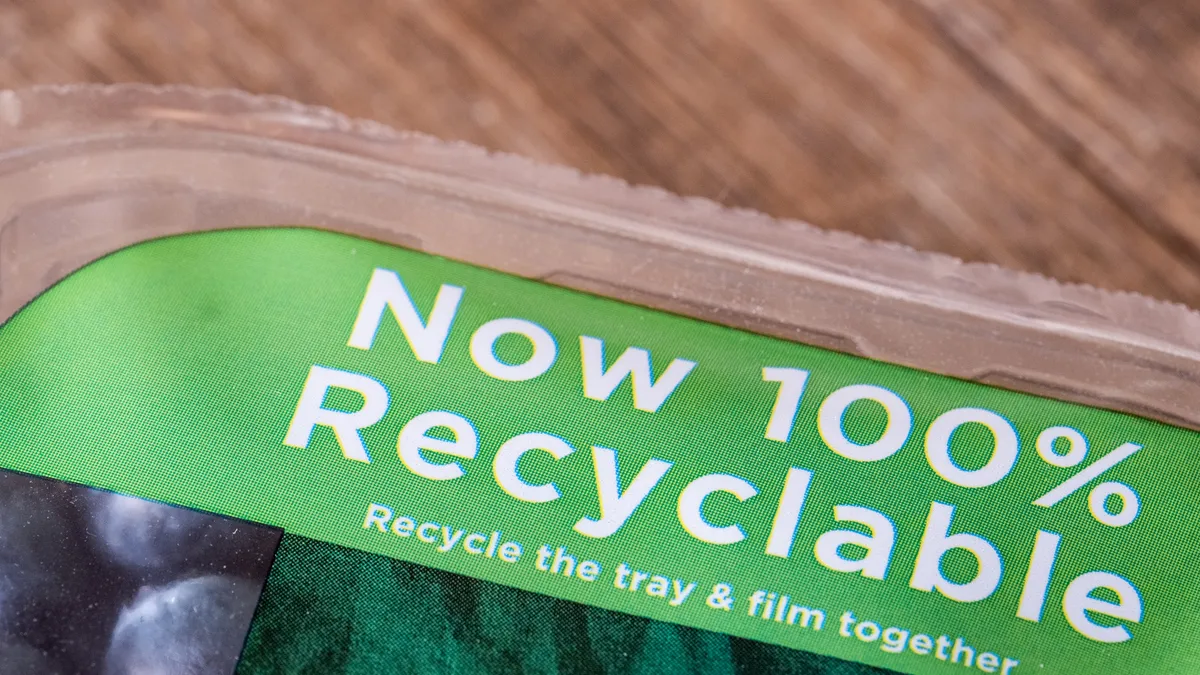
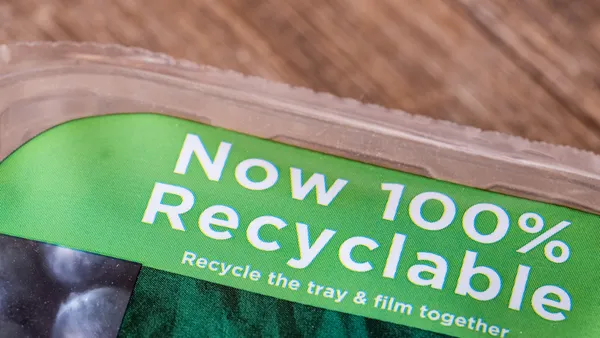
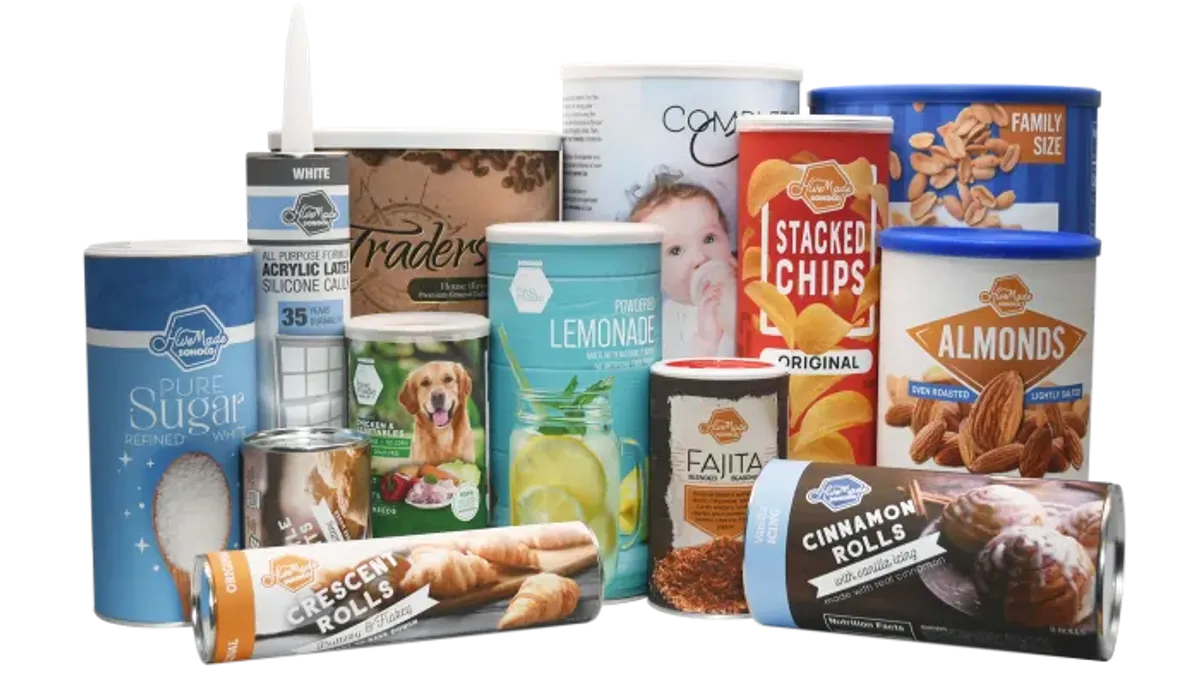
From a sustainability standpoint, a lot of the innovation is still focused on end of life. For the rigid paper can portfolio, whether that's a metal bottom or a metal end or a paper bottom, it’s making sure that the product is ultimately recyclable.
We've also been focused a lot on life cycle assessments. I know I kind of put that into the generation one, kind of old school focus, but I think it will come back. I think you see it a little bit in Oregon's extended producer responsibility program, where life cycle assessments are explicitly in the program.
We've been working on data and automation. Our team is doing a great job with our tube and core division globally. Just a year ago, when we had to get the carbon footprint of a package it might take two weeks going back and forth with the plant, with the sales manager, getting the SKUs, finding the facility. Now we've automated everything, and in two seconds — if you know the SKU — you can get the carbon footprint and the life cycle impact of that package. Right now, we're just looking at tubes and cores, but I think we’ll look at rigid paper, look at metal cans over the next year.
We're ready as customers demand more granular data on the carbon side to accurately, repeatably give that response. That's maybe our team innovation more than product innovation.
We’ve heard a lot about food cans, but what about aerosols?
We're a relatively large aerosol manufacturer in both the Americas and in EMEA. That's an interesting spot compared to metal food cans, because there's more questions around recyclability and end of life. Does it belong in a curbside bin or a depot program?
So we've had a lot of success, I think, as an industry on this situation, working with the Can Manufacturers Institute and the Household & Commercial Products Association on the Aerosol Recycling Initiative to gather a lot of that foundational data that just didn't exist before. I think aerosols for a long time were basically assumed to be recyclable: same process as food cans, same end markets.
Then, once you stepped into this regulatory space, you kind of got all of the right questions asked, but we didn't have the answers. Now we're getting the answers. I think the pilot programs they have in Oregon look like they're doing well, and hopefully they can extend to the other states.
Last year, Sonoco divested its flex-therm business unit. How does that affect the company’s sustainability strategy?
It simplifies it significantly. I think we went from 18 P&Ls in 2020 to three today.
The challenge we face is, some people say, “Hey, you've divested of plastics, so you're good to go, right? There are no more sustainability challenges?” Obviously, that’s not the case.
The reality of North America, especially if you look at California, is we have to understand those regulations regardless of whether we have the plastics component or not. There's an increase in complexity when you have plastics, but you still have to know the whole foundation of extended producer responsibility, how it impacts metal, how it impacts paper.
We certainly can be more focused. But from a sustainability standpoint, I need to constantly remind people that it doesn't mean sustainability doesn't matter anymore. To Sonoco and to our customers, it probably will start to matter even more over the next few years.
Still looking at materials: RPCs are made from fiber, but there are a lot of barriers and coatings involved with fiber. How does that play into your sustainability thinking?
There's work to be done to understand fiber, especially coated fiber, recyclability in the U.S. I was talking a little bit earlier about looking to Europe, and that applies here.
We've been pushing the industry to answer some of those questions. Sonoco is on the leadership committee of the Poly Coated Paper Alliance, very similar with the Aerosol Recycling Initiative. We're trying to gather a lot of foundational data, like how much polycoated paper is out there. Where does it go? What does it look like? What's the repulpability of polycoated paper more broadly — not just individual components, but of that category?
I’m hopeful that we answer some of these questions soon, like this year, because we need to then take those answers to policymakers and say this is what polycoated or coated paper looks like. This is how it performs, and this is how it should be treated in recycling.
I know we're not alone in this journey. The American Forest & Paper Association is working through their mixed paper recyclability voluntary standards, but hopefully this year they will have their voluntary standard for mixed paper recyclability, including coated papers. They're working on their design guide. The Recycled Materials Association is retooling their paper recycling readiness tool. And How2Recycle is also looking a lot at coated paper — they've been looking in the context of recycling labeling. The Sustainable Packaging Coalition also has some paper recycling collaboratives.
Hopefully these all kind of speak the same language, and we can start to get some answers. Then our sustainability team, our R&D teams, can design and drive towards what works.
One of the conference speakers said sustainability for packaging is failing. Do you see it the same way?
Sustainability is dead? I don’t see it that way.
I’m not going to say I’ve seen a lack of momentum, but people were looking at a lot of other things over the last 12 months. I mean, there were massive geopolitical challenges, there were tariffs. I think that many people saw sustainability take a back seat.
But I've seen in the last three months a really large uptick in interest. So I think we may have lost a little bit of time there, but I do think it was just kind of this transition from those voluntary commitments to looking forward to the data needs, the legal compliance needs, moving forward. And I expect that to continue.
Sustainability teams have always been there. We've always been working on it. But now, for better or for worse, we do have a nice financial incentive in the form of policy, like EPR.
Next year, sustainability will be revived — a little different, but I think it'll be almost right back where it was in maybe 2022 or the first half of 2023.