Dive Brief:
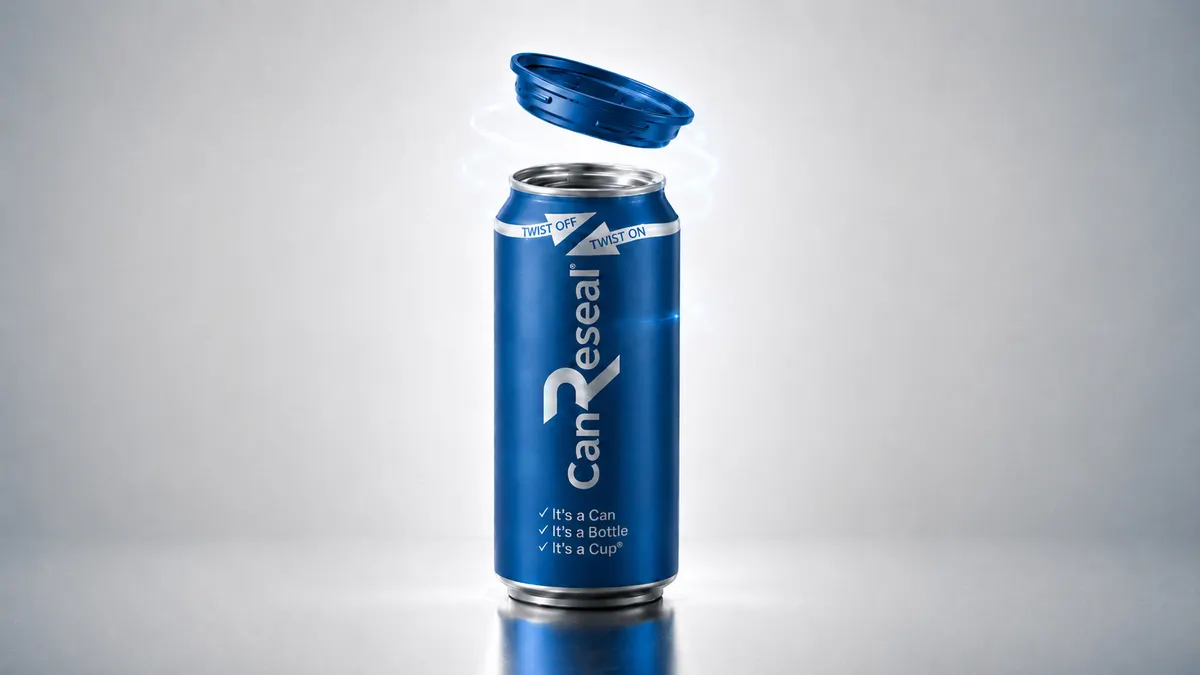
- Global beverage can manufacturer Canpack aims to commercialize resealable can ends via a collaboration with Florida-based startup Canovation, the companies announced this week.
- The companies say they intend to “bridge the gap between technology validation and real-world production readiness” in the aluminum beverage can supply chain.
- In the near term, the partners plan to complete the remaining development activities for Canovation’s patented CanReseal technology to tee up “pilot-line implementation.” Canovation also is engaging with additional “strategic and financial partners to support the next phase.”
Dive Insight:
While aluminum beverage cans are heralded for their recyclability, the drink containers are typically not resealable once opened. Resealable solutions in this substrate have largely been restricted to the less-common aluminum bottle format.
Resealable ends technology is available but has not been widely implemented. Nearly two decades ago, Ball Packaging Europe imported aluminum and plastic resealable ends to the U.S. to feature on some Monster energy drinks. More recently, Re:Lid USA announced this year it would bring its resealable aluminum can lids to the U.S. market, in partnership with beverage brand incubator L.A. Libations. Re:Lid USA licenses the technology from European company Re-Lid Engineering, shipping from Germany to the U.S., with plans to set up U.S. production.
To date, Canovation has been funded by angel investors, said Caleb Hayes, business development manager at Canovation, in an email. It’s now raising capital for a pilot line to be housed at and operated by Canpack. He said the goal is for the pilot line to be scaled to become the first commercial line for producing CanReseal parts.
Canovation’s 100% aluminum CanReseal solution “builds on aluminum's inherent recyclability and value retention, offering a sustainable alternative to single-use plastic packaging without disrupting today’s industry processes,” the company stated. CanReseal has multiple configurations, including ring end, airtight and peel-off versions.
“Importantly, the ring end and closure are also made from the same 3xxx series aluminum as the can body,” Hayes said. “This opens the doors to increasing the recycled content of beverage cans significantly, compared to today's global average of 71%.”
Working with existing can-making infrastructure is a key tenet of advancing CanReseal, according to Canovation. The company’s partners include Ohio-based Stolle Machinery, which has provided engineering, tooling and manufacturing equipment support.
Editor’s note: This story has been updated with additional details from Canovation.