Imports, lightweighting and thermoforms contributed to shifts in recycling dynamics for postconsumer polyethylene terephthalate in North America last year, according to a recycling report the National Association of PET Container Resources released Wednesday.
The PET bottle recycling rate in the United States dropped to 29% in 2025, down from 30.2% in 2024, NAPCOR shows. The broader North American PET recycling rate was 36% last year, down from 39.2% the prior year.
Average recycled PET content in bottles in the U.S. reached a record high of 22.9% in 2025, up from 20.7% in 2024.
Impors PET accounted for a record 39.1% of rPET use in the U.S. and Canada, up from 35.5% in 2024. The sharp incline of imports in recent years has affected domestic market dynamics and is considered a major contributor to the wave of domestic reclaimer closures that resulted in a 25% production capacity loss.
Imports have become “increasingly important and relevant to industry issues,” said Lauren Laibach, NAPCOR director of data services. “There was kind of a shift in what was being imported” in 2025, with the virgin material share decreasing year over year.
Lightweighting's heavy impact
Bottle lightweighting showed up as a substantial factor in NAPCOR's 2025 PET data, even having already been a trend to a lesser degree for years, Laibach said.
That partly stems from major beverage brands, namely Coca-Cola, debuting new lightweight bottle designs in 2024 with full market penetration occurring in 2025, she said. Coca-Cola's preform innovations dropped many of its bottle weights from 21 grams to 18.5 grams, which the company anticipated would result in an 800 million-bottle year-over-year reduction in new plastic use in 2025.
Plus, bottles for water tend to be lighter than those for carbonated beverages, Laibach said. Therefore, as consumer purchasing habits have shifted away from carbonated and other sugary drinks toward more health-conscious choices in recent years, that has driven a shift toward more lightweight PET bottles in the recycling stream.
Because of bottle lightweighting, “when some of this data is reported on a tons or pounds basis, it may not be fully representative of what’s getting collected,” said Akshatha Bhat, senior associate at Closed Loop Partners’ Catalytic Capital & Private Credit group, during an Oct. 29 session about PET trends at the Paper and Plastics Recycling Conference.
While lightweighting might help brands achieve sustainability targets, such as reducing plastic use by weight, it can bring “knock-on impacts in taking a lightweight bottle through the recycling value chain,” said Alexandra Tennant, director of circular plastics at Dow Jones Energy, during the PPRC session. “It does make processing some of the material more challenging.”
Complications arise with modern MRF sortation systems that use air jets to blow paper off the container line, explained Laibach. PET bottles can “flatten more easily and they can sort of behave like paper when they're super light. So losses can occur there if PET bottles don't even make it into the PET bale.”
Additional challenges can occur once the material reaches a reclaimer where it’s ground into flake and put into float-sink sortation tanks. “PET is denser and normally sinks, and lighter olefins will float and can be skimmed off. But if it's super lightweight, just the physics of surface water tension and stuff like that can sometimes mean that PET gets lost at that stage instead of sinking,” Laibach said.
Thinking about thermoforms
The weight of PET thermoforms recycled in 2025 grew 7.4% year over year and reached a new high of 226 million pounds, according to NAPCOR.
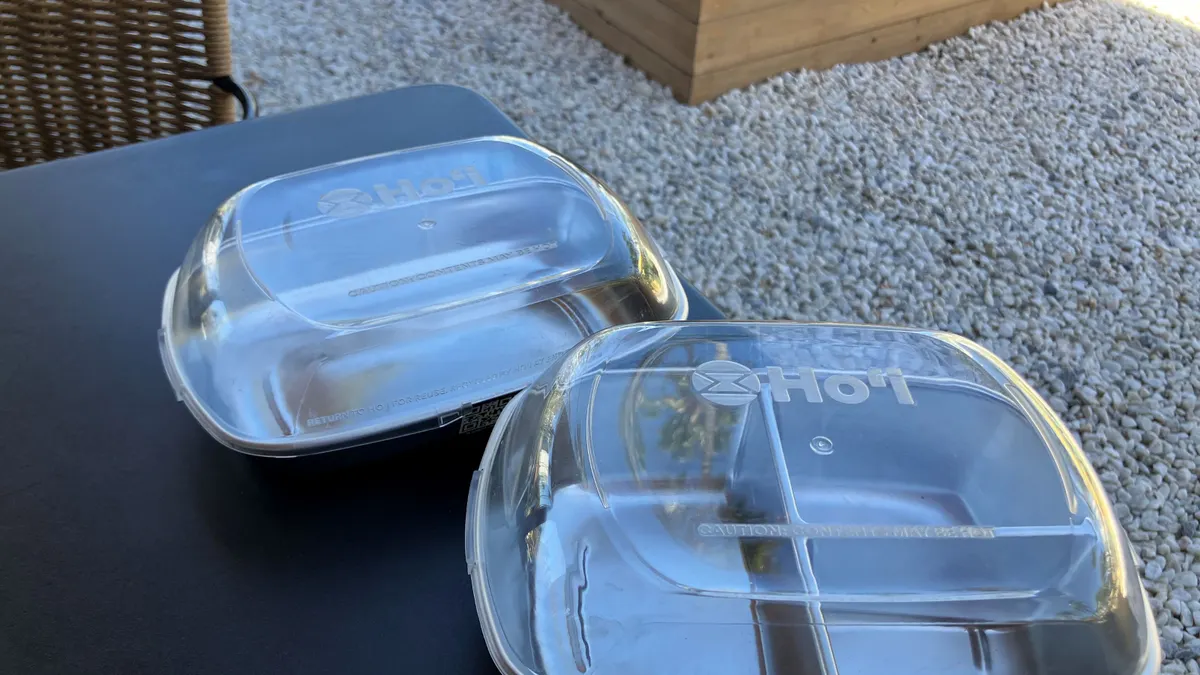
Thermoforms primarily are found in bottle bales, as few businesses segregate that format into dedicated bales: Only about 5% of thermoforms that reclaimers processed in 2025 were in dedicated bales, down from 17% the prior year.
While the thermoform recycling rate continues to climb, those items still present challenges for North American reclamation systems.
“The structure of these packages and how they behave in the recycling system is very different than how bottles behave,” Laibach said. “Reclaimers don’t necessarily prefer thermoforms unless they have a setup that is really optimized for thermoform recycling, and that's just not as common yet here in the U.S.”
For instance, thermoforms tend to have more adhesives and larger labels than bottles, she said, which complicates recycling. Plus, internal properties of PET that is thermoformed — such as being more brittle and prone to shattering — make the processing different, potentially becoming a form of contamination instead of a value add.
Thermoforms are considered an opportunity area by NAPCOR and multiple speakers at PPRC.
“I am optimistic. I've heard things coming down the line where people are going to be starting processes where they want what I think is [bales considered] highly contaminated with thermoforms,” said Gretta Jordan McDaniel, director of PET sales at Advanced Polymer Recycling, during the PPRC session. “I look forward to that day.”