Dive Brief:
- A federal judge upheld Oregon’s Plastic Pollution and Recycling Modernization Act, which created the state’s extended producer responsibility for packaging program, ruling that it is not unconstitutional. Oregon Department of Environental Quality Director Leah Feldon was the defendant in a suit challenging the law.
- Judge Michael H. Simon determined that Oregon’s EPR law did not violate either the dormant Commerce Cause or the Due Process Clause of the U.S. Constitution, as alleged by plaintiff National Association of Wholesaler-Distributors.
- NAW said in an emailed statement Friday afternoon that it “strongly disagrees” with the ruling. “While we are disappointed with the outcome, we were prepared for it. ... NAW is reviewing its options for next steps,” the association said.
Dive Insight:
In the 71-page ruling issued late Thursday, Simon said Oregon has been a “pioneer in waste prevention, reuse, and recycling legislation” for more than 50 years, and the state’s EPR law shows “innovative leadership” in its design to shift end-of-life product and recycling costs away from governments and onto producers.
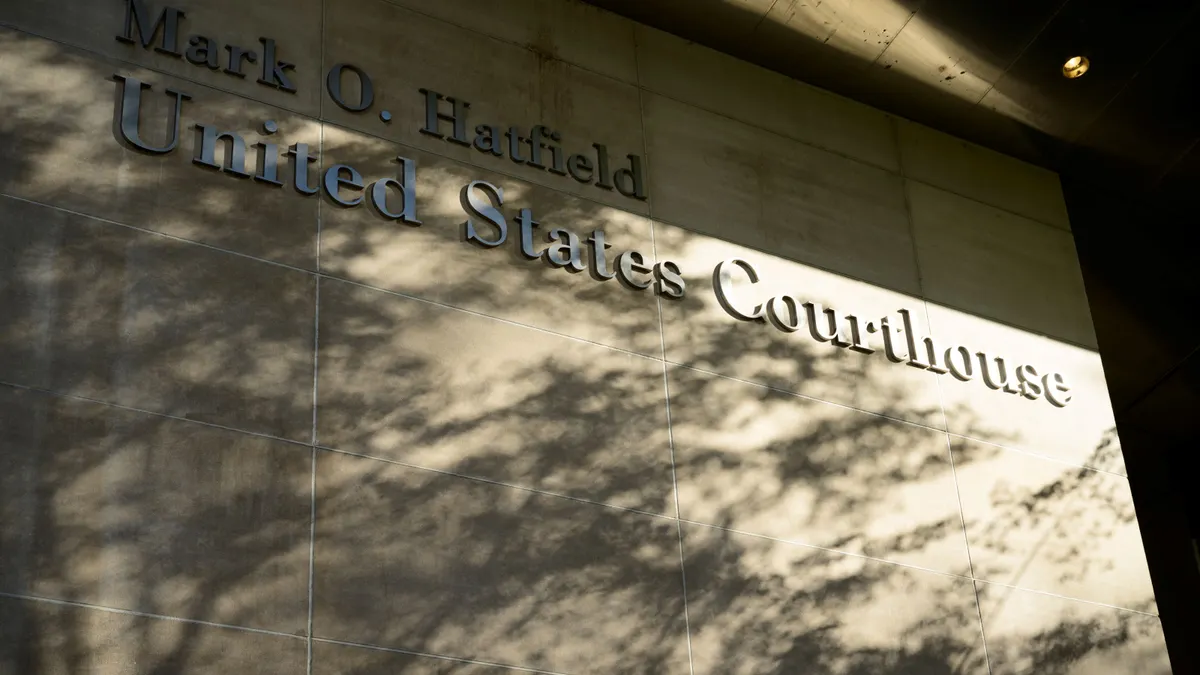
Simon made the decision based on evidence presented in the U.S. District Court for the District of Oregon during a five-day bench trial that ended July 17. The outcome has been widely awaited as an indicator of whether legal challenges to packaging EPR will work.
He said that EPR laws are intended to ensure that prices charged for products reflect any “hidden or unintended costs, rather than force third parties to deal with the total cost of placing a product into the stream of commerce.”
“Without governmental intervention, an economic actor directly participating in a transaction neither pays (nor receives) compensation for externalities,” Simon said in the ruling. “Further, when a self-interested economic actor does not consider externalities, ‘[s]elf-interested behavior may not always be in the best interest of society.’”
Oregon passed its Plastic Pollution and Recycling Modernization Act in 2021 and in July 2025 became the first state to implement an EPR for packaging law. NAW brought its lawsuit weeks later.
NAW claimed in the lawsuit that Oregon's EPR law violated due process by granting regulatory authority to producer responsibility organization Circular Action Alliance. CAA also has been named as the PRO for six of the seven other states that have passed EPR laws so far.
“The Court rejects NAW’s assertion, concluding that state action cannot violate procedural due process unless it risks wrongly depriving a litigant of a protected life, liberty, or property interest,” the ruling says. “NAW’s point may be correct if it were challenging a federal law, namely, an act of Congress. It is incorrect, however, for delegation arguments challenging a state’s law.”
The judge also disagreed with NAW’s argument that the fees CAA charges are “clearly excessive.”
CAA is only in its second year of operation and has underspent, Simon said in the ruling. That underspend accelerated the accumulation of reserve funds and could reduce producer fees this year and next year, the document says. “Given these projections, the Court concludes that NAW did not present evidence sufficient to conclude that the program’s fees and budget is ‘clearly excessive’ when compared to the program’s needs.”
CAA said in an emailed statement Friday morning that the judge’s decision “affirming Oregon's Recycling Modernization Act provides important clarity as Oregon's producer-funded recycling system continues to take shape.”
“We remain committed to supporting producers every step of the way as they meet their obligations under the law, while continuing to work closely with local governments, recycling partners and state agencies to implement the program. Together, we are building on years of meaningful progress and laying the foundation for a stronger, more accessible and more consistent recycling system for Oregonians through 2027 and beyond,” CAA said.
NAW also claimed Oregon’s law violated the dormant Commerce Clause, alleging the program favored in-state producers “while imposing disproportionate compliance costs on out-of-state businesses.”
NAW further said the EPR program subjected producers to "complex, non-reviewable volume-based fees and reporting obligations determined by the state-specific [producer responsibility organization].” It claimed that created inconsistent obligations that would force out-of-state producers to change packaging design and sourcing practices solely to meet Oregon’s law. Because many producers make such decisions to meet conditions of a national market, NAW alleged the EPR law “controls commerce occurring wholly outside of Oregon.”
The judge did not find NAW’s arguments about discrimination against certain businesses to be adequate.
“At trial, NAW did not present evidence sufficient to trigger strict scrutiny for either the gross revenue exemption or the immediate consumption exemption,” Simon said in the ruling. The group “presented no evidence other than speculation” for some claims.
The association initially cited additional claims of constitutional violations and named other defendants, including Oregon DEQ and Oregon Attorney General Daniel A. Rayfield. But in February, the court pared back the allegations and dismissed claims against certain defendants, leaving DEQ Director Leah Feldon as the sole defendant. At that time, the court also granted NAW a preliminary injunction to block enforcement of the EPR law while the case proceeded.
Oregon DEQ told Packaging Dive via email that it is aware of the court decision regarding Oregon’s Plastic Pollution and Recycling Modernization Act. “The law remains in effect, and DEQ will continue implementation,” the agency said.
NAW said in its statement that the ruling “does not change the facts established at trial or NAW’s position that these laws are unconstitutional.”
“In our view, the trial record demonstrated exactly what the Constitution prohibits: a state compelling businesses to pay nearly unchallengeable packaging taxes dictated by a private organization operating without adequate transparency or accountability,” the statement says.
NAW also is leading legal challenges against Colorado’s EPR law, and it is the sole business plaintiff in a lawsuit where 17 state attorneys general formed a coalition to challenge California’s EPR law, SB 54. The Oregon decision could influence the litigation in California and Colorado.
NAW said the Oregon court’s ruling “is not the final word.” The group says it’s committed to “challenging these unconstitutional laws and protecting businesses” and will continue making that case in the California and Colorado lawsuits while it considers next steps in Oregon.
Megan Quinn, a senior reporter on Waste Dive, contributed to this story.
Editor’s note: This story has been updated with statements from NAW, Oregon DEQ and Circular Action Alliance.