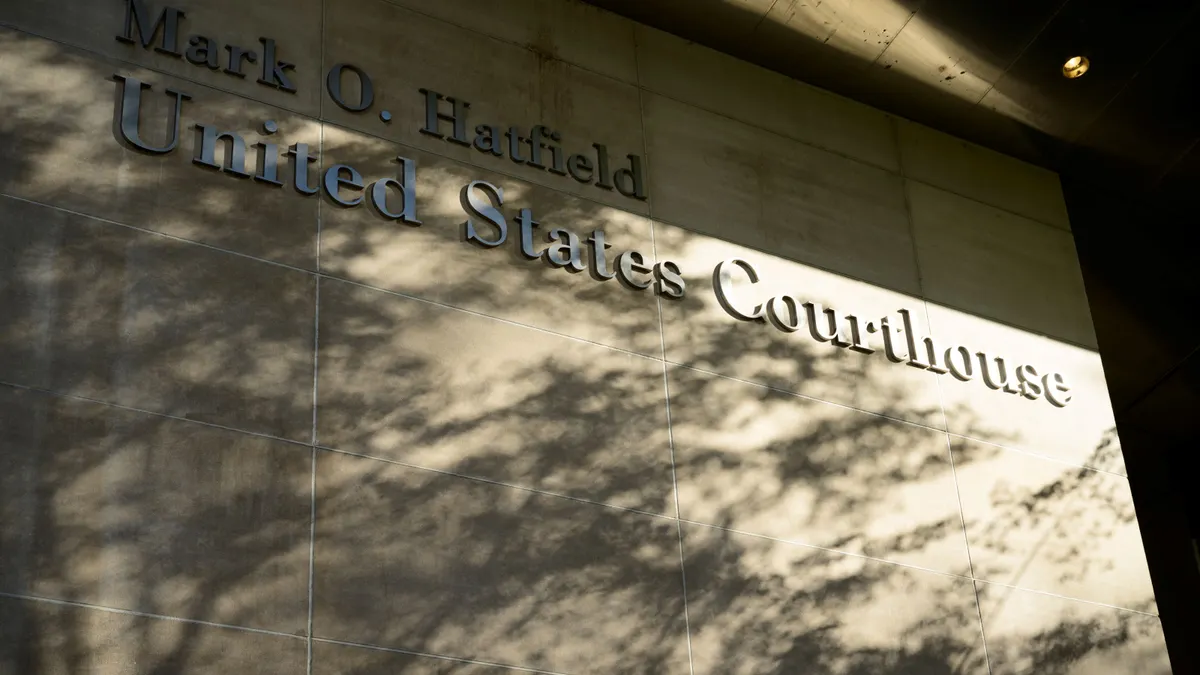
The National Association of Wholesaler-Distributors continues to advance a multistate legal offensive against extended producer responsibility programs, as a thicket of packaging policy lawsuits grows more complex and connected.
Updates in newer EPR challenges
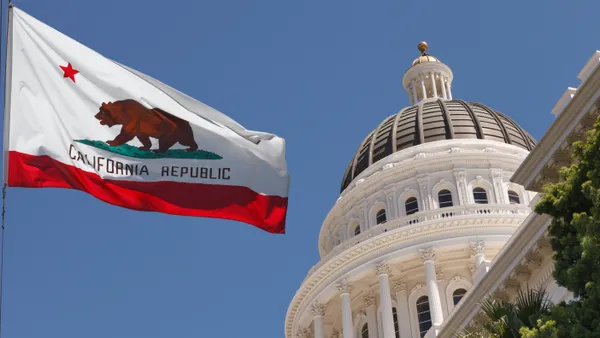
NAW recently launched a challenge in Colorado. And on Thursday, NAW announced it’s seeking a preliminary injunction to block enforcement of California EPR and source reduction law SB 54 as part of a lawsuit led by 17 Republican state attorneys general, a case that remains sealed.
Those actions follow a successful bid for a preliminary injunction in Oregon, part of NAW’s original state EPR lawsuit that went to trial in late July and now awaits ruling from a judge.
In NAW’s Thursday announcement, the trade group also shared that plaintiffs amended the California complaint, citing aspects of the successful preliminary injunction in Oregon as well as tie-ins to a separate lawsuit brought by different trade groups in California that has temporarily blocked enforcement of recyclability law SB 343. Among other arguments, the plaintiffs say that SB 54 is unconstitutionally vague in violation of the Due Process Clause.
“Earlier this summer, a federal judge blocked California from enforcing SB 343, the ‘chasing arrows’ recycling labeling law,” said Brian Wild, NAW’s chief government relations officer, in a statement. “SB 54 relies on the same definition of recyclability, so we are asking the court to come to the same conclusion and enjoin SB 54 as well.”
Awaiting an outcome in Oregon
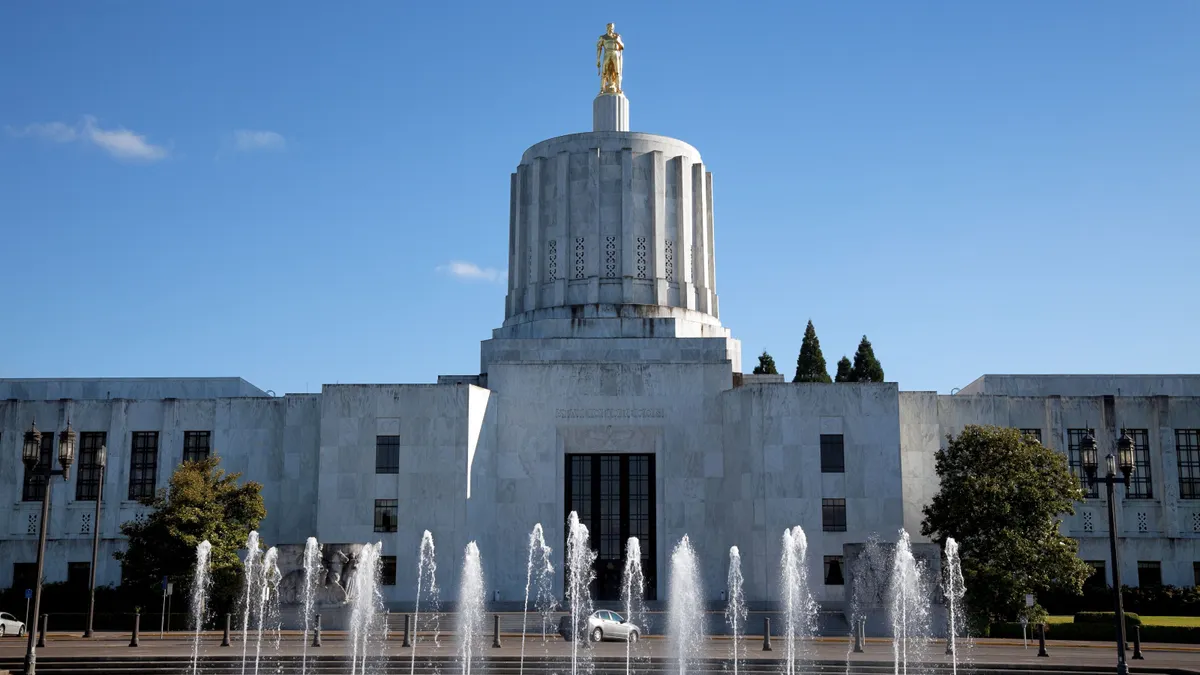
A five-day bench trial in Oregon concluded July 17. Judge Michael H. Simon requested post-trial briefings from both sides addressing particular questions.
On Aug. 4, the Oregon District Court stated it had reviewed those briefings and agreed that no further oral argument was necessary. But it did request that the defendant, Oregon Department of Environmental Quality Director Leah Feldon, file a short brief specifically addressing NAW’s newer argument that the law’s small producer exemption for Oregon public bodies is facially discriminatory and violates the Dormant Commerce Clause. There were some subsequent response filings from each side.
“The subsequent briefing shows that the parties disagree not only over whether the exemption is discriminatory, but also over whether NAW has standing to challenge it and what remedy would be appropriate if the court identifies a constitutional problem,” said L. Claire Hansen and Catherina D. Narigon, associates at Bergeson & Campbell, in an emailed analysis.
NAW in part argued that “the statutory text itself treats Oregon and out-of-state public bodies differently and that no evidence of real-world discriminatory effects is necessary to establish facial discrimination,” the B&C attorneys explained. “NAW also argues that its members have standing because exempting additional entities from the RMA's funding base increases the costs borne by non-exempt producers.”
Ultimately, the judge considered NAW’s asserted economic injury to be speculative “and argues that any defect in this particular exemption would not justify invalidating the broader regulatory program,” they said.
Betsy Stone, senior counsel with Foley & Lardner, also said it’s notable what the judge did not ask for.
“Judge Simon closed the book on additional briefing about the Dormant Commerce Clause, NAW's headline claim,” she said in emailed comments. “A court that declines supplemental briefing on a party's lead theory has, in effect, reached a conclusion on that theory. That is a material development regardless of which direction the conclusion runs.”
Stone believes the picture is clearer on procedural due process. “The architecture of Judge Simon’s questions suggests a high probability of a partial outcome. One that preserves the core EPR framework while surgically excising discrete provisions,” she said.
Stone also believes the supplemental briefing order on the small-producer exemption is a favorable signal for NAW on that issue. It appears an ultimate ruling may leave “the RMA’s basic regulatory architecture, such as DEQ oversight, PRO implementation, producer fee obligations, intact,” she said.
In general, the targeted scope of questions following the trial indicate the court is well versed and actively engaged in these issues, said Alexandra Ward, associate at Holland & Knight.
“It also signals that we likely are close to a decision because he's narrowing in on the things that he feels still need to be briefed before he can render a decision,” she noted.
Looking ahead, the judge is clearly aware of the implications for other states beyond Oregon, including those that may be considering future packaging EPR policies, said Halley Townsend, associate at Holland & Knight. “Legislators are probably watching this to see how they can craft their own laws in a way that might withstand constitutional scrutiny better after this decision.”
As for states with existing policies: “While Oregon is the bellwether, California is the main event,” Stone said. “As the world's fourth-largest economy, its EPR program cannot be ring-fenced. A California-scale mandate resets national and multinational supply chain dynamics because the requirements impact every market that touches California commerce.”